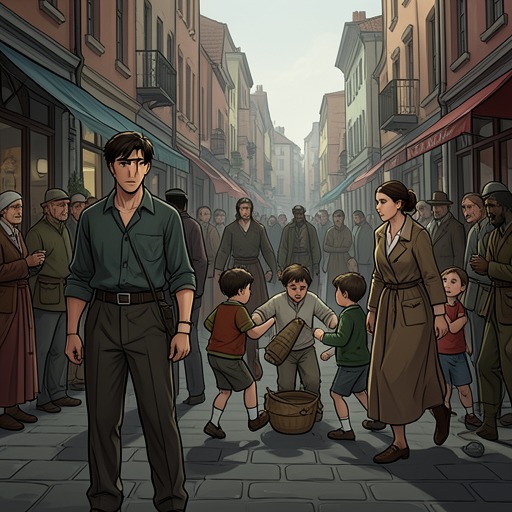
Romain Slaps the Moneylender Agroff
Promise at DawnRomain Slaps the Moneylender Agroff is a childhood confrontation that turns an insult into both a physical reprisal and a revelation about the narrator’s family origins. At fourteen, Romain Gary (narrator) strikes a moneylender who has demeaned his mother; the blow is the first in a series of slaps he will deliver on her behalf. The episode also establishes the painful bargain behind that role: he acts out of love and responsibility, even when he believes his mother’s grievance is mistaken and is ashamed of the violence she expects from him.
Causes and Setting
The encounter grows out of a debt contracted during a moment of exceptional financial distress. Agroff, a lender living in a dark cellar on Boulevard Gambetta, is attempting to collect the ten-percent interest. The narrator describes him as flabby and greasy, with a white face, and presents his occupation and dwelling through a deliberately contemptuous portrait. The debt is not incidental: his mother’s economic vulnerability brings her into contact with a creditor who can belittle her while pursuing repayment.
Agroff answers the difficulty of collecting interest by attacking her respectability. He tells the boy that his mother may present herself as a grande dame, but that he first knew her singing in cheap vodka joints and soldiers’ dives, where, he claims, she learned the language she now uses. The narrator identifies this as the sudden disclosure of the truth about his origins. The passage does not independently establish every detail of Agroff’s account; it records the moment as the first time the narrator hears the claim, delivered as an insult by a creditor trying to diminish the woman who owes him money.
The Slap and Its Immediate Aftermath
The narrator’s response is immediate. Though only fourteen, he feels capable of doing at least this much for his mother and gives Agroff a resounding slap. In the account’s fuller recollection, the first blow is followed by another, delivered for symmetry. Agroff answers with a black look and another insult, calling the boy a hooligan and describing his parents in contemptuous terms. The exchange therefore does not restore his mother’s standing or end the humiliation; it makes the boy’s violence part of the public confrontation.
That first attack becomes the start of what the narrator calls a long career of widely distributed slaps. His mother, dazzled by the initial exploit, begins summoning him whenever she decides that someone has insulted her. She typically concludes her account by insisting that the offender assumes she has nobody to protect her, and instructing her son to prove otherwise. The moneylender episode thus becomes a precedent: a single act of retaliation is converted into a family role that will recur in encounters with shopkeepers and other local tradespeople.
A Reluctant Protector
The narrator emphasizes the distance between his actions and his feelings. He detests these scenes and knows that, nine times out of ten, the insult is imaginary. His mother is often the one who has given offense, sometimes because exhaustion and frayed nerves have overcome her. Nonetheless, he plays the part. She has fought her own battles for years; as she ages rapidly and her health deteriorates, the assurance of having a man beside her who will stand up for her gives her comfort.
The pattern becomes a ritual. His mother names some supposed offender—a jeweler, butcher, tobacconist, or dealer in antiques—and the boy enters the shop with clenched fists. He announces that the man has insulted his mother and that he is going to teach him a lesson, then strikes him as hard as he can. His voice trembles, the narrator recalls, not simply with anger but with resentment at the role filial duty has imposed on him; he puts his strength into the blow to compensate for his lack of conviction. Around Boulevard Gambetta and the Buffa Market, the episodes earn him a reputation as a young hoodlum. The reputation conceals the shame and hurt he feels as he performs a kind of protection he neither likes nor wholly believes is justified.
At times he tries to refuse. When he knows that a complaint is entirely unwarranted, he has attempted to rebel, but his mother’s tears and expression of defeat overcome him. He rises without speaking and goes off to fight on her behalf. He later asks forgiveness of the people he struck and acknowledges that their sense of injury was matched by his own. He describes his hooliganism as a labor of love: the violence is real, but so is the helplessness that draws him into it.
Humiliation, Origins, and Destiny
The encounter’s deeper significance lies in the collision between the mother’s vulnerability and the boy’s need to defend her. The narrator says that he cannot bear to see a living creature helpless before its fate, whether human or animal. He sees his mother’s bearing as capable of expressing that helplessness with particular force. Agroff’s insult provokes the slap, but the sight of her exposed to contempt helps explain why the boy continues to accept a part he finds humiliating.
The revelation about his origins scarcely interests him at the time. What matters is the future his mother has imagined for him. He believes that he is destined to reach the heights she sees, and that nothing can prevent him from doing so for her sake. He understands his mission as a form of retribution for her toil, loneliness, and sacrifice: his achievement will somehow balance the hardships of her life. In the darkest moments of war, he will carry this same conviction into danger, feeling invincible because he imagines himself as his mother’s happy ending and victory. The childhood slap therefore sits at the beginning of a larger emotional logic, in which defending his mother and fulfilling her vision become inseparable.
Recurrence and Narrative Meaning
The book places the episode within a recurring pattern of public insult and maternal defiance. In Vilna, after neighbors report her to the Polish police as a receiver of stolen goods, his mother leads the boy from door to door and publicly predicts that he will become an Ambassador of France, a Chevalier of the Legion of Honor, and a great dramatist. The narrator recalls the neighbors’ laughter as a force that shaped the person he became. The later recollection of the assault on Agroff belongs to the same world: his mother faces humiliation by proclaiming her son’s future, while he answers insults by trying to act as her protector.
That pattern persists in altered form when older boys mock his imagined departure for France and then invoke the allegation that his mother had been a cocotte. Years later, when the narrator learns that a rule restricting flying-officer commissions can be applied to men born abroad or naturalized too recently, his declaration that he is French again meets an institutional judgment about belonging. These later episodes do not form part of the confrontation with Agroff, but they echo its central pressure: public speech assigns a degrading identity, and the narrator resists by holding to a different account of who he is and what he will become.
As a remembered action, the slap is not presented as a clean victory over an aggressor. It leaves the narrator with an unwanted reputation, deep embarrassment, and knowledge of a damaging insult, while giving his mother the reassurance of a defender. Its importance comes from that contradiction. The boy can resent the task and still perform it; he can recognize his mother’s mistakes and still refuse to abandon her. In the narrator’s retrospective account, the blows begin a lifelong effort to answer her vulnerability with loyalty and to make the future she imagined seem, against humiliation and hardship, attainable.