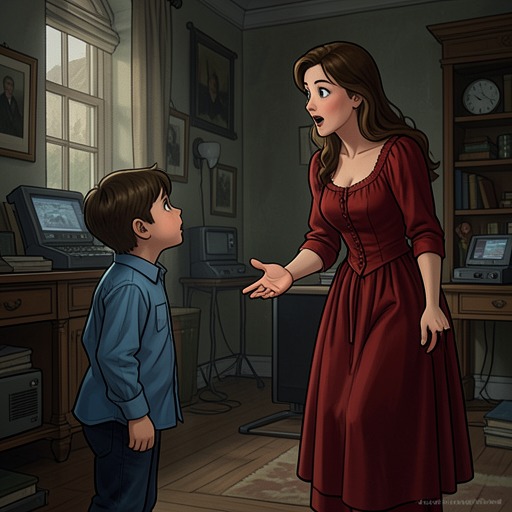
Romain Swallows a Galosh to Impress Valentine
Promise at DawnRomain Swallows a Galosh to Impress Valentine is a childhood episode in which Romain Gary’s devotion to Valentine becomes a contest of increasingly extravagant proofs. Nearly nine years old, he believes that eating what she gives or points out is a way of making himself worthy of her. The rubber galosh is the most consequential of these offerings: his attempt to impress Valentine ends with him being taken to hospital, yet the episode remains with him for decades as both a literary source and a remembered measure of romantic effort.
The first encounter and the contest for attention
The episode begins near a woodshed, where the nettles mark the edge of a field. Valentine is eight, dressed in white and carrying a ball. For Gary, her sudden appearance is overwhelming. He tries to make an impression through a grand gesture modeled on his mother’s romantic manner, gazing toward the light until the tears come. Valentine stays absorbed in her ball. When this display fails, he offers three green apples he has stolen from the neighboring orchard. She accepts them without ceremony and tells him that another boy, Janek, had eaten his entire collection of sump for her.
That comparison establishes the terms of Gary’s pursuit. He understands Valentine’s story not as a reason to withdraw but as a challenge to surpass. Over the following days, he eats earthworms, rare butterflies belonging to her father, a mouse, decaying leaves, and other things she indicates. He also recalls eating cherries after Valentine removed and ate their flesh, leaving him the stones, as well as a Japanese fan, cotton thread, a paperback novel called Nat Pinkerton, and three goldfish taken from her music teacher’s aquarium. The growing catalogue makes his devotion comic in its scale, but its governing logic is serious to the child: each act is an attempt to prove that he can give more than his rival.
The galosh as a declaration
Gary remembers the two children meeting behind the nettles, where he asks permission to kiss Valentine. She agrees on the condition that he not wet her cheek. He counts the kisses and asks whether he may continue, while Valentine handles her hoop with an air of indifference. The scene captures the mismatch between his intense investment and her casual participation. His attention turns from the permitted kisses to an undefined sense that something more is expected of him, though he does not know what that might be.
He eventually offers to eat one of his rubber galoshes for Valentine. She watches as he cuts into it with his penknife and asks whether he intends to eat it raw. Gary proceeds, reading her close attention as a sign that she may at last admire him. The decisive action is not simply another item in his catalogue of offerings: the galosh is his chosen proof that he will accept an extraordinary challenge for her sake. In his childhood understanding, enduring the task means satisfying Valentine and demonstrating that he is becoming a man.
The narrator places this episode within a larger retrospective joke about boasts of romantic achievement. He contrasts the usual claims and statistics of amorous exploits with his own absurdly literal account of what he swallowed for Valentine. The humour depends on the gap between the adult narrator’s knowledge of how love is conventionally described and the child’s mistaken but earnest belief that these acts constitute its practice. He recalls that children were taught nothing about sexual matters and says that, at the time, he understood swallowing one thing after another to be how people made love. The episode thus makes his error visible without diminishing the force of the feelings behind it.
Illness and the aftermath
The effort has an immediate cost. Gary becomes very ill and is carried to an ambulance on a stretcher. His mother sobs, Aniela screams, and the workroom girls run about in panic. Against the alarm around him, the child is proud of himself. That contrast gives the ending its characteristic mixture of comedy and danger: the adult narrator can see the extremity of what he attempted, while the boy regards the ordeal as a successful act of devotion.
The galosh does not disappear from the story when the hospital episode ends. For more than twenty years, Gary carries a child’s rubber galosh with four large holes in it among his belongings, keeping it within reach wherever he goes. The object becomes a material recurrence of the childhood event: what began as an offering to Valentine travels with him long after the affair itself has passed. Eventually, when he is more than forty, he leaves the galosh behind somewhere along his way. He presents that decision plainly, refusing to pretend that life can be lived more than once. The object’s long passage through his wanderings gives the episode an afterlife without suggesting that the childhood contest can be repeated.
A remembered model for later work
Gary says that his affair with Valentine lasted almost a year and brought about a complete change in him. He describes having to compete with rivals and prove his virility through acts such as walking on his hands, stealing from shops, smashing windows, and fighting. The galosh episode therefore belongs to a wider pattern in which the child tries to answer romantic indifference with feats. Another Polish boy courts Valentine by juggling five apples. After repeated attempts to match him, Gary recalls feeling defeated when the apples scatter; in adulthood, however, he can keep three in the air. On his hill at Big Sur, he sometimes performs that smaller feat when the sea and the expanse of the sky awaken a remaining trace of defiance. The remembered rivalry has changed scale, but its language of challenge and performance persists.
The childhood affair also becomes material for Gary’s writing. He identifies it as the inspiration for his first novel, A European Education, and for passages in The Company of Men, twenty years after the events. The memory thus operates on two linked levels: it records a boy’s literal and hazardous attempt to demonstrate love, and it shows the adult writer returning to that attempt as a source of fiction. Valentine’s indifference, the rival’s challenge, the hospital alarm, and the four-holed galosh all remain distinct parts of the recollection. Together they make the episode more than an isolated childhood escapade: it is an early instance of Gary’s recurring image of devotion expressed through performance, remembered with both irony and enduring seriousness.