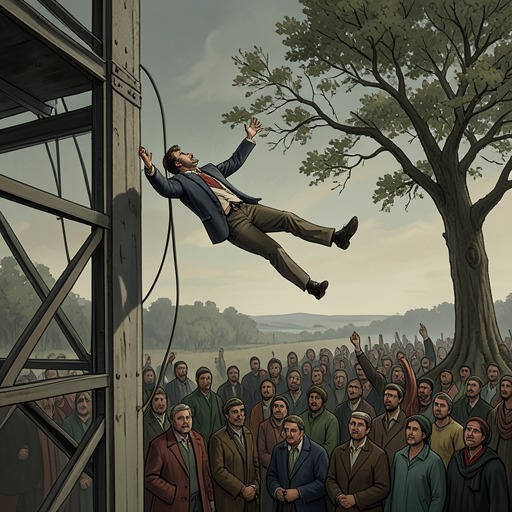
Sacred naïveté of the species
Promise at DawnSacred naïveté of the species names a stubborn faith in human possibility that survives the narrator’s repeated encounters with danger, grief, and defeat. It is not confidence that events will turn out well: it is the refusal to let suffering teach resignation or indifference, and the conviction that courage and life can recur in those who come after.
Meaning and Wartime Use
In wartime, this naïveté first appears as collective morale. Traveling toward Gibraltar, the narrator and his companions imagine their English allies waiting to welcome them and cast their fight as resistance to forces seeking to enslave humanity. The language is consciously grand; the narrator admits that its literary quality may be poor, but says that it helped. The ideal matters less as a precise prediction than as a means of sustaining courage and a sense of human dignity.
That hope meets an immediate reversal when the group reaches Gibraltar and learns that the British fleet has sunk French naval units at Mers-el-Kébir. The news strikes at what they had regarded as their last hope. The narrator’s image of Totoche, the god of Stupidity, laughing in the harbor gives the setback an absurd, almost mythic scale. Yet the existence of a cruel reversal does not, in his account, disprove the value of the hope that preceded it.
Persistence Through Illness
The narrator’s illnesses test the same disposition at an intimate scale. During a grave illness in childhood, he worries that he will leave his mother unsupported and fail to fulfill the future she expects of him. His imagined unfinished achievements include becoming a Frenchman and winning the ping-pong championship of Nice in 1932. Even in that crisis, the possibility of a life still to be lived gives his fear its particular shape.
His mother refuses to allow doctors to operate on his kidney, despite the recommendation of a specialist summoned from Berlin. The narrator later connects her opposition to her belief that a man’s kidneys were closely linked to his sexual capacities, and to her expectation that his future should exceed what the doctors called normal. He survives without the operation. The episode places his mother’s extravagant hopes beside the bodily uncertainty of his survival: the future she imagines for him is not a guarantee, but it remains a force in the family’s struggle against despair.
Years later, a typhoid illness in Damascus again brings him close to death. His friends offer their blood, and Sister Félicienne nurses him through a prolonged delirium and a slow return to reason. In the aftermath, his recovery is incomplete: he suffers lasting facial paralysis and other health problems. Nevertheless, as soon as he can speak, he asks when he and his companions can return to battle. The doctors tell him that the war is over for him and doubt that he will walk normally or fly operationally again; three months later, he is back in a Blenheim hunting submarines over the eastern Mediterranean. The recurrence of hope here takes practical form in his renewed participation, not in an absence of physical cost.
Defeat, Continuity, and Renewal
The narrator gives the expression its clearest meaning when reflecting on age and the dead. He recognizes that many of his young comrades have been killed, and that time takes away what it cannot replace. Still, the gestures and laughter of the young can recall the faces of those who died. At Big Sur, he imagines the courage and youth of those who will come after him as something felt in his own body, and looks toward the ocean and the passing seals and whales with confidence in renewal.
He distinguishes defeat from surrender. The hostile powers he calls the monkey gods have not made him wise in the sense of becoming prudent, resigned, or indifferent. The species’ sacred naïveté remains precisely because experience has not extinguished his capacity to expect life to begin again. His final image is not of individual invulnerability but of continuity across generations: the living and the dead gathered into a renewed human presence.