The Absolute and the Roots of Heaven
Promise at DawnThe Absolute and the Roots of Heaven is the name Romain Gary gives to a childhood experience of longing that no concrete wish could fulfill. At nine, imagining gifts for his mother, he discovered that each attainable fantasy fell short of an unnamed demand. He later connected that failure to the absolute and to the artistic vocation he believed began in that moment: art could not provide a final answer, but writing offered a way to continue asking the question.
The childhood encounter
The experience takes shape around a talisman that Gary has been trying to make work. Once its maker declares it complete, all that remains is for the boy to make a wish. Gary sits on the ground with the bottle between his legs and turns first to his mother. His imagination supplies abundance in lavish, visible forms: jewels, yellow Packards driven by liveried chauffeurs, and a marble palace where Vilna’s good society gathers on its knees before her. These fantasies make his devotion tangible, but they do not meet the need that has awakened in him.
The decisive detail is not that the imagined gifts are insufficient in scale. Even a palace, wealth, and public homage remain only “poor crumbs of reality” beside a longing for which Gary can find no face, content, shape, or answer. His wish is directed toward his mother and motivated by love, yet the desire exceeds any gift he can name. The scene thus moves from a child’s extravagant generosity to the discovery that generosity cannot master what it is trying to satisfy.
The failure of the wish
Gary describes the longing through oppositions: confused yet piercing, tyrannical yet impossible to formulate, vague yet commanding. Its force is certain even though its object is not. This distinction gives the episode its central reversal. The boy appears to be choosing among possible wishes, but the wishes themselves expose the limits of choice: each can be pictured and granted in imagination, while the demand behind them remains untouched.
In retrospect, Gary understands this as his first acquaintance with the absolute. It does not arrive as a possession or a revelation that resolves uncertainty. Instead, it makes its absence felt. He describes that absence as something that would remain within him, a summons without a final destination. The experience is therefore both an awakening and a deprivation: he becomes aware of a scale of fulfillment that ordinary reality cannot meet, without learning how or where that thirst could be quenched.
From the absolute to The Roots of Heaven
Gary links the childhood episode to the title of the novel he would write three decades later, The Roots of Heaven. The connection is retrospective: the nine-year-old could not have known what name his later work would give the longing, but the adult narrator reads the moment as an early encounter with the impulse that the title would express. The absolute is not presented as a solved idea contained in the novel’s title. It is a continuing pull, first experienced as a lack and later recognized as a source of artistic work.
His reflection widens from an individual memory to a claim about human desire. He proposes that the appetite for total possession and fulfillment can nourish both humanity’s worst crimes and its greatest achievements, including museums and poetry, as well as cruel empires. He also speculates that the yearning may reach toward an immortal continuity of time and life from which human beings are separated at birth. These are meditations prompted by the memory, not explanations that cancel its mystery: Gary preserves the gap between the overwhelming force of the longing and his inability to give it a definite object.
The artist and the unanswered question
Gary identifies this moment as the beginning of his life as an artist. He does not define art as a successful means of obtaining the perfection he wanted for his mother. Rather, he calls it a supreme failure: an attempt to pass off as an answer something that remains a beseeching question. The formulation makes artistic creation continuous with the childhood wish. Both reach toward fulfillment; neither can make the absolute present as a finished possession.
The memory also gives the desire a bodily and emotional sequence. Gary says he already felt that his time was limited and struggled to imagine something worthy of his mother, his love, and the masterpieces he wanted to give her. When nothing proved sufficient, his lips trembled, his face tightened with vexation and anger, and he howled in fear, astonishment, and rage. The yearning is therefore not merely an abstract theory added later to a childhood scene: in his account, it first arrives as pressure on the body and as an immediate crisis of feeling.
The talisman left behind
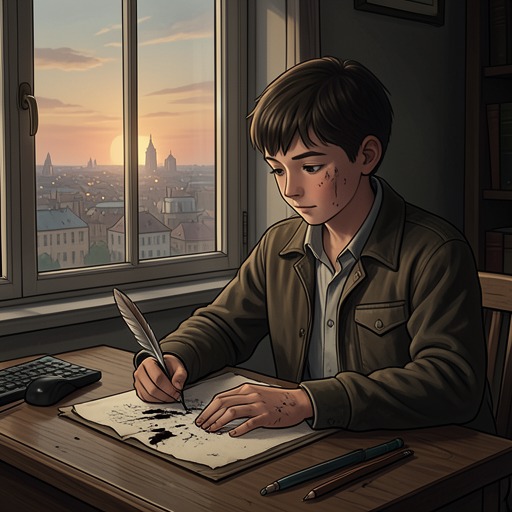
After the outburst, Gary says that he gradually grew accustomed to the idea. Instead of howling, he writes books. This change does not mean that writing fulfills the old desire; the contrast preserves its unanswered character. Books become what he does with the longing, rather than proof that it has been satisfied. Artistic practice converts the childhood cry into repeated work, while leaving intact the gap between the demand and any possible answer.
The physical ending is quieter. Gary buries the talisman deep in the woodshed and prudently marks its location with a top hat so he can find it again. Yet disenchantment has already taken hold, and he never searches for it. The object that had promised a magic formula is abandoned just as the boy recognizes that no formula can supply what he wants. In the structure of the recollection, the buried bottle closes the childhood attempt without closing the desire: the talisman disappears from use, but the absolute’s pull persists in the books that follow.