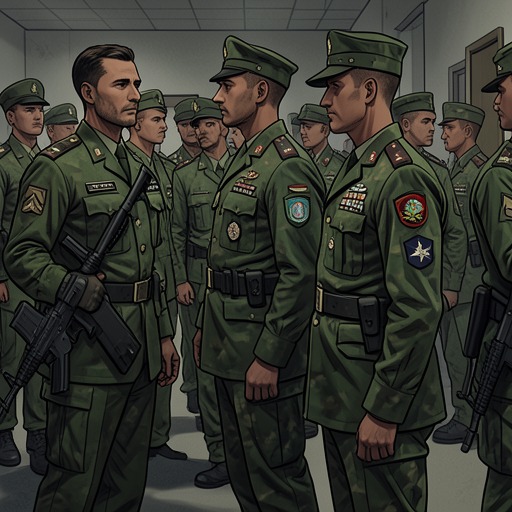
The Narrator Is Awarded the Order of Liberation
Promise at DawnThe Narrator Is Awarded the Order of Liberation is both a wartime distinction and the fulfillment of a promise Romain Gary had made to his mother. The honor arrives after years of service, illness, and uncertainty about whether he would ever meet her hopes for him. Its green and black ribbon recognizes the living airman, but Gary understands it through the absent mother whose faith in France and in her son had shaped the meaning of his fight. He receives the news believing he can still carry the honor home to her; the later discovery of her death turns that anticipated reunion into a more complicated act of remembrance.
A hard-won return to flying
Gary’s path to the award had been marked by serious illness well before the wartime episode that nearly ended his flying career. As a young man he fell ill after scarlet fever, and doctors believed an acute kidney inflammation left him unlikely to survive. He worried that his death would leave his mother unsupported and would mean failing the ambitions she had formed for him. When doctors proposed an operation on his right kidney, she refused it despite the insistence of a specialist summoned from Berlin. Gary survived without the operation, and later regarded his determination to remain responsible to his mother as part of his struggle to live.
That earlier crisis became a pattern of illness interrupting, but not finally extinguishing, his ambitions. In Damascus, typhoid with internal bleeding left doctors giving him only one chance in a thousand. Friends came to offer blood, and Sister Félicienne, an Armenian nun, cared for him through a prolonged delirium. His recovery was slow and left lasting effects, including partial paralysis of the lower left side of his face and continuing heart damage. The doctors doubted he would walk normally or return to operational flying. Yet three months later he was back in a Blenheim, searching for submarines above the eastern Mediterranean. That return makes the later award more than a ceremonial reward: it follows a recovery in which flight itself had seemed lost.
By the time of the award, Gary was again with the Lorraine Squadron. He had been declared unfit for further flying duty by the Royal Air Force after a wound, but the Free French returned him to service. He flew bombing missions against the Rommel line along the coast, helping open the way for the Allied landing in Normandy. The sequence places the decoration within active service rather than apart from it: Gary had resumed the work of a combat airman after repeated threats to his life and fitness.
The telegram at Hartford Bridge
A few days before the news arrived, Gary and Arnaud Langer had been summoned to the British Broadcasting Corporation for an extended interview about a sortie. Gary expected the interview to serve wartime publicity and did not attach much importance to it. He was more surprised when the following day’s Evening Standard carried an article about them. The publicity preceded, but did not prepare him for, the message that reached him back at Hartford Bridge.
Gary was in the mess when an orderly handed him a telegram. He glanced at the signature and saw that it was Charles de Gaulle. The message informed him that he had been awarded the Cross of the Liberation. Gary recalled the moment as the happiest of his life, a sudden recognition that transformed the meaning of the preceding years without erasing their cost. The honor connected his individual service to the cause for which he and his comrades had continued to fight.
The distinction was exceptionally rare. Gary understood that, apart from the most distinguished dead, only a small number of living French combatants had received it. He could not be certain whether the total number of recipients, living and dead, exceeded six hundred. The ribbon therefore stood not merely for public praise, but for a restricted bond among people whose service and losses he regarded as inseparable. He felt exaltation, gratitude, and love, yet also an impulse to apologize for receiving an honor he believed his own efforts did not warrant.
The honor and his mother’s expectations
Gary measured the award against his mother’s expectations rather than against his own record alone. He believed that whatever he had achieved was slight beside what she had expected of him and taught him about France. His account thus makes the decoration an answer to a relationship as well as a military recognition: the son’s achievement carries the mother’s imagined future into public view.
The hope of telling her shaped his immediate response. Some months after the telegram, Charles de Gaulle pinned the Cross of the Liberation to Gary’s tunic beneath the Arc de Triomphe. The ceremony closed, in Gary’s telling, the episode of Avord, an earlier source of disappointment whose details he does not rehearse here. The formal presentation gave the honor a public setting and concluded a long period in which his standing and prospects as an airman had been uncertain.
Gary lost no time in arranging for his mother to hear the news. He sent a telegram to Switzerland and wrote to a member of the British Embassy staff in Portugal, asking that a carefully worded letter be forwarded to Nice when possible. He expected to go home at last. His book had given his mother some measure of the artistic fame she had dreamed of for him; now he hoped to bring her what he regarded as the greatest French military honor, one she had earned through the hopes and instruction she had given him. The award’s private destination was therefore as important as its official presentation.
The delayed revelation
Letters arriving from Nice seemed to Gary to carry joy and serenity, but also an unexplained tenderness and apology. His mother wrote that they had been separated for years, that she had never doubted him, and that he should forgive her when he returned and understood what she had done. Gary could not identify the cause of her apology. He wondered whether she had remarried, then recognized in the letters the familiar embarrassment that accompanied her eccentric schemes. He read them as signs that she was waiting for him, and the honor strengthened his expectation that he could soon return and explain everything in person.
The homecoming overturned that expectation. When Gary reached the Hôtel-Pension Mermonts after the liberation, no one was there to greet him; the people he questioned had only a vague recollection of a Russian woman who had once run the place. His mother had died three years and six months earlier, only weeks after his departure for England. The honor he had meant to present to her could not be delivered in the reunion he had imagined.
Instead, Gary learned that she had arranged another means of remaining beside him. In the last days of her life, she wrote nearly two hundred and fifty letters and sent them to a friend in Switzerland, with instructions that they be forwarded at intervals. The letters had concealed her death and sustained him through the war, just as he had continued to believe she was waiting for his return. The Cross of the Liberation is therefore both the culmination of his service and a hinge in the memoir’s account of maternal support: he receives the honor in time to believe he can share it with her, but discovers only afterward that her care had already carried him through to victory from beyond his knowledge.