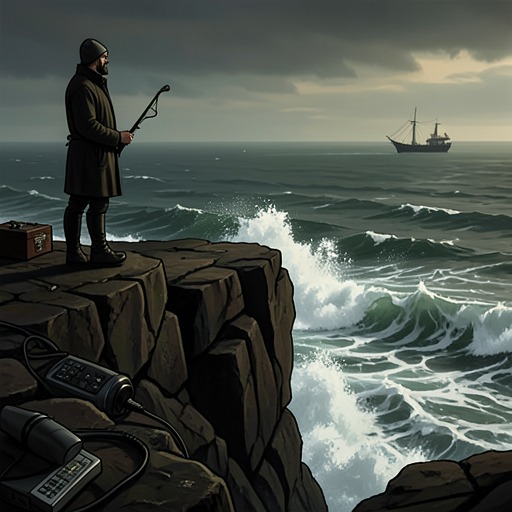
The Ocean as Home and Solace
Promise at DawnThe Ocean as Home and Solace is a recurring idea in Romain Gary’s memoir, where the sea offers the narrator an intimate answer to alienation, illness, and loss. First encountered as a startling vision of home, it later becomes a living presence that grants peace; at Big Sur, however, its comfort coexists with memories of conflict that remain unresolved.
A Living Presence
The narrator resists treating the sea as an impersonal object. He experiences it as animated and expressive, as if it were trying to communicate a message that people have not yet learned to decipher. Its meaning is deliberately not reduced to a single explanation: it can suggest eternity, answer a need for peace, and evoke the mother, while still remaining a presence whose message is beyond full understanding.
That sense of life is carried by physical encounters rather than abstraction alone. The narrator describes salt on his lips as a taste of eternity and the shore as a place where he can let himself fall and be freed from his burdens. The sea’s consoling force is therefore bodily as well as reflective: it is encountered through the senses and through the act of returning to the water’s edge.
The First Arrival at Alassio
The narrator’s first encounter with the sea comes during his recovery from a grave fever. After he is taken by stretcher to Bordighera in the hope that the Mediterranean sun will help him regain strength, the train stops at Alassio. His mother lowers the compartment window, and the cool air wakes him. Looking outside, he sees the blue sea, a pebble beach, fishing boats drawn up on their sides, and a few palms.
The sight brings a sudden, complete certainty that he has arrived. He cannot explain exactly what happens in that instant, but recalls a flash of happiness and infinite peace: he feels that he has come home at last. This homecoming is not a return to a known house or country. The sea itself supplies the feeling of arrival, turning an unfamiliar shore into a place of belonging.
The Sea and the Mother
The sea’s refuge is closely connected to the narrator’s relationship with his mother. He says that no person or thing, apart from her, has made a more profound impression on him. He wonders whether the sea reminds him of her and links the shoreline, tentatively, to the idea of returning to the womb. The association makes the ocean a form of consolation that can be approached after separation: it offers a peace resembling maternal security without being simply identical to the mother.
The encounter at Alassio also takes place in her presence. She opens the window, smiles as she follows his gaze, and shares the moment in which he recognizes the sea as home. The passage thus joins bodily recovery, the mother’s care, and the first sight of the water, while leaving the precise source of the narrator’s sudden happiness unexplained.
Big Sur: Solace Without Erasure
At Big Sur, the narrator returns to the ocean’s edge at forty-four, lying motionless on an empty beach among mist, birds, and seals. A seal emerges from the waves with a fish, and its devoted care for its young gives the scene an image of parental tenderness. Nearby seabirds gather so closely that the narrator imagines being covered by their feathers; the encounter stirs his old longing for total tenderness.
Yet the shore does not make the past disappear. Even after the battle is over, he sees enemy legions leaning over him, watchful for submission and defeat. The contrast gives the ocean’s solace a limit: the sea can free him from burdens and make it feel, on his return, as though no one had died, but memories of struggle still surface beside it. The movement from the remembered first arrival at Alassio to the later scene at Big Sur makes the ocean both a refuge and a place where the narrator’s unresolved history remains visible.