The Promethean Artist
Promise at DawnThe Promethean Artist is the narrator’s image of creation as an act of survival and defiance. In his retelling of the Prometheus myth, the artist does not merely endure punishment: he turns the struggle into a reason to begin again. This idea takes shape while Romain Gary is gravely ill and fears leaving his mother without the future he believes she expects of him. It makes literary invention a practical answer to helplessness, and it returns in the memoir’s account of his later illness during the war.
The Artist and the Reversed Myth
In the story the narrator calls The Truth about the Prometheus Affair, he challenges the familiar ending of the myth. Prometheus has stolen fire and been chained to a rock, where a vulture attacks him. But the gods, returning to inspect the earth, discover that he has freed himself and turned the encounter around: he has seized the vulture and uses the struggle to recover his strength and reach again for the sacred fire. The decisive change is not that suffering disappears; it is that Prometheus acts within it rather than accepting the role assigned to him.
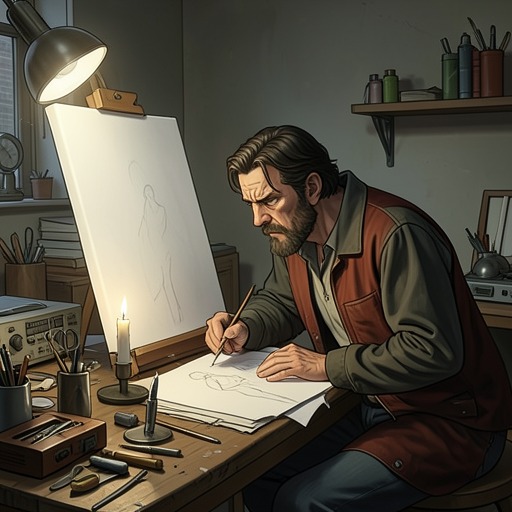
The narrator identifies Prometheus as an artist. That identification makes artistic work more than a finished object or a path to recognition. It is a repeated effort to recover the capacity to create after defeat. The myth’s reversal supplies a compact pattern for the narrator’s own account: a person may be overpowered, but can still answer the force acting upon him. The story does not promise a final victory over pain. Its artist persists, returns to the task, and tries again for the fire.
Illness and the Need to Write
The idea grows from a period of childhood illness in which doctors believed the narrator was unlikely to survive. His fear was bound up with his responsibility toward his mother: he could not bear the thought of leaving her without support, or of failing to become the person she imagined he might be. In his recollection, that future included achievements he had not attained, from musical distinction to becoming a French ambassador and a Frenchman. The scale of those hopes makes his vulnerability feel inseparable from the work still expected of him.
His mother refused the doctors’ proposed operation on his right kidney, despite the insistence of a specialist brought from Berlin. The narrator later understood that she associated the kidneys with a man’s future vitality, and that the doctors’ assurances of an ordinary outcome did not meet her hopes for him. He kept the kidney and survived, though the specialist had predicted that his death was only days away. In retrospect, this episode joins medical uncertainty to the mother’s fierce investment in his future: her intervention does not establish that she knew what would happen, but it becomes part of the history through which he understands survival and obligation.
A later crisis in his mother’s health sharpens the connection between danger and writing. After years of hiding her diabetes, she collapsed from hypoglycemia following an insulin injection. The narrator describes the discovery as a shock, intensified by the thought that she might die before receiving the justice he believed she deserved. With her approval, he temporarily left the lycée and shut himself in his room with three thousand sheets of paper, then attempted to write under the pen names Francis Mermonts and Lucien Brulard. Publishers returned the manuscripts. Yet literary creation had already become, in his account, a necessity: a means of resisting human helplessness and remaining alive to what could still be made.
The Prometheus Story as an Answer
The story titled The Truth about the Prometheus Affair begins with a question the narrator draws from seeing his mother gravely unwell: whether life is an honorable undertaking or whether dignity might require refusing it. He says that his answer came immediately, through an instinct for self-preservation, and that he wrote the story at feverish speed. The myth therefore answers a crisis of judgment rather than offering an abstract literary ornament. Against the prospect of surrender, its Prometheus keeps struggling for the fire.
The narrator’s account also gives artistic persistence an irreverent, comic edge. He presents the myth as an ending withheld from its audience, then imagines his own continuing contest with the vultures and the possibility of a new sign in the Zodiac if the struggle finally drives him from his rock. The humor does not erase the threatened defeat; it changes the terms in which defeat can be narrated. By making the artist’s resistance part of the myth, the narrator recasts endurance as invention and invention as a way to refuse the last word to despair.
Recurrence During the War
The pattern returns in the narrator’s account of typhoid in Damascus, where he was given little chance of recovery. Friends came to offer blood after repeated transfusions failed to halt the illness, and Sister Félicienne, an Armenian nun, nursed him. His recovery was slow: his mind remained disordered, he could not initially speak, and he was left with lasting physical effects. The narrative does not treat the earlier story as proof that he could master every crisis. Instead, its Promethean figure offers a language for his continuing attachment to life while the outcome remains uncertain.
Once able to articulate words, the narrator wanted to know when he and his comrades could return to battle. The doctors told him that, as far as they were concerned, the war was over: they doubted he would walk normally, expected lasting heart damage, and did not think he would fly an operational aircraft again. Three months later, he was back in a Blenheim hunting submarines above the Eastern Mediterranean. That reversal echoes the myth’s refusal of a fixed ending, while remaining distinct from it: the memoir records a concrete recovery, with serious lasting consequences, rather than claiming that art or will made the body invulnerable.
Significance
The Promethean Artist brings together three forms of persistence in the memoir: the struggle to remain alive, the responsibility the narrator feels toward his mother, and the repeated act of writing. The mother’s hopes and the narrator’s fear of failing her give the artistic ideal a personal pressure; his illness makes the question of whether to continue more than a metaphor. In turn, the Prometheus story converts that pressure into a form the narrator can tell and revisit.
Its defining gesture is reversal, not invincibility. The artist is vulnerable to defeat, dependent on others, and changed by illness; still, he tries to regain the fire. The image thus presents creation as an ongoing response to forces that cannot simply be reasoned away or brought under control. Its achievement is not to promise that suffering will end, but to make renewed effort imaginable within it.