The narrator’s romantic relationship with Louison
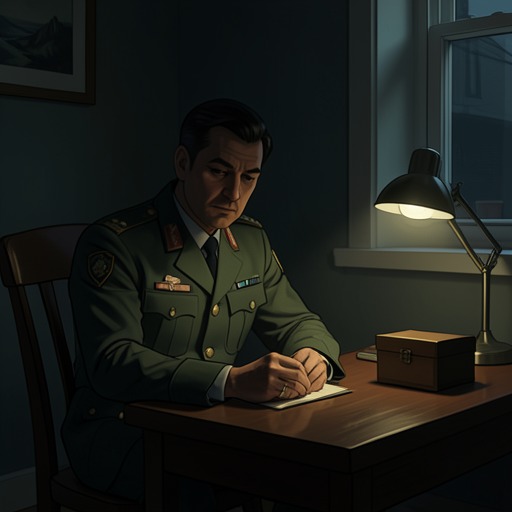
Promise at DawnThe narrator’s relationship with Louison is a brief, defining attachment formed in Bangui and broken by her diagnosis of leprosy, her transfer for treatment, and his military service. He remembers the relationship as a moment of extraordinary happiness, but its course turns on separation: he cannot accept the first demand that they part, later cannot reach her, and never sees her again. His retrospective account holds together both his intense devotion and his admission that he cannot be certain how to name it.
Meeting and Union
The narrator encounters Louison walking near his bungalow in Bangui, carrying a basket of fruit. She is sixteen. He describes her as an image of youth and life, and says that when she pressed against him he felt he had kept his promises and accomplished everything. He goes to her parents, and they celebrate their union according to the rites of her tribe. Louison then comes to live with him.
The narrator remembers the early relationship through attention rather than conversation. Louison speaks constantly, but she does not speak French, and he says he understands none of her words. He nevertheless takes pleasure in listening and watching her, recalling her voice, face, hair, and delicate features. The passage makes their connection vivid while also recording a limit: the narrator cannot report the content of her speech, and his memory centers on his own experience of her presence.
Louison’s age and the narrator’s position as a serving military pilot are part of the circumstances the account establishes. He arranges her medical examination and later her transport, while the narrative provides little independent access to her perspective. It reports that she was gay and that she asked when he would return, but the relationship is chiefly presented through the narrator’s recollection and response.
Diagnosis and Resistance to Separation
The narrator first becomes concerned when Louison develops a slight cough. A squadron doctor examines her and says the cough is not serious, but notices a mark on her arm. Later, the doctor tells the narrator that Louison has leprosy and that they will have to separate. The narrator refuses to accept the diagnosis at once. He describes a terrible night holding her while she sleeps, and recalls that she began treatment but continued to return each night to sleep with him.
His account does not treat the separation as a settled decision between them. The doctor does not press the matter or blame the narrator, and the narrator says he would not hear of parting until he learned of a newer remedy being tried at Leopoldville. The information he receives suggests that the disease might be stabilized and perhaps cured. That possibility does not resolve the danger or promise their continued life together; it gives him a reason to resist an immediate, permanent break.
The narrator’s response moves between certainty and uncertainty. At first he simply denies that Louison could have the disease. Later, looking back, he cannot say whether he loved her or whether he was unable to stop looking at her. The memoir thus preserves the intensity of his attachment without presenting his interpretation of it as final or uncomplicated.
Departure and Failed Reunion
The narrator arranges for Louison to travel by aircraft from Bangui to Brazzaville for care. He watches her leave from the airfield and describes himself as utterly lost, imagining that the enemy had occupied not only France but the whole world. He plans to follow on a later military flight. The departure therefore begins as a separation he expects to bridge, rather than one he understands as final.
That journey is repeatedly delayed by events in his squadron. The aircraft scheduled to maintain contact with Brazzaville crashes in the forest, killing several of his friends; the narrator is also incapacitated by malaria for a week. The next proposed trip depends on another aircraft and pilot, who also disappear in the forest. The narrator is then ordered to rejoin his squadron on the Abyssinian front. He obeys, and never sees Louison again. The sequence turns an intended visit into a succession of impediments, followed by military reassignment.
For a time, news reaches him through friends in Brazzaville. Louison is being cared for, there is hope of a cure, and she asks when he is coming back. The narrator also hears that she remains gay. These reports keep the possibility of reunion alive without making it attainable. Eventually the news stops. He writes letters, makes inquiries through official channels, and sends angry telegrams, but receives no answer. The evidence does not establish what happened to Louison after the silence began.
Aftermath and Memory
While serving in Libya, the narrator is examined for signs of leprosy and has none. He says that this offers little comfort: his distress is bound to Louison’s absence, not merely to the possibility that he might have contracted the disease. He describes himself as haunted by her voice and features, and remembers her eyes as a place of belonging from which he has not known where to go. The language of haunting marks the relationship’s persistence after contact has ended, without supplying a reunion or a confirmed ending for Louison.
The memoir’s account of the relationship is shaped by that unresolved loss. Its movement is from the narrator’s conviction that their union has made life complete, through the diagnosis and her departure, to the failure of news and the endurance of memory. Louison’s reported question about his return remains unanswered in the narrative. The narrator’s own final uncertainty about whether he loved her or could not stop looking at her does not diminish the attachment; it shows that, in retrospect, he can describe its force more confidently than he can define its name.