The secret and private planet
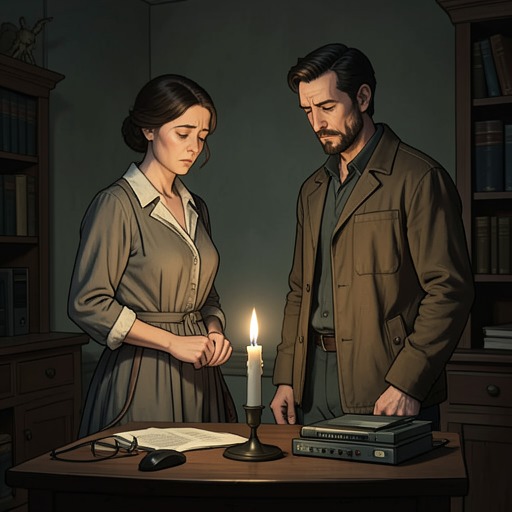
Promise at DawnThe secret and private planet is the name Romain Gary gives to the intimate imaginative world he shares with his mother, a refuge that feels more real to them than their surroundings. Born from her words and his faith in the future she imagines for him, it turns maternal love into a lasting source of courage. The image links a childhood bond to his adult memories of illness, wartime separation, and the letters his mother arranged to reach him after her death.
A private world made of promises
The narrator describes the planet as a wonderland created by a mother’s murmur to her child: a promise of future achievement, justice, and love. Its privacy matters. When his Air Force companions mock his mother, the show of toughness he has adopted falls away; he puts an arm around her and, in his account, the two return to their shared world. The contrast is between public embarrassment and a closeness in which her hopes for him can still be believed.
That imagined future is not detached from hardship. On the day war is declared, his mother travels five hours by taxi to see him at the Air Force Academy in Salon-de-Provence and wishes him many victories in the sky. He imagines returning to her victorious, having given meaning to her years of self-denial and sacrifice. The planet thus carries both affection and an expectation: he is to make good on the future she has pictured and to help create a world freed from the enemies they fear.
Care, fear, and responsibility
The shared refuge is tested by illness as well as by separation. After scarlet fever, the narrator develops a serious kidney infection, and doctors believe he may die. In his rare lucid moments he worries about leaving his mother without support and about failing the hopes she has placed in him. He later understands his refusal to abandon those responsibilities as one reason he fought to survive. The bond is therefore not only a shelter from fear; it gives his struggle a purpose beyond his own life.
His mother’s response to the proposed kidney operation shows how her hopes shape her care. She forbids the procedure despite the advice of the doctors and a specialist summoned from Berlin. The narrator later connects her resistance to her belief about what the operation might mean for his future, and recalls the episode with affection as well as regret. Her protection is forceful, even when it conflicts with medical judgment, because she cannot separate his survival from the larger life she expects him to live.
The care also runs in the other direction. His mother conceals her diabetes while managing the daily work of the lodging house. One day, after repeatedly climbing the stairs between its restaurant and kitchens, she collapses; a doctor identifies hypoglycemia caused by an excessive insulin injection. Her illness frightens her son because he fears she might die before he has fulfilled what she expects of him. The secret planet is sustained by her labor, but it also makes him acutely aware of how much of her life is being spent for his future.
The bond under wartime pressure
During a later, near-fatal bout of typhoid in Damascus, the narrator receives blood transfusions and care from friends and a young Armenian nun. As he slowly recovers, his mind remains confused and his body is left with lasting effects. Yet the bond with his mother continues to organize his sense of himself: when he can speak again, he wants to know when they can return to battle. The doctors tell him that war is over for him and doubt that he will fly operationally again; three months later, he is back in a Blenheim hunting submarines above the eastern Mediterranean. His return does not erase the ordeal, but it echoes the promised return to action that has animated the private world since his youth.
The book also places that enduring tenderness against a wider longing. At Big Sur, the adult narrator lies on the shore among seabirds and seals and recognizes that he still dreams of universal tenderness. The scene does not make the childhood planet literal; it shows how its desire for complete, protective love has survived into adulthood. The sea and the animals frame that desire in solitude, while memories of his mother supply its most intimate form.
Letters, absence, and the lasting image
When the narrator returns to the Hôtel-Pension Mermonts after the war, no one is there to greet him. His mother has been dead for three and a half years, having died a few weeks after he left for England. But she had anticipated that he would still need her support: during her final days she wrote nearly two hundred and fifty letters and entrusted them to a friend in Switzerland, who forwarded the undated messages at intervals. He had therefore continued to receive her words without knowing she was gone.
The narrator presents this arrangement as the continuation of the bond across an otherwise final separation. He says the umbilical cord kept functioning: the mother’s planned letters carried strength and courage to him until victory. At Big Sur, where the adult narrator has come to bring his story to an end, the image of the secret and private planet gathers these memories into one account of love. It began as a child’s trust in his mother’s promises; it endured as responsibility, protection, and imagined companionship; and, through the letters, it outlasted her physical presence.