Treating Life as a Work of Art
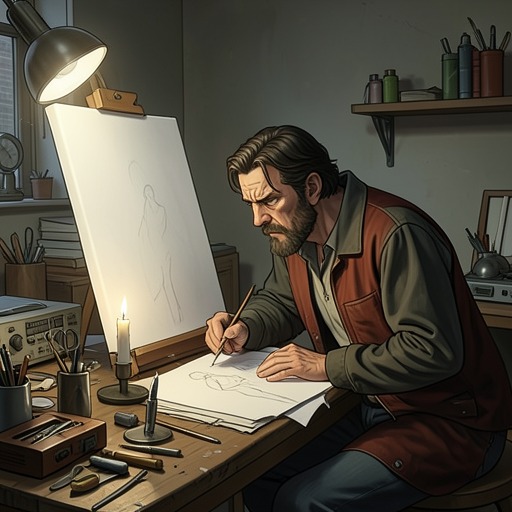
Promise at DawnTreating Life as a Work of Art is the narrator’s lifelong attempt to make existence answer to an artistic ideal: beauty should lead to justice, suffering should be redeemed, and a life should take the shape of a masterpiece. His mother gives this hope its first language through stories and promises, and it becomes a source of endurance as well as a standard he cannot meet. The memoir ultimately revises the ideal rather than simply discarding it: life resists being shaped, but the impulse to imagine a better world persists in writing, action, and irony.
Origins in His Mother’s Stories
The ideal begins in childhood, when the narrator’s mother tells him beautiful tales with such force that he experiences them as promises binding both their lives. She imagines a remarkable future for her son, who will become a celebrated French writer and ambassador despite his obscure beginnings. In retrospect, he understands that her talent made him see life as raw material for a future masterpiece. Her vision does not remain a comforting story at the edge of his life; it becomes a demand to realize, through his own effort, the beauty and happiness she has imagined.
That demand is already present during a grave illness in his youth. The narrator fears leaving his mother without support and is tormented by the thought that he has failed to become what she expects. He measures his life against a series of unrealized ambitions, including becoming a great musician or a French ambassador, and even against the modest triumph of winning the ping-pong championship of Nice in 1932. He later connects his determination to survive with his refusal to evade his responsibilities to her. In this episode, life’s value appears to depend on completing a story whose promised achievements have not yet arrived.
The ideal also encounters the body’s vulnerability through his mother. While managing the daily work of the Hôtel-Pension Mermonts, she collapses after taking too much insulin; the incident reveals to her son that she has diabetes and has concealed it for years. His fear that she might die before receiving the justice he believes she deserves shows how closely he has joined private love to an imagined moral order. Yet neither devotion nor a beautiful story can guarantee that order. The memoir places this fear beside the practical fact of illness, making the gap between the life he wants to compose and the life they inhabit increasingly visible.
The Limits of Composition
Looking back after twenty years, the narrator describes his younger self as a serious, fiercely proud dreamer, loyal to a nursery tale and intent on mastering his fate. He had treated life as if it were ink and paper and destiny as if it were literature. His effort to impose a perfect form upon experience, he now recognizes, was exhausting: life is not a shapeless lump that human determination can simply mold. The more insistently a person tries to leave a mark on it, the more powerfully life can impose its own tragic, grotesque, insignificant, or comic shape in return.
This reversal changes the meaning of artistic ambition. The narrator had wanted to live an ideal that, in his later judgment, could only be sung. Art had awakened a thirst that life could not satisfy, and the wish to transform the world into a happy garden had to confront the difference between aesthetic desire and human experience. He still believes that beauty and justice belong together as an aspiration, but he acknowledges that life can be beautiful without being just. Perfection remains present, no longer as a rule by which experience can be corrected, but as the subject of an ironic smile.
Turning the Ideal into Writing
During the war, the narrator tries to preserve his mother’s faith in him through a literary project suited to his circumstances. Living aboard a ship in cramped quarters, he plans a series of short stories about people fighting injustice and tyranny, with tyranny understood as broader than German rule. He intends to join the stories into a larger narrative about the French Resistance and the refusal to submit. A central character, modeled more or less on himself, would tell the stories in the manner of picaresque novelists. Even if he died before finishing the whole work, the separate tales could leave a trace of his beliefs, hope, and rebellion.
The project turns an abstract ideal into a concrete artistic method. Rather than claiming that life itself has become a masterpiece, the narrator tries to make a work that can carry his principles forward under the threat of death. He writes the first story of A European Education aboard the ship carrying him to battle and reads it to his mother on deck at dawn. Her response, invoking Tolstoy, Gorki, and then Prosper Mérimée, places the new work inside the literary future she has long imagined for him. The scene joins the private origin of his ambition to its public and political purpose: writing becomes both an answer to her hopes and a record of resistance.
Letters, War, and the Imagined Hero
After the narrator reaches England, letters from his mother continue to sustain the ideal across separation. Sent secretly through a friend in Switzerland and forwarded to London in the care of Charles de Gaulle, they arrive as short, undated notes. For three and a half years, he experiences them as a continuing bond and a source of courage stronger than his own. Their tone assumes that he is performing extraordinary feats, and her accounts turn his wartime life into the heroic story she has always expected.
The narrator recognizes that her version of events is imaginary, but he admits that he reads it with satisfaction. She credits him with the victories of English fighters and imagines him present wherever the Royal Air Force raids German targets. His name becomes, in her account, part of every battle report, while her familiar pride links those imagined exploits to his childhood success in Nice. Her letters thus do more than reassure him: they keep alive his belief that life can be made to conform to a beautiful narrative. At the same time, the distance between her account and his actual wartime experience reveals how much that narrative depends on imagination.
Revision Through Illness and Irony
The memoir tests the ideal again through the narrator’s severe illness in Damascus. While his comrades die in a flying accident in Libya, he is gravely ill and his survival is uncertain. After slowly recovering, he is left with lasting effects, including partial paralysis in his face and heart damage. When doctors tell him that his flying career may be over, he nevertheless wants to return to battle as soon as he can speak. Three months later, he is flying again. This course does not prove that determination can master every circumstance; rather, it shows the persistent force of an aspiration that survives even when the body and the doctors’ expectations threaten its fulfillment.
In the memoir’s later reckoning, that persistence no longer means that destiny can be made obedient to art. The narrator has ceased to trust poetic inspiration as a guarantee that the world can be transformed into a just and happy design. Yet he has not stopped dreaming of a better world. The ambition survives in altered form: perfection is now accompanied by irony, and the desire to shape life is tempered by recognition that life shapes its participants in return. Treating Life as a Work of Art therefore names both a formative belief and its correction. The artist’s task is not to force existence into a flawless composition, but to continue imagining and making meaning without mistaking that work for control over destiny.