Vilnius
Promise at DawnVilna is the childhood setting in which the narrator’s mother struggles to make a future for her son, and where a public humiliation becomes one of the defining memories of his life. In this then Polish, formerly Lithuanian, and now Russian town, an apartment building holds several sharply different worlds: a cold flat where his mother keeps the family going, a staircase where her confidence is met with ridicule, a neighbor’s room made generous by pastries and toys, and a courtyard that the boy turns into an arena for imagined battles. The remembered Vilna is therefore both the site of precarious survival and the landscape in which the narrator begins to form his ideas about ambition, shame, and endurance.
Vilna as a temporary home
The family is stranded in Vilna, but the mother insists that the halt is temporary. Their intended destination is France, imagined as the place where her son will settle, study, and become somebody. That future is not a casual hope: she invests it with such certainty that it shapes how the boy understands both himself and his prospects. The city’s importance lies partly in the contrast between this promised destination and the family’s present circumstances.
Those circumstances are severe. The family’s last jewels have been sold, winter snow gathers along the wooden sidewalks, and the hats the mother makes sell poorly. She works without prior experience designing women’s hats and promotes them as the creations of the famous Parisian fashion designer Paul Poiret. She carries hatboxes from house to house while her son stays at home with Aniela, who had followed the family from Moscow. The owner of their building confronts her on the stairs and threatens eviction if the rent is not paid within a day. Somehow, it is paid; the stove is lit, and tea, bread, butter, and eggs still appear for the boy. His mother returns cold from her rounds, kisses him, and looks at him with pride. In the remembered scene, the warmth of that domestic care persists beside the threat of homelessness.
The staircase and the mother’s prophecy
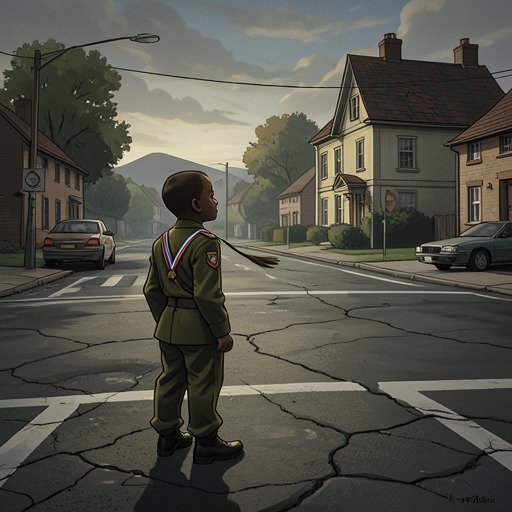
The apartment building’s staircase becomes the setting for a humiliation that the narrator, writing as an adult, says remained with him. His mother’s grand vision of his future is exposed to mockery there, and the boy experiences the laughter and insults as terrifying. He recalls the faces around them as hateful and contemptuous, though he later recognizes them as ordinary human faces displaying ordinary cruelty. The difference between the child’s immediate terror and the adult’s retrospective understanding gives the episode its lasting force: the memory does not erase the injury, but it changes how he interprets those who inflicted it.
His mother stands straight and proud, presses him against her with both arms, and shows no embarrassment or humiliation. The scene makes her composure a visible counterforce to the crowd’s ridicule. The boy, however, is intensely vulnerable to public shame. He describes his distress as an animal in pain and panic trapped in a cage within his chest. In later life, he says, he learns to lose his trousers in public without embarrassment and to understand that a person cannot be reduced to an object of ridicule. He credits the laughter on the staircase with having shaped everything he became, for better or worse. Vilna is thus not merely where the event happens; it is the place to which the adult narrator traces a lasting change in his relation to shame.
A neighbor’s response and a change in fortune
Not everyone in the building joins in the laughter. Mr. Piekielny, a meticulous, melancholy, and gentle neighbor, takes the mother’s prophecy seriously. He watches the boy respectfully on the stairs, sometimes pats his head, and gives him a dozen lead soldiers and a cardboard Foreign Legion fort. Later he invites the child into his flat and serves him pastry and Turkish delight. His kindness offers a private counter-scene to the public mockery: in the same building, one person treats the boy’s imagined future as worthy of attention.
Vilna’s circumstances also change. As winter begins to recede and spring arrives, the hats promoted as Parisian become successful. Two girls help with the growing work, and customers who had once needed to be sought out now come to the family’s showroom. The mother expands the business’s claims, advertising an arrangement with Paul Poiret and representation of dresses as well as hats. A sign announces the fashion house at their door. These improvements do not cancel the earlier insecurity; instead, they show the mother’s persistence turning a desperate improvisation into a growing enterprise. The city holds both phases of the family’s life: days when rent is under threat and a later moment when business begins to prosper.
The courtyard as an arena of memory
The narrator remembers the building’s courtyard as an immense arena where he served an apprenticeship for the battles of adult life. It is entered through a large, tunnel-like passage. A pile of bricks stands in the middle, remnants of a munitions factory destroyed during fighting between Lithuanian and Polish forces. Beyond it are a woodshed, a field of nettles, an orchard fence, and old barns. The boy fights among the nettles with a wooden sword, in the name of France, beneath a tricolor flag made for him by the girls in the workroom and embroidered in gold by his mother with the ideals of liberty, equality, and fraternity.
The barns deepen the courtyard’s imaginative reach. The boy removes planks from their roofs to get inside, forces the locks on tenants’ trunks and boxes, and discovers objects left behind by former owners. Hats, ribbons, medals, shoes, costumes, mirrors, photographs, dolls, and other discarded belongings prompt him to imagine the lives that preceded his own. The courtyard becomes more than a childhood playground: its stores of neglected objects teach him to look at traces of vanished lives and to make stories from them. Alongside the staircase of humiliation, it forms a second kind of training ground—one in which play, historical remnants, and imaginative attention shape the adult narrator’s understanding of struggle and memory.