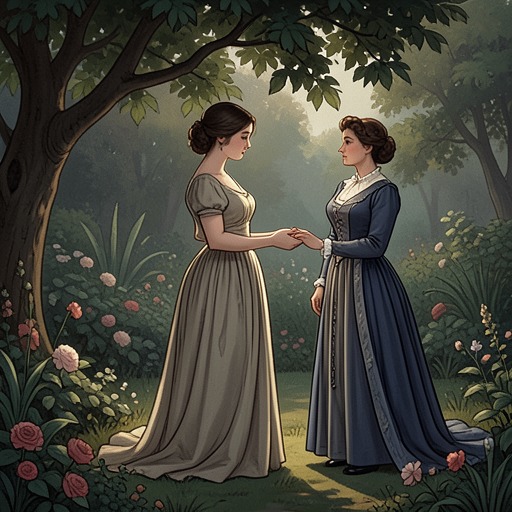
Castle Rannoch
Queen of HeartsCastle Rannoch is the Scottish home that gives domestic life in the novel its sharpest measure of rank and belonging. It is presented less through rooms or landscape than through what living there requires: for Mummy, residence at the castle is the price attached to being a duchess; for Queenie, it is the place where the duchess’s disapproval makes her feel unwelcome. The castle’s significance lies in this double pressure, joining aristocratic privilege to the obligations and exclusions that accompany it.
Identity and Background
Castle Rannoch is identified as a castle in Scotland and as the home associated with Mummy’s life as a duchess. Georgiana explains that her mother had been a leading stage actress when she met and married Georgiana’s father, a grandson of Queen Victoria. Mummy later enjoyed being a duchess, but Georgiana believes she would probably have remained one longer if living at Castle Rannoch had not been part of the bargain. The detail makes the castle more than a family address: it is a condition of the title and the life attached to it.
The evidence offers no architectural description of Castle Rannoch. Its character instead emerges through the people who must accommodate themselves to it. Mummy’s aristocratic role sits uneasily beside her Cockney origins and former stage career, while the household’s standards of conduct reach down to the treatment of a servant. That contrast gives the castle social meaning without requiring a detailed picture of its physical spaces.
Queenie and the Household Hierarchy
Queenie’s response makes clear that Castle Rannoch is not an uncomplicated home for everyone who serves there. When Georgiana asks whether she objects to her employer, Queenie distinguishes Georgiana from the duchess who lives at the castle. She says the duchess dislikes her because she is too common. Her complaint locates the conflict in the household’s class expectations: Queenie has a job and a place in the household, but she believes the person who presides over the castle regards her manner and background as disqualifying.
Georgiana answers by reminding Queenie that she should not criticize her employer or her employer’s family, especially when employment is hard to find. She also tells Queenie that she has not learned to address her by her proper title. Queenie knows the correct form, my lady, but objects that it sounds too toffee-nosed; she sees Georgiana as friendly and ordinary rather than as a distant superior. Their exchange shows that the castle’s hierarchy is not simply accepted: Queenie challenges its language even as Georgiana insists on its rules. The tension is personal, but it is anchored in the household associated with Castle Rannoch.
Mummy’s Departure from the Role
Mummy’s account of her life makes residence at Castle Rannoch the decisive cost of duchesshood. Georgiana remembers a woman who was tough despite her small, fragile appearance, and who had once been a leading lady. She also recognizes that Mummy is capable of performing weakness when it suits her: on the journey to the United States, Mummy presents herself as vulnerable among supposedly dangerous Americans, although Georgiana knows she can take care of herself. The performance underscores how readily Mummy moves between identities, from actress to duchess and from formidable mother to apparently helpless woman.
That adaptability has limits. Mummy may have enjoyed being a duchess, but the condition of living at Castle Rannoch helps explain why the role did not last. The castle therefore marks a constraint within a life otherwise shaped by reinvention. Georgiana’s recollection does not say that Mummy rejected every aspect of aristocratic life; rather, it distinguishes the pleasure of the title from the demands attached to its residence.
Home and the Contrast with Travel
When Georgiana and Mummy stay at Brown’s Hotel in London, the hotel’s treatment of Mummy briefly preserves the social standing she has lost. The staff welcome her as Your Grace, and Georgiana realizes that Brown’s conveniently overlooks that Mummy is now Mrs. Homer Clegg. The contrast is telling: at the hotel, the old title can still be performed and acknowledged, whereas the account of Castle Rannoch emphasizes the practical bargain behind the title. Mummy’s changing names and marital circumstances further complicate any simple identification of her with the duchess’s home.
At the end of the American journey, Mummy says she has had enough of the United States and wants to be back home, complaining about its ideas of equality and her inability to buy a decent face cream. Castle Rannoch has already been established as the Scottish home connected with her duchesshood, but the farewell does not explicitly name it as the destination. That distinction matters: the castle frames the family’s sense of home and status, while the final return is expressed more broadly as a wish to leave America. Across these references, Castle Rannoch remains a powerful point of comparison—an aristocratic home whose obligations Queenie resents and whose associated life Mummy has left behind, even as the idea of home continues to draw her back.