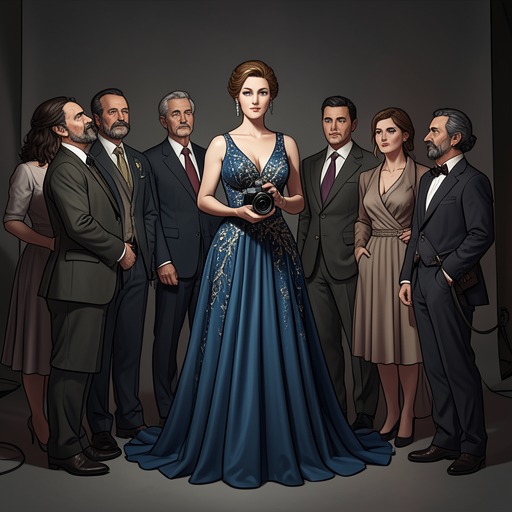
Claire Daniels
Queen of HeartsClaire Daniels is Georgiana Rannoch’s mother, a former duchess of Rannoch and a seasoned actress whose arrival in California entangles a private marital problem with the upheaval of the film industry. She comes to the United States intending to obtain a divorce in Reno and marry Max von Strohheim, but takes a part in a Hollywood production rather than spend six weeks waiting for the divorce. The resulting career detour reveals her theatrical skill, her appetite for admiration, and a lighter, more affectionate connection with her daughter than Georgiana’s first impressions might suggest.
Identity and Background
Claire enters Georgiana’s story in conspicuous contrast to the quiet setting around her: she arrives in a car, hatless and windswept, in bright red slacks and a white halter top, with large sunglasses and high platform espadrilles. Her hair is soon perfectly arranged despite the drive. Georgiana introduces her as the former duchess of Rannoch, a title that is accurate but does not capture the many later changes in Claire’s romantic life. The narration characterizes her as repeatedly married and prone to leaving partners; Claire herself describes an English husband who drinks heavily and pursues women. The evidence presents this marital history as a source of both comic candor and practical difficulty, rather than giving a full account of each marriage.
Claire is also a professional performer with an established reputation. Georgiana recognizes the voice that had delighted theatergoers around the world, and later sees that her mother’s stage presence translates readily to the camera. Claire says she prefers theater to film after enduring repeated takes of a short scene. Her irritation is specific: the same passage has been shot thirty-four times, while Juan de Castillo’s accent cannot be changed overnight. Her response suggests that she understands performance as a practiced craft, not simply as glamour, even as the movie production tests her patience.
Marriage, Travel, and the Hollywood Role
Claire’s visit to California begins amid competing plans. She has recently been away with Max von Strohheim at Lake Lugano and is still involved with him when she arrives to find Georgiana. Max now insists that he wants to marry her, while Claire remains legally tied to a husband who does not believe in divorce. She has heard that divorce can be arranged in Reno, but Cy Goldman warns that the process is not immediate: it requires six weeks. Claire’s reaction makes the cost concrete. Rather than spend that interval in a Reno motel, she accepts the prospect of a film role.
The choice links Claire’s personal circumstances to the opportunities and pressures of Hollywood. Cy Goldman flatters her and offers work, while also presenting film acting as a practical alternative to waiting for a divorce. Claire initially says the American visit is short and that she must return to Max in Germany, who dislikes her absence. Yet the chance to perform, and the prospect of avoiding six weeks in Reno, alter her itinerary. Her decision does not resolve the marriage; it postpones the intended divorce while giving her a new professional engagement.
At Golden Pictures, Claire plays Mary in a historical film. Georgiana first sees her on a palace set, dressed in a revealing costume, opposite Juan, who is playing King Philip. The scene is repeatedly interrupted and restarted. When Cy criticizes Juan’s accent as unsuitable for the audience he has in mind, Claire continues working through the retakes; at lunch she remarks that a speech coach would need weeks to change the way he speaks. The production’s demands make voice an employment condition: Cy wants a Spanish-sounding performance that will nevertheless be easy for American viewers to understand.
Performance and Conflict on the Set
Claire’s work quickly becomes a point of comparison with Stella Brightwell, whose career Cy regards as vulnerable in the transition to sound films. He tells Stella that her voice is not good enough for the new medium and threatens that Claire will outact her in every scene. Claire is not the one who initiates this confrontation, but her casting gives Cy leverage over Stella and intensifies Stella’s resentment. The dispute also exposes Cy’s power as producer: he can praise Claire, threaten an established star, and alter Juan’s role when he decides the actor does not meet the studio’s requirements.
The film’s production is not simply a stage for Claire’s professional success. Cy praises her as believable and tells Georgiana that her mother is a remarkable actress, while Claire’s own account of the thirty-four takes stresses how mechanically demanding filming can be. She appears to possess the kind of confidence that allows her to shine before an audience, but she is not portrayed as untroubled by the repetition and compromises of studio work. Her skepticism about the production sits alongside her willingness to take the part, making Hollywood at once an opportunity and an expedient interruption in her plans.
Claire’s interactions with the men around the production also show how performance and identity overlap. When Craig Hart arrives as a possible replacement for Juan, Claire comments that he is kind to Georgiana and makes her daughter feel special. Later, Cy’s appraisal of Claire is tied to the commercial and visual logic of casting: he promises that makeup can make her look as young and beautiful as Craig. Claire’s presence is therefore valued both for her acting and for the image the studio believes she can project. The evidence does not show her challenging that calculation directly; it does show her continuing to assess the work from the perspective of an experienced theater performer.
Mother and Daughter
Georgiana’s account mixes affection with exasperation. Claire’s sudden arrival is a surprise: she has been searching for her daughter after learning from Belinda that Georgiana is staying with the Eynsfords. Georgiana hastily supplies her mother with the socially acceptable title of former duchess, aware that the older women present may know more of Claire’s history than the introduction reveals. The scene establishes both Claire’s ease at entering a room and Georgiana’s instinct to manage the consequences of that ease.
Their relationship becomes more openly tender during the film episode. Claire notices Craig’s attention to Georgiana and calls his kindness reassuring; Georgiana, embarrassed by the attention, recognizes her mother’s amusement. After the fire at Cy Goldman’s estate, Claire runs toward the others with her hair still in curlers. Georgiana notes how unusual this is for a woman who never normally lets anyone see her without makeup and perfectly arranged hair, and interprets the sight as proof of how frightened her mother was. The vanity that has shaped Claire’s public image yields, briefly, to immediate concern.
That warmth is clearest after the danger has passed. Beside the pool at the Beverly Hills Hotel, Claire concludes that the destroyed production has probably ended her film career. She calls the picture foolish and says she is not sorry to leave it behind: Max would have been furious, and she now enjoys privacy and leisure. She admits that she had been flattered to discover that the world still regarded her as a star, but suspects that Stella wanted her cast as Mary partly to make Stella appear younger and more beautiful by comparison. Georgiana answers that Claire looked and acted better. Claire is genuinely pleased by her daughter’s praise, turning professional rivalry into a moment of uncomplicated mother-daughter approval.
Ending and Significance
Claire’s apparent exit from film is accompanied by a return to the marital problem that brought her to America. At the ranch, she goes to find Homer Clegg while Georgiana waits anxiously. Claire comes back delighted: Homer has arrived in Reno intending to obtain a quick divorce because he has found someone else he wants to marry. The husband who had resisted divorce is suddenly willing to end the marriage when his own plans require it. Claire expects the divorce to be completed within days, freeing her and Max to go home.
The change reverses Claire’s original predicament. She had been the one seeking a divorce from a reluctant husband; now Homer’s desire to marry someone else supplies the opening she needed. The resolution is practical rather than sentimental. Claire declines to attend Cy Goldman’s funeral, reasoning that the crowd will be enormous and that she and Cy were not close friends. She says she has had enough of America and wants to return home, where she can escape what she calls its foolish ideas of equality and obtain decent face cream. Her final decision restores her earlier preference for privacy and familiar comforts, even after the excitement of a film career.
Claire’s arc connects romantic freedom, performance, and the instability of celebrity. Marriage is both an intimate arrangement and a legal obstacle; acting offers money, attention, and a temporary alternative, but the studio’s commercial judgments can reshape careers and cast one woman against another. Claire navigates these conditions with theatrical fluency and self-interest, yet the moments with Georgiana complicate any portrait of her as merely flamboyant or self-absorbed. Her public composure slips at the fire, and her daughter’s praise matters to her. By the end, she has neither become a Hollywood star nor remained trapped in the marriage that prompted her journey: she is poised to leave, with the divorce finally within reach.