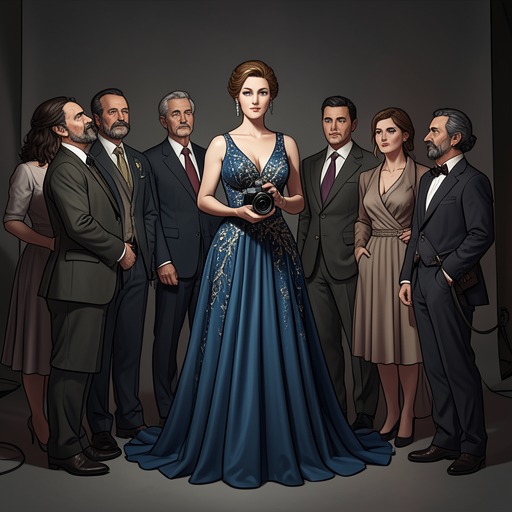
Claire Daniels Accepts a Role in The Tudor Sisters
Queen of HeartsClaire Daniels’s acceptance of Mary Tudor in Cy Goldman’s The Tudor Sisters turns a practical trip to the United States into an unexpected return to the screen. The offer gives her an alternative to spending six weeks in Reno while pursuing a divorce, but it also answers a more personal challenge: Claire wants to show Stella Brightwell that she can still command a leading role. The production quickly tests that confidence against the demands of sound-film acting, the studio’s control over performers, and the uneven power between its producer and its stars.
The Offer and Its Circumstances
Claire’s initial purpose in traveling to the United States is not a film career. Still married to a husband who does not believe in divorce, she intends to go to Reno because her current beau, Max von Strohheim, is insisting that they marry. Cy Goldman cautions that the process cannot happen overnight: Stella Brightwell, who has been through a divorce herself, can explain that it takes time. The prospect means six weeks in a Reno motel, a possibility Claire finds less appealing than an unexpected alternative. Mexico is mentioned as another route, but with the warning that not every state would recognize a Mexican divorce.
Goldman and Stella are trying to persuade Claire to join their picture. Claire resists the idea of playing anyone’s mother and worries that taking a film role will make her look like a has-been attempting a comeback. Stella counters that audiences would be struck by how young and beautiful Claire still looks. Claire also says that she has little time for Hollywood: this is meant to be a short trip, after which she expects to return to Max in Germany, where he dislikes her being away. Her hesitation is therefore practical as well as professional; the offer would disrupt the purpose and timetable of her visit.
The pitch is tailored to the distinction Claire draws between herself and Hollywood performers. Goldman wants a British actress who can play British convincingly, and presents Claire as a genuine stage actress rather than someone trying to imitate that quality. He promises her a leading, glamorous part opposite Stella, not a maternal supporting role. Stella is to play Elizabeth, the future Elizabeth I, while Claire is cast as Mary Tudor. The proposed picture, tentatively called The Tudor Sisters, is to concern Mary and Prince Philip of Spain, although Claire is unsure how her part fits the premise until Stella identifies her as Mary.
Why Claire Accepts
Goldman offers more than employment: he says that he will direct the film himself and predicts that it will be a tremendous hit that makes Claire a star. Claire asks whether Juan will play Philip and objects that he is scarcely older than her daughter. Goldman answers that makeup can make her look as young as Juan, treating the age difference as a problem the production can manage through appearance. The exchange makes the role’s demands explicit: Claire is being asked to perform youth as well as royalty, and the studio promises that its technical resources can bridge the gap.
Claire’s eventual decision is not presented as a sudden recovery of uncomplicated ambition. She admits that the film is preferable to six weeks in a Reno motel, then accepts. Later, at the Beverly Hills Hotel, she tells Lady Georgiana Rannoch that she does not need the money or particularly want to become a film star. She suspects that Stella is the reason she agreed. Their history explains the attraction: when they last worked together, Claire was the pantomime’s leading star, while Stella and her sister were a novelty act of young dancers and acrobats who adored her. Claire’s account gives the casting a private stake alongside the public promise of stardom. She wants to establish that the earlier hierarchy has not simply disappeared with time.
The Role Meets the Production
The arrangement carries Claire directly from her decision into a working film set. After the train journey to Los Angeles, Goldman’s assistant Ronnie collects Claire and Lady Georgiana Rannoch at the station. He takes them to the Beverly Hills Hotel, where Claire learns that the car will collect her at six the next morning. Goldman is already filming; the final script will arrive later that afternoon, with the scenes for the following day marked. Claire is expected to learn lines almost immediately, a pace she contrasts with the more civilized routines of theatre.
Her first experience of filming confirms that the new medium brings a different kind of labor. During a scene in which Mary asserts her authority over Philip, Goldman calls cut and praises Claire, while instructing Juan to reduce his accent and avoid a lisp. Juan objects that this is simply how he speaks and argues that Spanish men speak that way. The scene is repeated; at lunch, Claire tells Lady Georgiana Rannoch that the same short passage has been performed thirty-four times. She also observes that Juan will not lose his accent overnight and would need weeks with a speech coach, while Goldman is dissatisfied. The difference between Claire’s established theatrical skill and the set’s repeated retakes is immediate: a successful performance is not simply played once but made to meet the director’s requirements again and again.
Casting, Control, and Consequences
The dispute over Juan becomes a broader demonstration of Goldman’s authority. Stella defends Juan when Goldman calls him a Spanish peasant, pointing out that he comes from an old family with a castle and accusing Goldman of believing money lets him take whatever he wants from Spain. Goldman responds by invoking Stella’s vulnerability in the talkies: without him, he says, her career is finished, her voice is not good enough, and Claire will outact her. The threat makes the casting competition personal and economic. Stella has a starring role, but Goldman presents that opportunity as something he can grant or withdraw.
Juan later confronts Goldman after learning that he is no longer wanted for his part. Goldman again cites Juan’s accent and lisp, while Juan treats the criticism as an insult to his mother tongue and country. Goldman refuses to let him leave, reminding him that his contract binds him to Golden Pictures just as Stella’s and Craig Hart’s do. He offers Juan a smaller part and voice coaching, then invites Darcy O’Mara to take the role of Don Alonso. The replacement shows how the same production can offer opportunity while narrowing performers’ choices: Claire is recruited for the qualities Goldman wants, while Juan’s own speech becomes a reason to demote him, and his contract prevents him from simply walking away.
Claire’s acceptance thus begins as a compromise with the practical inconvenience of her divorce plans, but it is also a wager on her own standing beside Stella. The role gives her the glamorous prominence she initially feared she had lost, while the first days of filming expose the work and institutional control behind that promise. Her later admission that she wanted to prove she still had it supplies the decision with its sharpest personal motive; the repeated takes and shifting casting make clear that, in Goldman’s Hollywood, confidence alone cannot determine who gets to keep a part.