Cy Goldman
Queen of HeartsCy Goldman is the impresario of Golden Pictures, a Hollywood producer who treats celebrity, history, and cultural property as materials to be acquired and reshaped. His genial confidence helps him recruit Claire Daniels for a film, but the same entitlement becomes lethal when Juan confronts him over candlesticks taken from a Spanish convent. Juan’s eventual confession makes Goldman’s murder the violent consequence of a conflict between commercial possession and inherited cultural meaning.
Identity and Introduction
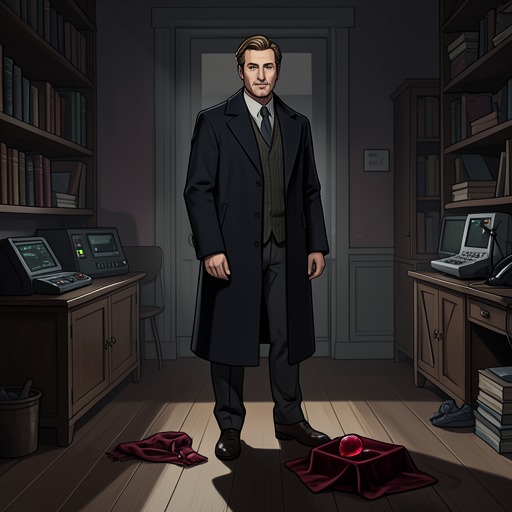
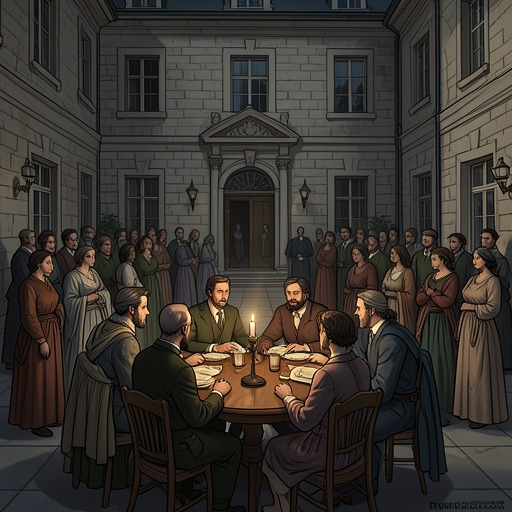
Goldman first appears aboard ship with Stella Brightwell. He is a stocky, middle-aged man with shock-gray hair and round wire-rimmed spectacles; the narrator’s first impression is of a bear-like figure with an owlish look. His expansive manner is immediately apparent: he opens his arms to greet Claire Daniels and tells her he has long wanted to meet her. The captain identifies him to the assembled dining room as the impresario of Golden Pictures, placing him at the center of the film world before the reader has seen his work.
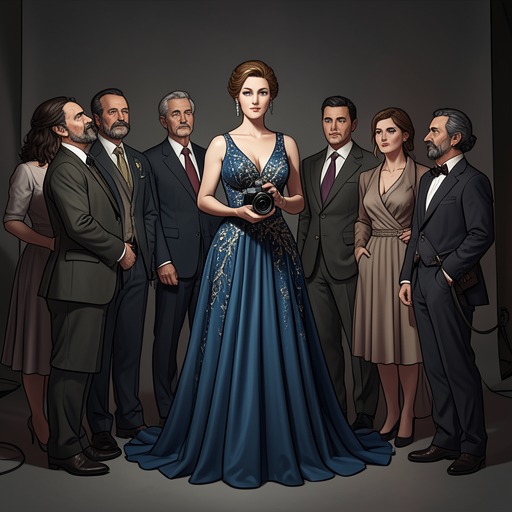
Goldman’s warmth is also a form of persuasion. He makes Claire the focus of attention and later beckons her to join a conversation about a movie, presenting her not simply as a guest but as the person the filmmakers need. His boisterous manner and assurance make the invitation sound like an opportunity already waiting to be accepted.
Hollywood Ambitions and Claire Daniels
Goldman is building a property above Malibu that incorporates parts of old Spanish buildings. Stella has nicknamed it Alhambra Two, although Goldman says it has no official name. The half-built estate reflects his taste for grand spectacle and for turning fragments of the past into part of a new personal project.
His film plans show a similar approach to history. Goldman says that a movie is not a history lesson: when the past seems dull, he believes it should be spiced up, and he expects American audiences to enjoy stories about British queens and princesses. He intends to direct the picture himself and predicts that it will be a tremendous hit, promising Claire that she will become a star. Juan, he confirms, is to play Philip. Goldman’s confidence in the project rests as much on his own conviction and salesmanship as on any detail about the production.
Claire resists the offer. She worries that appearing in a film would make her seem like a has-been attempting a comeback, and says she has little time for Hollywood because she plans to return to Max von Strohheim in Germany. Stella counters that audiences would be amazed by how young and beautiful Claire still looks. Goldman’s recruitment thus draws on both commercial opportunity and the promise of restored celebrity, while Claire’s hesitation reflects the uncertainty of how her public image might be received.
The conversation also exposes Claire’s private purpose in traveling to the United States: she plans to go to Reno to seek a divorce from a husband who refuses to divorce her, because her current beau insists they marry. Goldman warns that the process will not be immediate and points to Stella’s experience of divorcing Freddie. His practical intervention briefly places him within Claire’s personal dilemma as well as her prospective career, though the evidence presents the divorce discussion as part of the social conversation rather than a plan he undertakes to manage.
Wealth, Property, and Juan’s Grievance
Goldman’s dealings with Spanish religious art reveal the harder edge beneath his genial public manner. In Juan’s account, the candlesticks came from the convent where Juan’s great-aunt is mother superior. The convent, short of money for repairs, sold them to Goldman; it also sold an El Greco painting for what Juan considers a pittance. Goldman, Juan says, boasted of buying an entire chapel in Spain and planned to ship it to California stone by stone, rebuilding it as a bathhouse.
These details are reported through Juan, whose understanding of the transaction differs sharply from Goldman’s. The convent’s members, Juan says, were simple, holy women who did not know the value of what they possessed. To Goldman, the candlesticks were his property once purchased and would look better on his dining table than in the convent’s old chapel. To Juan, they belonged to a family and religious inheritance that the sale had failed to protect. The disagreement is therefore not merely over price: it concerns whether legal acquisition settles the moral question of who has the right to remove and repurpose sacred objects.
Murder and Narrative Significance
Goldman’s confidence that ownership is final becomes the immediate point of rupture. Juan had pretended to go to bed, entered the library ahead of the others, and hidden behind curtains until Goldman was alone. Goldman was not alarmed when Juan emerged; he offered him a brandy and a cigar and began putting the candlesticks back in their box and into the safe. Juan demanded their return on behalf of the sisters of Santa Theresa. Goldman rejected the demand, insisting that the objects were his and that they belonged on his dining table rather than in the chapel.
Juan then picked up a candlestick and struck Goldman once across the head. He says that Goldman fell, that he dropped the candlestick in shock at what he had done, and that he fled by hiding behind a statue before slipping away amid the confusion. When asked whether he regretted the killing, Juan refused; he described it as vengeance for the insult to his culture, religion, and family. His confession establishes that Goldman’s murder grew directly out of the dispute over the convent’s property, though it also shows Juan choosing lethal violence rather than simply recovering the objects.
Before that confession, the missing candlesticks and Goldman’s death invite suspicion elsewhere. Stella believes Helen Goldman may have had a motive because Cy planned to divorce her and marry Stella, and the investigation also considers whether Bella Brightwell, attempting to steal the candlesticks, struck him. Juan’s account overturns those suspicions by separating the theft attempt from the murder: Bella says she found Goldman already injured, while Juan identifies himself as the assailant. Goldman’s importance to the mystery lies in that double role—as a wealthy film impresario whose social confidence conceals the conflicts produced by his acquisitions, and as the victim whose death exposes the people and histories his idea of ownership has disregarded.