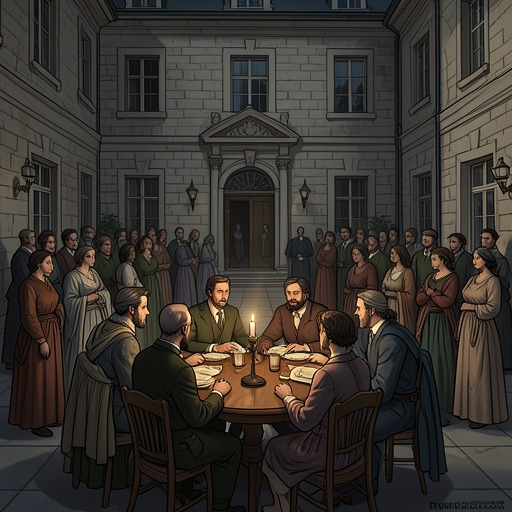
Cy Goldman Murder Case
Queen of HeartsCy Goldman Murder Case transforms a gathering at Cy Goldman’s estate into a homicide investigation, with a missing candlestick and the apparent security of the grounds narrowing suspicion toward the people already inside. Its early turns repeatedly unsettle the simplest explanation: the death may have occurred during a burglary, yet the guarded entrance makes an outsider difficult to account for; later, a candlestick appears in Stella Brightwell’s bedroom, creating a pointed accusation that she says is a frame-up.
Discovery and Immediate Response
The case opens when Ronnie goes to the library after finding Cy absent. The room still carries signs of recent occupation, but Cy is nowhere to be seen; Ronnie then notices that the candlesticks are missing. Darcy enters, and Georgiana Rannoch follows. They find Cy lying between the library table and the closed drapes around the window alcove, with one candlestick beside him. The discovery makes the missing object more than a theft: it is now connected to the death, while its presence beside Cy gives the investigators an immediate but not conclusive clue.
Darcy takes charge of the first response, telling everyone to leave the room and not touch anything, and insisting that the police be called. Ronnie explains why that may not be straightforward: the estate falls under the jurisdiction of Ventura County rather than a nearby city, and he does not know how quickly the sheriffs can respond or whether they have homicide investigators available. His uncertainty makes the practical distance between the estate and law enforcement part of the scene. The household has to preserve the room and wait while those present are still working out whom to contact.
Georgiana’s mother asks whether the death could instead be treated as an accident, suggesting that Cy might have fallen ill and that police involvement would bring scandal. Darcy rejects that possibility, judging that Cy’s death resulted from considerable force. The contrast establishes two competing pressures from the outset: the need to treat the death seriously and the desire to avoid the public consequences of an investigation. The suggestion of an accident does not settle what happened; it shows how readily the household’s concern for reputation could obstruct the search for an answer.
A Closed Circle and Competing Theories
Stella Brightwell resists being led away from Cy. She proposes that he interrupted a burglar and points to the missing candlestick as a possible motive. At the same time, she emphasizes the apparent difficulty of entering the estate: there is a single way in, through the gate, and the gatekeeper, Jimmy, would not ordinarily admit someone he did not know. She also describes safeguards around the gatehouse, including an alarm button, a telephone connection to the main house, and armed groundsmen. These details make the estate seem protected, but they do not yet establish that no one could have entered or that everyone inside is innocent.
Darcy draws the unsettling implication that the killer may be one of the people gathered at the estate. Georgiana considers whether the London burglar she and Darcy have discussed could have entered unnoticed, perhaps by waiting until the household was at dinner. Darcy does not rule out that possibility, noting the burglar’s history of taking risks and gaining access by unconventional routes. But he also sees a mismatch: the violence of Cy’s death does not fit what is known about a thief associated with careful, daring jewel thefts. The suspected outsider remains a possibility, not an explanation that resolves the scene.
The others develop their own versions of the burglary theory. Craig Hart rejects the idea that a gang could have entered the library without being heard, while Stella argues that a group of thieves would likely have taken the second candlestick as well, despite its connection to the death. Her reasoning favors a single burglar. She recalls that a ruby and a diamond ring were stolen aboard RMS Berengaria during the Atlantic crossing and that the thief was never caught, then wonders aloud whether that same person followed them to the estate. The earlier thefts give the present case a wider pattern to test, but the evidence presented so far does not prove that the crimes share a perpetrator.
Stella is herself an obvious focus of suspicion and an uneasy counterexample to the burglar theory. Georgiana knows that Stella’s career has depended on Cy and that the two were lovers. Their relationship might appear to give Stella a reason to fear a change in Cy’s intentions, especially after an argument before dinner; Georgiana also considers whether a possible divorce and financial settlement involving Cy’s wife could have sharpened tensions. Yet she finds it difficult to reconcile Stella’s public position and elegant appearance with the image of a risk-taking cat burglar. This is Georgiana’s assessment, not an exonerating fact: affection, dependence, and social image shape how she weighs the possibilities, while leaving the central question open.
The Gate and the Suspect List
The possibility that the killer has already left the estate is tested when a telephone call comes from Jimmy at the gatehouse. He reports that the sheriff has arrived and asks permission to let him in, a small procedural detail that reinforces Stella’s confidence in his conscientiousness. She argues that no one could have passed him and that, unless the fence proves otherwise, the murderer must still be on the premises. Charlie Chaplin voices the more alarming conclusion that the killer may be one of the people present. The chain of reasoning remains conditional: the gatekeeper’s vigilance supports the closed-circle theory, but it cannot establish whether the killer entered by another route or was already inside.
The gathering’s reactions expose how difficult it is to separate evidence from self-protection. Stella rejects the suggestion that someone among them would kill Cy merely to take a candlestick, reasoning that a person intent on theft could have entered the library when it was empty. Her objection has force as an argument about timing, but it does not explain the death or identify who had access. Meanwhile, the sheriff’s arrival brings official scrutiny into a household already anxious about scandal, reputation, and the possibility that the crime reflects on one of its own members.
The Candlestick in Stella’s Bedroom
The investigation takes a sharper turn when a scream brings Darcy, Craig, Ronnie, and Georgiana upstairs. In Stella’s bedroom, one candlestick lies in the middle of the bed. Its placement supplies the missing object in a location that immediately invites suspicion, but Stella says someone must have put it there to frame her. The discovery changes the status of the candlestick from a clue associated with the library to possible evidence against a specific person; it does not, by itself, show who carried it upstairs or when.
The sheriff advances a theory that Stella killed her lover and took the candlestick, then had to hide it after Cy’s body was found sooner than she expected. Stella counters that she could afford to buy such an object and says Cy would have given it to her if she had asked. She also maintains that they loved one another and would have married if Cy’s wife had granted him a divorce. Her response places their relationship and his marital situation directly beside the physical evidence, but neither her denial nor the sheriff’s accusation resolves its meaning. At this stage, the case is defined by the gap between an incriminating object and an unproved account of how it got there.
The narrative constructs its suspense through successive reversals in what the candlestick can signify: a missing possession suggests theft, the one left in the library connects the theft to Cy’s death, and the one found on Stella’s bed appears to implicate her while also making a planted clue plausible. The secure gate creates a parallel uncertainty about access, turning the apparent boundary of the estate into a test of every suspect theory. The evidence establishes a murder investigation and a tightening circle of suspicion, but these episodes leave the identity of the killer and the candlestick’s route to Stella’s room unsettled.