Disguise and Mistaken Identity
Queen of HeartsDisguise and mistaken identity are not merely visual tricks in the novel: they are methods of gaining access, concealing a criminal identity, and manipulating what other people think they have seen. Bella Brightwell exploits her resemblance to Stella Brightwell to enter places where Stella is welcome, while the difference between their voices and the details of their movements eventually lets Georgiana Rannoch uncover the substitution. The scheme works because observers accept the familiar face before testing the identity behind it; it fails when those separate clues are assembled into a pattern.
Resemblance as Access
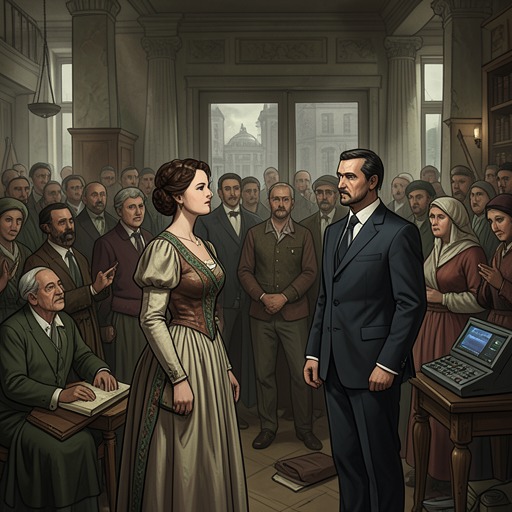
Bella’s impersonation depends on a real likeness to Stella Brightwell, but the resemblance is not complete. When Georgiana and Belinda confront her, Stella’s face seems familiar, yet the woman’s voice lacks Stella’s polished, breathy film-star quality. That mismatch turns an initially plausible identification into a question. Belinda recognizes that the woman is not Stella, and Georgiana goes further, identifying her as Stella’s sister, Bella Brightwell, formerly known as Flossie Oldham.
The difference matters because Bella does not need to convince every observer under every circumstance. She needs to pass briefly as a person whose presence would be expected. At house parties where Stella is a guest, a sighting of a woman who looks like Stella is easily explained as Stella herself. Bella can therefore slip among people without attracting the suspicion that an unfamiliar intruder might invite. Her sister’s established identity supplies the cover; the mistaken recognition supplies the opportunity.
Bella’s own account makes the contrast between the sisters part of the scheme’s emotional as well as practical logic. She acknowledges that Stella was considered to have the looks and talent, while insisting that she has succeeded in her own way. The impersonation draws power from that comparison: Bella can borrow the appearance that others associate with Stella even as she resents the judgments that have distinguished them.
The Pattern Behind the Sightings
Georgiana’s deduction depends on connecting Bella’s disguise to the apparent impossibility of Stella being present at several places. She remembers being told about the sisters’ childhood act and compares that history with reports of Stella at locations where she could not have been. The crucial distinction is between the person seen and the person assumed to have been seen. If Bella appeared as Stella, the sighting did not contradict Stella’s alibi for the actual robbery; it helped explain how an apparent Stella could be present without Stella committing the crime.
That explanation reframes the repeated sightings as a deliberate method rather than a collection of coincidences. Bella could enter the house parties attended by her sister, and anyone who encountered her could mistake her for the invited guest. Georgiana explains this reasoning to Darcy O’Mara, who recognizes the ingenuity of the solution and asks whether the sisters acted together. Georgiana rejects that suspicion: Stella was astonished to see Bella after years without communication. The likeness had enabled the crimes, but it did not establish Stella’s complicity.
The distinction preserves two identities where the disguise had blurred them. Stella’s presence at a party could be either genuine or an imposture, and appearances alone could not settle which. The pattern becomes intelligible only when the sightings are tested against what is known about each sister and the circumstances of the robberies.
Wigs, Uniforms, and the Ruby
Bella’s theft of Princess Promila’s ruby shows that her disguises are supported by preparation and changes of role, not resemblance alone. She says she traveled under a fake passport and first presented herself as Stella, pretending to have gone to Princess Promila’s cabin by mistake. That visit let her observe where the princess kept her possessions and how attentive the servant was. Bella then borrowed a stewardess’s uniform, waited until the servant was dozing and Princess Promila was out, and entered the cabin to take the ruby.
The uniform changes the identity Bella presents, while her observation of the servant’s inattention makes the change useful. She also has a concealed compartment under her wig in which the ruby fits. Wigs thus serve two connected purposes: they help Bella alter her appearance, and they provide a hiding place for stolen property. Her account of carrying spare wigs and duplicate dresses of Stella’s explains how she can reproduce the sister’s appearance when needed and carry several possible identities with her.
When Bella fears that her cabin may be searched, she throws the disguises and duplicate dresses overboard. The discarded hair floating on the water had led Georgiana to think someone was drowning; Bella explains that it was the remains of several identities being disposed of. The episode makes the disguise materially vulnerable: the objects that enable concealment can also expose it if they are discovered. Bella’s fear follows an attempted theft of a diamond brooch at a costume ball, where a real steward saw her trying to enter a cabin and alerted security. She abandons the brooch attempt and destroys the evidence rather than risk a search.
Exposure and the Limits of Impersonation
At the country estate, Bella again relies on being taken for Stella. She drives in through the main gate after the others, trusting that the people in a car with tinted windows will not notice who its passengers are. Her method has worked before, but Georgiana points out the contingency: if Stella had been driving another car, the mistake might not have held. Bella answers that she watched the group leave and saw a young man driving. The impersonation is therefore not effortless magic; it depends on observing who is present, choosing the right moment, and anticipating what others can see.
Other clues converge on the same conclusion. Georgiana knows that a black glove was found on the grounds and that it left a print on the window frame. Bella explains that she did not climb down from Stella’s window but lowered herself from it and climbed back up, a maneuver she says she performs regularly. This account joins the physical evidence to the false identity: access to Stella’s room and appearance can help Bella move through the house, while the glove and window trace the movements that the disguise was meant to hide.
The reveal comes when familiarity itself proves insufficient. Belinda first detects that the woman’s voice is not Stella’s; Georgiana identifies the sister behind the face and explains the pattern of thefts. Bella’s surprise at being recognized confirms that the disguise has depended on other people failing to connect those details. Her own admission that the ruby was easy to steal reinforces the difference between success and proof: she claims that others cannot prove she was aboard the ship, even as her account supplies Georgiana with the explanation of how the theft worked.
Narrative Significance
The mistaken identity plot turns recognition into an act of reasoning rather than a simple response to appearance. Bella’s resemblance gives her a convincing first impression, but voice, clothing, timing, physical traces, and the sisters’ history each qualify what a face seems to establish. Georgiana solves the mystery by treating apparently conflicting sightings as evidence of impersonation and by separating Bella’s actions from Stella’s presence.
The disguise also links criminal ingenuity to the sisters’ estrangement. Bella has repeatedly used Stella’s public identity as cover, yet Stella was not in on the scheme and had not communicated with her sister for years. Their reunion is described as touching, especially because Bella later saves Stella’s life. The same resemblance that enabled deception therefore also belongs to a genuine family relationship whose recovery cannot be reduced to the criminal use Bella made of it. Across the plot, disguise creates false proximity and false presence; the eventual recognition distinguishes the sisters again without erasing either the harm of the impersonation or the possibility of their reunion.