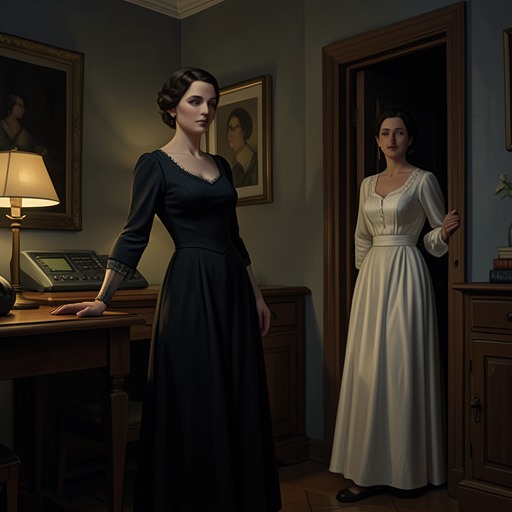
Georgiana Rannoch and Queenie
Queen of HeartsGeorgiana Rannoch and Queenie are bound together by an arrangement that is both familiar and unequal: Georgiana is Queenie’s employer, but their daily exchanges often sound less like formal service than an ongoing argument between companions. Low wages explain why Georgiana tolerates Queenie’s lapses; trust and demonstrated loyalty explain why the relationship survives beyond that economic bargain. Their disputes over titles, duties, leisure, and class expose the limits of Georgiana’s authority, while moments of danger reveal a dependable bond beneath the friction.
Dependence and the Terms of Service
Georgiana Rannoch recognizes the practical value of a maid who is willing and efficient, but also understands why she can employ Queenie: Queenie works for very little because other gentlewomen would be unlikely to hire her. Georgiana cannot afford a more suitable servant, and the arrangement therefore suits them both much of the time. Their familiarity is not separate from this financial dependence; it grows inside a working relationship in which each knows the other has limited alternatives.
That dependence does not prevent Georgiana Rannoch from insisting on hierarchy. When Queenie complains about Georgiana’s family and her treatment by the duchess at Castle Rannoch, Georgiana reminds her that she should not criticize her employer or the employer’s relatives and ought to be grateful for having work during hard times. She also points out that Queenie has not learned to address her by her proper title. The correction is personal as well as professional: Georgiana has accepted a degree of informality, but she does not want that familiarity to erase the distinction between mistress and maid.
On another occasion, Georgiana Rannoch decides that Queenie’s recent complaints require a firmer response. She invokes Queenie’s job, food, and shelter, and contrasts her conduct with that of Claudette, whom she presents as a model lady’s maid. Queenie responds with an apologetic grin and recalls her father’s warning against becoming too proud. The exchange briefly restores the expected order, after which Georgiana turns to practical instructions about ironing. Her authority is real, but the scene also shows how much of it depends on verbal reminders rather than effortless obedience.
A Familiarity That Tests Authority
Queenie’s informality repeatedly unsettles the role Georgiana Rannoch expects her to perform. After the crossing’s masquerade, Queenie explains that she stayed awake in case Georgiana needed help out of her cat costume, only to find she had managed it herself. She has also recognized that Darcy O’Mara is aboard and asks whether Georgiana knew. Georgiana tells her to keep his presence secret because he is on a mission. Queenie’s curiosity and teasing are characteristic of their ease with each other, while Georgiana’s request shows that she trusts Queenie with information she must not disclose.
That trust extends to practical responsibility, even though Georgiana initially doubts Queenie’s capacity for it. When a plan requires someone to remain in Georgiana’s cabin while a thief is being sought, Georgiana laughs at the suggestion that Queenie can be brave and responsible. Darcy counters that Queenie has shown courage before, recalling that she once tried to strike him when he was sneaking into Georgiana’s room. Georgiana accepts the proposal as worth trying. The moment makes their relationship legible as more than employerly tolerance: Georgiana may underestimate Queenie, but others have seen a protectiveness that Georgiana can rely on.
Their shipboard differences also turn on Queenie’s changing circumstances. Once she has found her sea legs, she is more interested in the ship’s food than in her earlier discomfort, and protests when Georgiana orders her to remain in the cabin. Her appetite and concern about missing dinner give the disagreement a comic, everyday scale, but the dispute also illustrates how Queenie asserts her own needs within a role Georgiana assumes she can direct.
The United States and Contested Class Rules
In the United States, Queenie treats the claim that everyone is equal as a challenge to the conventions governing her work. When she sees a swimming pool and wants to use it, Georgiana Rannoch tells her that a lady’s maid cannot swim with her social superiors. Queenie answers that she performs her duties when needed and should be free to use her own time otherwise. Georgiana invokes the example of a maid at Buckingham Palace, but recognizes that this is not Buckingham Palace and cannot produce a persuasive answer to Queenie’s argument. She ends the exchange by calling the swim inappropriate for the moment and directing Queenie back to the bungalow.
The disagreement exposes a distinction the two women do not resolve: Georgiana regards status as governing where a servant may go, while Queenie regards leisure outside working hours as her own. Queenie’s appeal to American equality does not simply make her defiant; it gives her a language for questioning the conditions Georgiana has treated as normal. Georgiana’s response, in turn, reveals that her authority is less secure when the pair leave the social setting that supports its familiar rules.
The conflict becomes sharper when Queenie briefly works for another employer in Beverly Hills. She reports that the employer expected her to clean toilets because there was no need for someone to dress her, and that Queenie refused, insisting that she was a lady’s maid. She also admits to melting the employer’s rayon underwear while ironing it. Queenie says she left because she objected to being treated as though her work and status did not matter, despite being paid well. She then returns to Georgiana Rannoch, preferring to work for her for no money. Her account complicates the earlier bargain: she may be poorly paid and frustrating to manage, but she chooses Georgiana over a better-paying position whose demands she considers degrading.
Loyalty Under Pressure
The relationship’s strongest evidence appears in the fire at the estate. After escaping danger, Queenie explains that she had delayed leaving because Claudette was distressed about packing Georgiana’s mother’s belongings. Queenie helped Claudette, then went back for her when she tripped over a fallen branch. By the time Queenie thought of packing Georgiana’s own things, it was too late; she notes that the mother’s clothes were better than Georgiana’s and that the mother would have made a fuss if they had not been saved. Georgiana is moved that Queenie remained at her post until instructed otherwise.
This episode does not make Queenie consistently obedient: her priorities are improvised, and her explanation retains the irreverence that marks their ordinary exchanges. But her actions establish the depth of her practical loyalty. She helps a fellow servant, returns for her when she falls, and risks being caught in the fire rather than simply abandoning her task. Georgiana Rannoch and Queenie remain divided by rank and repeatedly irritated by one another, yet their relationship rests on more than the employer’s inability to afford a replacement. Its comedy comes from their arguments; its substance comes from the responsibilities Queenie accepts, and from Georgiana’s growing recognition that her supposedly hopeless maid can be trusted when it counts.