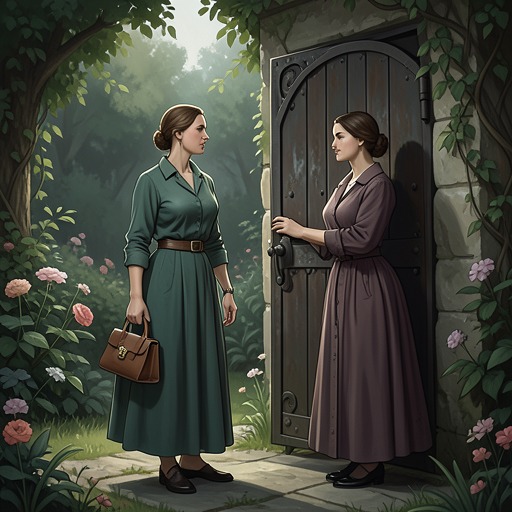
Georgiana and Darcy’s love constrained by poverty
Queen of HeartsGeorgiana and Darcy’s love constrained by poverty is a relationship whose emotional certainty repeatedly meets practical limits. Georgiana has a marriage candidate she wants, and Darcy shares her intention, but neither has money or prospects. Their difficulties are not simply a matter of winning permission to marry: even after Georgiana learns that a royal restriction can be avoided, Darcy insists that he must first be able to provide for her. The result is a romance sustained by mutual attachment but held in suspense by class expectations and financial insecurity.
Identity and Background
Georgiana Rannoch is a young woman of royal connections and limited independence. She is Lady Georgiana, cousin to King George, and describes herself as the daughter of a duke and granddaughter of a princess. Her upbringing has prepared her for the duties and forms of aristocratic life, but not for earning a living. She would like to do useful work and make money, yet sees no acceptable employment open to a young woman of her station. Against that background, marriage is both a personal possibility and an expected social role: she is supposed to marry a Continental prince, though she has avoided the unsuitable princes put before her.
Darcy O’Mara is the man Georgiana hopes to marry. He is an adventurer who leaves for missions in distant parts of the world and does not remain in one place for long. His mobility gives their relationship a recurring practical difficulty: even when they are together, their time can be brief, and his departures make a shared future harder to establish. His own lack of money is not incidental to this separation. He is trying to recover what his father lost, a project that shapes what he believes he must accomplish before marriage.
A Royal Obstacle and a Possible Choice
At first Georgiana believes she may be barred from marrying Darcy because he is Roman Catholic and she is thirty-fifth in the line of succession to the throne. The obstacle is constitutional and personal at once: her royal position, however remote from actual rule, appears to constrain whom she may choose. The proposed solution is for her to renounce her claim to the throne. Georgiana judges that prospect manageable because she considers it unlikely she would ever become queen, and she understands that giving up the claim would leave her free to marry whom she pleased.
That apparent answer does not immediately settle the matter. Georgiana and Darcy have not announced plans to marry, because neither has a penny to their names. The contrast matters: the succession rule can be addressed through a deliberate choice, while poverty has no comparably simple remedy. The conversation takes place while Georgiana is tossing a quoit on deck, an ordinary pause in which the possibility of renouncing her royal claim becomes concrete. Yet even as the legal barrier recedes, the material question remains in place.
Money, Duty, and the Meaning of Provision
Darcy’s financial ambition is tied to a specific loss and a specific vision of restoration. He is trying to make money to compensate for what his father lost, and he hopes one day to buy back the family home and the racing stables. He recognizes that this is a large dream, but he treats it as part of what marriage requires of him. His wish is not merely to marry Georgiana; he wants to restore a family inheritance and establish a home in which he can support her.
Georgiana does not share his sense that a substantial provision must come first. When he says he cannot marry her and set her up in a shabby little flat, she answers that she does not need much. Their disagreement is affectionate but significant: she measures a life together by the relationship, while he measures his readiness partly by whether he can offer material security worthy of her birth. Her title and lineage intensify his sense of responsibility. Darcy tells her that, as the daughter of a duke and granddaughter of a princess, she must either be provided for properly or not at all. His standard turns devotion into postponement: he is not withholding commitment, but insisting that commitment must include a level of provision he cannot yet afford.
Intimacy and an Unsettled Future
The relationship is presented as mutual rather than speculative. Georgiana calls Darcy the man she hopes to marry one day, and she openly resists the idea that she needs the comforts he believes necessary. Darcy responds with tenderness, smoothing a curl from her face and giving her a brief kiss on the forehead before asking her to return to the work at hand. The smallness of the moment sits beside the scale of his ambitions: their affection is present in the immediate scene, while the home, stables, and financial security he imagines remain future goals.
Their circumstances also expose the gap between aristocratic expectation and actual means. Georgiana has a rank that makes ordinary paid work difficult to contemplate, while Darcy’s lost family wealth leaves him striving to rebuild what once belonged to his family. Neither can simply convert social standing into financial independence. The evidence establishes their intention and the conditions delaying marriage, but not a final resolution. Their bond therefore remains defined by a tension between Georgiana’s willingness to begin with little and Darcy’s conviction that love requires him to provide properly before they can begin.