Hollywood, Los Angeles
Queen of HeartsHollywood, Los Angeles, is both the promised destination that helps persuade Claire Daniels to spend six weeks in the United States and the working film environment that complicates her return to acting. For Lady Georgiana Rannoch, arrival brings the thrill of the Hollywood sign and a landscape of pastel villas; for Claire, it means early calls, repeated takes, and a renewed contest with Stella Brightwell. The place’s glamour is real, but so is the industrial pressure beneath it.
Arrival and Setting
Hollywood enters the journey as part of a bargain. Cy Goldman proposes that Claire use the six-week Nevada divorce-residency period to make a picture with him, with accommodation at the Beverly Hills Hotel, Los Angeles, and weekend visits to his hilltop castle. He presents the arrangement as a pleasurable alternative to six weeks in a Reno motel, even suggesting that Claire’s daughter would meet movie stars rather than cowboys. Claire is nervous about the residency requirement, but eventually accepts that the film opportunity sounds better than remaining in Reno.
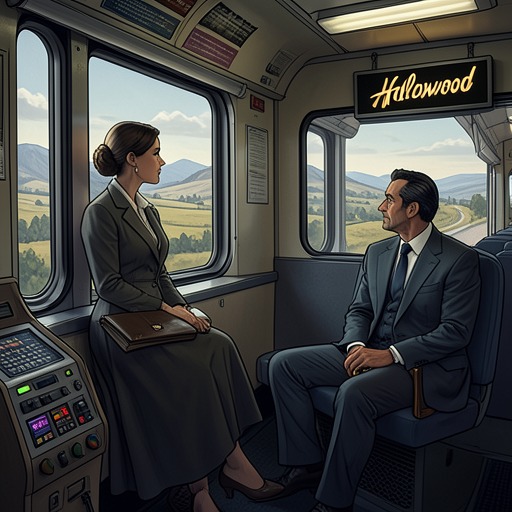
After a couple of days in New York City, Claire and Lady Georgiana are to travel across the country to Hollywood, where Claire may be persuaded to act in a film. The journey makes the destination feel like a change of world. The train crosses the mountains; after a glimpse of San Francisco Bay, the travellers board the Coast Starlight. At first the view consists of golden hills, but after they fall asleep the Pacific Ocean appears beside the train. They arrive at the Los Angeles station, where Ronnie, Cy Goldman’s assistant, meets them. Since Cy is still filming, Ronnie takes charge: he has porters appear, seats the party in a very long black motorcar, and sends the maids and luggage in a taxi.
Lady Georgiana’s first impressions give the destination its vivid surface. From the car she sees pastel villas scattered across wooded hills and the Hollywood sign above them; the sight makes the journey’s promise suddenly tangible. Sunset Boulevard is busy with motorcars and lined with new buildings in bright pastel shades, with a tramline running down its centre. Compared with New York City, the Great Depression seems much less visible. At the Beverly Hills Hotel, Claire responds with pleasure to a pink building framed by palm trees and brilliant tropical plants, a setting that appears almost fantastical after the cross-country trip.
A Film Opportunity and Its Costs
The hotel’s abundance does not mean Claire has arrived for a holiday. Ronnie tells her that Cy wants her on set at six in the morning because filming is already under way. Her final script will arrive later that afternoon, with the next day’s scenes marked. She may order what she likes from the restaurants and bars and sign the charges, a privilege that contrasts sharply with the demanding schedule. Once Ronnie leaves, Claire admits that she does not expect to take to films: she prefers the more civilized routine of the theatre, does not need the money, and has no particular wish to become a film star.
Her reason for accepting the work is personal rather than financial. Claire wants to prove to Stella that she still has her acting ability. The comparison reaches back to their earlier work together: Claire was then the major star of a pantomime, while Stella and her sister were a novelty act, remembered as thin young dancers and acrobats who adored her. Hollywood therefore becomes the stage for a reversal in their professional relationship. Claire’s arrival offers her a chance to demonstrate that she remains compelling, while Stella, now an established screen actress, faces the possibility of being outperformed.
The Studio and the Sound of Acting
The studio scenes expose the difference between theatrical performance and film production. During a scene with Juan, Claire must repeat the same piece thirty-four times. The crew dabs makeup on her between takes, and the work proceeds through repetition rather than the continuous flow she values in theatre. Juan is asked to reduce his Spanish accent and avoid a lisp so audiences in Peoria can understand him. He protests that this is how he speaks and how Spanish men speak; the production’s concern is not simply the actor’s interpretation, but whether his voice fits the expectations of a mass audience.
That demand affects casting and status. Cy considers replacing Juan because of his accent, even while acknowledging his looks and appeal. He tells Stella that her voice is not suited to talkies and warns that Claire will outact her in every scene. Stella, in turn, challenges Cy’s dismissal of Juan and objects to his assumption that money gives him the right to buy everything. When Juan asks whether he is no longer wanted in the picture, Cy points to his contract with Golden Pictures: the actors belong to the studio, and Cy claims the authority to decide when they work. He offers Juan a smaller part and a voice coach, while inviting Darcy O’Mara to take the role of Don Alonso. Hollywood’s promise of opportunity is thus inseparable from the studio’s power to assign roles and define which voices count as commercially usable.
Narrative Significance
Hollywood’s arrival scenes set visual enchantment against practical constraint. The sign, the pastel architecture, the long car, and the hotel’s palms fulfil the glamour anticipated during the journey; the six o’clock call, unfinished script, and thirty-four repetitions reveal the labour concealed by that image. The visible contrast with the depression in New York City further makes the film district seem unusually insulated, without making its working conditions easy.
The place also concentrates the conflict between theatrical experience and the changing demands of film. Claire’s confidence rests on her stage past, but the studio measures performances through repeated takes and evaluates voices according to audience comprehension. Stella’s career anxiety, Juan’s defence of his mother tongue, and Cy’s contractual authority all surface within this production environment. Hollywood is therefore not merely the destination of the cross-country journey: it is where the characters’ ambitions meet the business and technical conditions of the talkies.