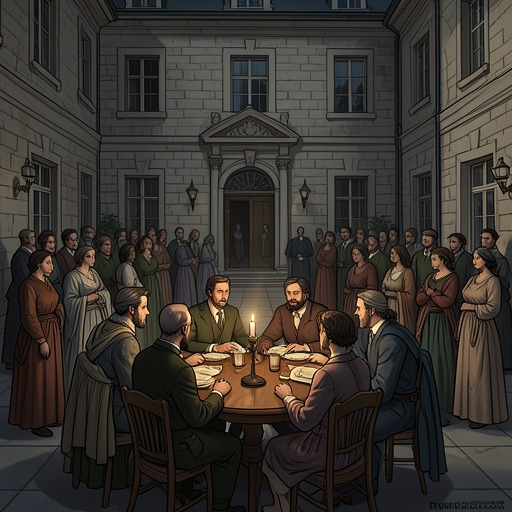
Juan and Cy Goldman
Queen of HeartsJuan and Cy Goldman’s relationship changes from a promised route to Hollywood fame into a collision over a broken bargain and the removal of objects from Juan’s family’s convent. Goldman’s rejection of Juan as a film prospect deepens the disappointment, but Juan identifies the candlesticks taken from the convent as his decisive grievance. He kills Goldman and describes the act as vengeance on behalf of his people, while the circumstances show a deliberate confrontation that ends in sudden violence and a self-justifying confession.
The Promised Opportunity and Its Collapse
Goldman had brought Juan from Spain with the prospect of making him a movie star. Juan believed that fame and the money it might bring could help his family, which was no longer wealthy enough to maintain its hacienda. The offer therefore carried more than professional promise: Juan saw it as a possible answer to his family’s worsening circumstances.
That hope collapsed after Juan arrived. Goldman decided that Juan was not ready for films, disliked his accent, and made fun of it. Juan later described Goldman as having first been polite and enthusiastic, then having proved a liar and a thief. The contrast between the welcome Juan remembered and the treatment he received gives their relationship its personal fracture: the same man who seemed to offer advancement became, in Juan’s account, an exploiter who had deceived him.
The investigation raises another possible dimension to their conflict. Georgiana suggests that Juan and Stella seemed attracted to each other, after considering whether Goldman’s treatment of Juan alone could explain the murder. This is presented as a possibility, not established as a motive. Juan’s own explanation centers instead on the convent’s property and the insult he believed Goldman had done to his culture, religion, and family.
The Convent’s Objects and Juan’s Grievance
Juan’s claim that Goldman was a thief rests on a specific history. The candlesticks had come from the convent where Juan’s great-aunt was mother superior. Juan says his family had sent its women to that convent for centuries, and describes the women there as simple and holy. In his account, the sisters did not understand the objects’ financial value; the convent needed repairs, and Goldman paid them for the candlesticks.
Juan also cites the sale of an El Greco painting for a very small sum. He says Goldman boasted of buying an entire chapel in Spain and planning to ship it to the United States stone by stone, to rebuild it as a bathhouse changing room. To Juan, these examples connected Goldman’s wealth to the conversion of religious and familial heritage into valuable possessions and private display. He says that after learning what Goldman had acquired, he decided to take the convent’s things back and act on the sisters’ behalf.
The disagreement is thus not simply over whether Goldman had legally purchased the candlesticks. Goldman regarded them as his property; Juan rejected that claim as morally invalid, because he believed the sisters had been underpaid and did not understand what they were selling. The object at the center of their final encounter embodies that incompatible judgment: a possession Goldman intends to secure for himself and, to Juan, property taken from a community to which he remains bound.
The Confrontation and Killing
Juan says he pretended to go to bed after dinner, slammed the front door to support that impression, and then entered the library ahead of the others. He waited behind curtains in an alcove. When the other men had left and Goldman was alone, Juan came out to confront him. The account presents the meeting as planned rather than accidental: Juan had arranged to remain at the estate and chose the moment when Goldman was by himself.
Goldman, according to Juan, was friendly and unsuspecting. He offered him a drink and a cigar and said he would first put the candlesticks back in their box and into the safe. Juan responded that he had come on behalf of the sisters of Santa Theresa to take their property back. Goldman answered that the candlesticks now belonged to him and would look better on his dining table than in the convent. Their exchange makes the dispute immediate: Goldman is about to secure the objects, while Juan insists that the transaction did not give him a rightful claim to them.
Juan says he struck Goldman once on the head with a candlestick. He describes being appalled by what he had done, dropping the object, and leaving the library by creeping down the hallway. He hid behind a statue in a niche. When a crash drew everyone else toward the disturbance, he used the confusion to leave and return to bed. These steps explain how he attempted to conceal his presence after first arranging a false appearance of having retired.
Exposure and the Meaning of Juan’s Defense
The investigation links Juan to the killing through his claim that he slept through the whole episode. Georgiana points out that he knew where the body lay, although he could not have seen it from his bed if he had truly been asleep. The contradiction shifts suspicion from the apparent alibi toward the knowledge Juan could have had only by being present. His eventual account confirms that he had hidden in the library and remained at the scene until he could slip away.
When challenged, Juan does not deny killing Goldman. He says Goldman insulted his culture, religion, and family, and maintains that Goldman had taken the convent’s heritage. He expresses no regret and calls his act a defense of his people and country. The sheriff invokes the gas chamber, and Juan responds with defiance; the evidence establishes his attitude toward the threatened punishment, not its eventual outcome.
Juan’s relationship with Goldman is therefore defined by a sharp reversal: an anticipated benefactor becomes, in Juan’s view, both a humiliating employer and a plunderer of sacred property. The narrative gives substance to his grievance through the candlesticks, painting, chapel, and convent, but also shows the boundary he crosses when he turns a claim of restitution into a killing. His certainty that Goldman deserved death remains his own justification, not a resolution of the moral conflict between recovering cultural property and taking a life.