RMS Berengaria
Queen of HeartsRMS Berengaria is the vast ocean liner that carries Georgiana Rannoch and her mother across the Atlantic in July 1934. For Georgiana, who has crossed the Channel but never seen an ocean liner, the ship is at once a spectacle of luxury and a self-contained stage for the voyage’s suspicions: as it nears New York, the search for stolen jewels raises the possibility that a person, as well as a jewel, may have gone overboard.
Identity and History
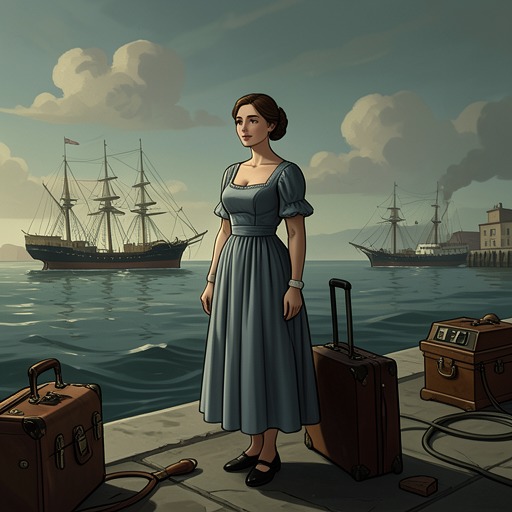
On Thursday, July 12, Georgiana is eager to sail for America and finally sees the liner beside the Southampton departure route. Its three bright red funnels send up wisps of smoke, and its immense size makes her think of the Dorchester. That first view establishes the ship as a world apart from her earlier Channel crossings: its scale is not merely a matter of distance traveled but an immediate, physical impression of grandeur.
The liner’s present identity carries the trace of another nation’s pride. Tubby Halliday explains that it had been a German ship called Imperator, with a portrait of the kaiser once displayed on the grand staircase. After it was handed over as war reparations, the portrait gave way to a nautical scene and the ship was rechristened Berengaria. Its name, Tubby says, is an old-fashioned woman’s name; he jokes that he is glad the name has gone out of style. The ship’s history is thus visible in the replacement of its former imperial decoration, even as its new name gives it a different public identity.
Aboard the Liner
The contrast between Georgiana’s expectations and the vessel’s accommodations makes the crossing’s class distinctions tangible. Having known only a Channel cabin resembling a railway sleeping car, she expects bunks and a washbasin. Instead, her mother’s suite on A deck opens into a spacious sitting room with a sofa, armchairs, a writing desk between two picture windows, thick carpeting, flowers, and champagne on ice. The first-class welcome is exactly the sort of attention her mother expects, and the suite marks the crossing as an experience of comfort rather than simple transport.
The ship’s shared spaces extend that display. Georgiana and Tubby walk through a ballroom and lounge beneath impressive stained-glass skylights before he leads her down the grand central staircase. The interiors make the liner feel almost like a grand hotel afloat, while the staircase also serves as a place where its history is explained: the vanished portrait and the changed name connect present luxury to the consequences of war. Tubby estimates that the Atlantic crossing usually takes five days. He contrasts that pace with ships that have made it in four and says that, after the retirement of the Mauretania, the English lack a record-setting contender until the new Queen Mary is completed.
Voyage, Suspicion, and Arrival
The crossing is not only a passage through the Atlantic but the setting for an unresolved jewel theft. On the final morning aboard, July 16, there have been no new reports of burglaries. As Georgiana helps prepare to go ashore, she realizes how difficult it would be to search everyone thoroughly: a jewel could be hidden in a shoe, among stockings or handkerchiefs, or cut into the pages of a book. The ship’s crowded passage from private suites to public rooms and onward to shore makes concealment seem practical, not merely theoretical.
The approach to New York sharpens that unease. Georgiana sees the skyline and the Statue of Liberty, then notices that the dock is swarming with policemen. The sight prompts her to question whether the police are searching so thoroughly because of the robbery or because her earlier suspicion may be right: the real Princess Promila might have been killed and thrown overboard. She recalls a splash and hair floating in the water, and wonders whether the apparent victim had been dead before entering the sea. The ship’s arrival therefore brings both the promise of America and the threat that the voyage concealed a more serious crime.
Narrative Significance
RMS Berengaria gathers several kinds of evidence into one confined setting: a ship’s changing national identity, the visible privileges of first-class travel, and the practical problem of tracking valuables among passengers. Its scale first inspires Georgiana’s wonder; its enclosed social world then gives her suspicions room to develop. By the time New York’s police come into view, the liner has become more than the means of crossing the ocean: it is the setting in which the distinction between a jewel theft and a possible murder remains unresolved.