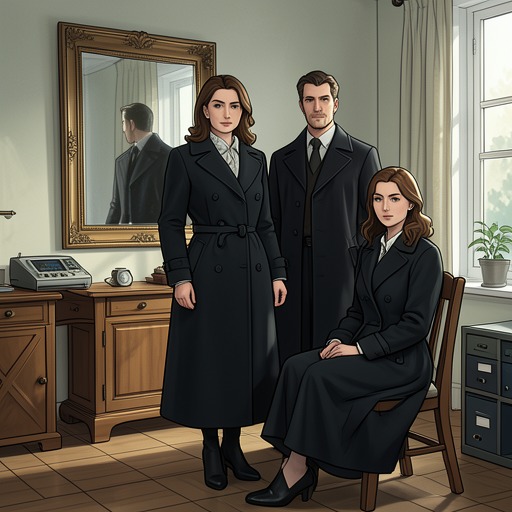
Stella Brightwell’s declining film career
Queen of HeartsStella Brightwell’s declining film career is presented as a collision between changing film technology and an industry in which Cy Goldman can decide who gets a role. Her difficulty with the talkies is not merely a private disappointment: Goldman treats her continued employment as dependent on his support, and the later judgment that her star is waning makes that dependency newly precarious after his death.
A career exposed by the talkies
On the set of Goldman’s historical picture, the work makes the demands of sound production visible. Claire Daniels and Juan repeat a scene while the director calls for adjustments: Juan is told to reduce his accent and avoid a lisp so that audiences will understand him. The scene is performed again and again; during the lunch break, Claire says they have repeated the same passage thirty-four times. The production’s insistence on audible clarity is therefore not abstract. It shapes casting and performance, with an actor’s voice assessed as a condition of being usable on screen.
Stella’s own position is vulnerable to the same change in medium. Goldman tells her that her voice is not really good enough for the talkies and uses that judgment to remind her that he is the person giving her starring roles. His assessment is also backed by the narrator’s account of a scene between Stella and Claire: Claire shines, as she does on stage, while Stella’s voice sounds sharply unpleasant to the narrator. The same observation describes Stella as still looking older than the eighteen-year-old character she is meant to play, despite her makeup. These are the narrator’s impressions of a particular performance, not proof that Stella lacks all ability; within the production, however, they reinforce the weaknesses Goldman uses to question her prospects.
Goldman’s patronage and control
Goldman frames Stella’s employment as a favor that can be withdrawn. After Juan is judged unsuitable for his original part, Stella defends him against Goldman’s dismissal of him as a Spanish peasant, pointing out that he comes from an old family with a castle and accusing Goldman of believing that money lets him take whatever he wants. Goldman answers by pulling her close and warning that without him she is finished. He calls her a has-been, invokes her voice, and asks who else would give her a starring role. His threat turns a production dispute into a reminder that her career rests on his power to hire and cast.
The contrast between that power and Stella’s own limited leverage sharpens when Goldman tells her that Claire will outact her in every scene. Stella tosses her red hair and returns to the studio, while Goldman follows with a smirk. He then appeases her by letting Juan try out for the role of Don Alonso, the dashing Spanish adviser. The casting change does not undo the imbalance: Goldman can accommodate Stella in one decision while continuing to define the terms on which she and others work. Elsewhere, he insists that Juan, Stella, and Craig Hart belong to Golden Pictures under contract and must do as he directs. His control is both personal and institutional, joining the pressure he applies to Stella to the studio’s contractual authority over its performers.
Performance beside the changing industry
Stella’s career is also set against the uneven move from silent films to sound films. Craig, whose comedy was made for silent cinema, says that not everyone makes the transition smoothly; he then assesses Stella as hanging on by her fingertips because Goldman has kept her going. The comparison is pointed without making their careers identical: Craig speaks directly about his own silent-comedy style, while his comment on Stella identifies Goldman’s support as the reason she has remained in the picture business. The exchange presents the coming of sound as an industrial change that can unsettle performers, not as a simple measure of their talent or effort.
The production offers a concrete instance of how that change operates. Goldman first objects to Juan’s accent and voice, then considers bringing in an alternative, and ultimately offers Darcy O’Mara the part of Don Alonso. Juan protests that Goldman has removed him from the picture; Goldman replies that the contract gives the studio control, while promising him a smaller part and work with a voice coach. Stella’s own dependence is less openly framed as a contract dispute, but Goldman’s warning to her reveals the same structure: voice, role, and continued employment are decisions made within a system he controls. Her defense of Juan briefly puts her in opposition to that system, even as Goldman continues to determine her own opportunities.
Decline after Goldman
After Goldman’s death, the question of what his absence means for Stella’s career is raised explicitly. The narrator asks Craig whether Goldman’s death means the end of Stella’s career. Craig does not declare it over; he says instead that her star is definitely on the wane. That distinction matters. The evidence presents a serious decline and the loss of a powerful supporter, but it does not establish that Stella stops acting or that she has no possible future work.
Her earlier role in a film and her later prospects thus form a clear but unresolved trajectory. During production, Goldman can still promise her a starring part while using the threat of replacement to make her comply; after his death, Craig’s assessment leaves her without the same sustaining patronage and with her place in the industry uncertain. Stella’s career decline is consequently shown not as a single dismissal but as a weakening position: the talkies expose a vulnerability in her voice, Goldman’s support temporarily keeps her working, and his absence leaves the downward movement unmistakable without supplying a final verdict.