The Unmasking of Juan as Goldman's Killer
Queen of HeartsThe Unmasking of Juan as Goldman's Killer turns Georgiana Rannoch’s attention to a small inconsistency in Juan’s account and exposes the motive behind Cy Goldman’s death. The accusation grows from what Juan knows about the room, not from a discovered weapon or an eyewitness: Georgiana notices that his knowledge contradicts his claim to have slept through the discovery. A bluff then draws out his confession, revealing that his grievance concerns the removal of religious and cultural property from his family’s convent. Juan admits to the killing, but escapes before Sheriff Billings can take him into custody.
The Clue in the Library
The breakthrough comes as Georgiana revisits the scene in the library. Mrs. Goldman had objected to being questioned in the room where her husband lay dead, and Juan had suggested that the sheriff could draw the curtains over the body. That suggestion gives Georgiana pause. The room was large, the body lay partly beneath the drapes in a window alcove, and Juan had supposedly been asleep when the others discovered it. If he had not seen the body, he had no apparent reason to know its precise location.
Georgiana puts the discrepancy to Sheriff Billings: Juan must have known where the body was because he could not have learned it while asleep in his own bed. The sheriff initially asks why Juan would have wanted to kill Goldman, noting that Goldman had brought him from Spain with the promise of a film career. Georgiana cannot supply a settled motive. She recalls that Juan and Stella Brightwell seemed attracted to one another, but treats that as a possibility rather than an answer. The candlesticks offer another question: perhaps Juan entered the library to steal them. Rather than claim certainty, Georgiana proposes a test of what he knows.
A Bluff Becomes an Interrogation
Georgiana asks the sheriff to watch Juan’s eyes when he enters the library, reasoning that an immediate glance toward the body would support her suspicion that he already knew where it lay. She also suggests that Sheriff Billings tell Juan there is proof he killed Goldman. When the sheriff points out that he has only Georgiana’s word, she recommends a further deception: say that Bella Brightwell saw him. The assertion is designed to unsettle Juan, not to report an actual eyewitness account.
That stratagem draws on a second revelation in Georgiana’s investigation. She had identified the woman impersonating Stella Brightwell as Stella’s sister, Bella, formerly known as Flossie Oldham. Bella had tried to wriggle free when Georgiana named her, and her resemblance to Stella made the impersonation plausible. Bella also admitted taking Princess Promila’s ruby and described using a fake passport to avoid being linked to the theft. When Georgiana asked whether Bella had dressed as Stella and pretended to have entered the princess’s cabin by mistake, Bella’s surprised response confirmed that Georgiana had reconstructed the method. Bella’s proven disguise and theft make her useful to the bluff, but the evidence does not establish that she witnessed Goldman’s killing.
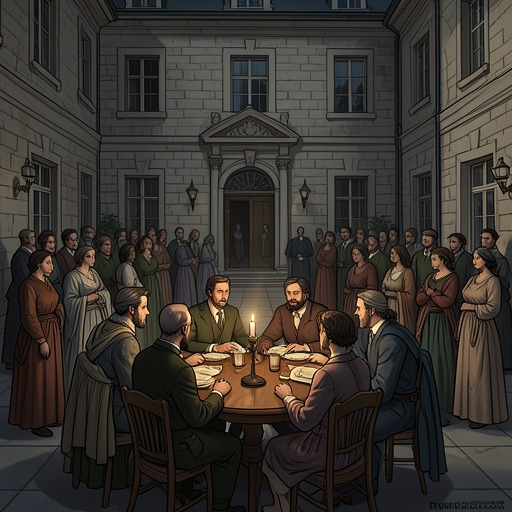
Juan arrives angry that he has been brought from bed without time to wash, shave, or dress. He complains that the authorities treat him disrespectfully because he is a foreigner and accuses them of looking for a scapegoat. Sheriff Billings answers that he knows Juan killed Goldman and claims that someone saw the crime. He then steps aside to reveal Bella. Juan immediately recognizes that she is not Stella and asks who she is. Georgiana identifies Bella as Stella’s sister and explains that she came to steal the candlesticks. The confrontation has made the false eyewitness claim concrete enough to provoke Juan, while leaving the sheriff’s actual evidence unchanged.
Juan’s Account of the Motive
Juan first resists the accusation that he could have reached the library by climbing down the wall. When Bella offers to demonstrate, his defiance gives way to an admission: he says Goldman deserved to die for insulting his culture, religion, and family. He recounts how Goldman had promised to make him a star in Spain. Juan believed fame and money would help his family, which could no longer afford to run its hacienda. In America, he says, he discovered that Goldman had deceived him.
The grievance Juan describes is larger than a failed career promise. Goldman had bought candlesticks from a convent associated with Juan’s great-aunt, who was its mother superior. Juan says that women in his family had entered the convent for centuries, and that the sisters, simple and devout, did not understand the value of what they sold. The convent needed repairs; it also sold an El Greco painting for little, seeing it as a Madonna with child rather than recognizing the artist’s name. Juan further says Goldman boasted of buying a chapel in Spain and planning to ship it to America, stone by stone, to rebuild it as a bathhouse. Juan interprets these transactions not as ordinary purchases but as the theft of his heritage. He says he intended to take back what Goldman had taken from the sisters and to do justice on their behalf.
The Killing and the Escape
Juan admits that he only pretended to go to bed after dinner. He says he slammed the front door to make it seem that he had left, then entered the library ahead of the others and waited behind curtains in an alcove. Once the other men had gone and Goldman was alone, Juan emerged to confront him. Goldman, according to Juan’s account, was friendly and unafraid; he offered him a drink and a cigar while preparing to put the candlesticks back in their box and into the safe. Juan demanded their return on behalf of the sisters of Santa Theresa. Goldman refused, insisting that the candlesticks were his and would look better on his dining table than in the convent chapel.
Juan says he struck Goldman once with a candlestick and then dropped it, appalled by what he had done. He describes slipping into the hallway and hiding behind a statue in a niche. When a crash drew everyone else away, he took the opportunity to leave and went back to bed. His account resolves the earlier puzzle: Juan knew the body’s location because he had been in the library, concealed in the alcove, before the discovery. It also transforms Georgiana’s tentative inference into a confession that supplies both the concealed route and Juan’s stated motive.
The confession does not end in arrest. Sheriff Billings warns Juan that he will face the gas chamber, but Juan rejects the threat, spits on the marble floor, and runs out through the open front door. Those present are stunned; the sheriff recovers and says deputies will bring dogs to track him. The event therefore ends with the murderer identified and his account exposed, but with his immediate whereabouts unknown. The reversal is characteristic of the episode’s investigative tension: careful attention uncovers the truth, while the delay between recognition and custody gives the revealed killer a chance to escape.