
Bharata’s Refusal of the Throne
RamayanaThis thread follows Bharat’s rejection of the kingship obtained through Kaikeyí’s scheme and his effort to restore Ráma’s rightful place.
increasing Bearing strength in each event
 decreasing
Bearing strength in each eventdecreasingThe News from Ayodhya

The News from Ayodhya
A return to grief
Bharat returns to Ayodhyá and learns that Daśaratha has died and Ráma has been exiled. Kaikeyí presents the throne as a reward for her plans, but Bharat receives the news as a family catastrophe.
Refusing the gain
He condemns his mother’s actions and declares that he did not seek the kingdom. His refusal makes clear that political advantage cannot replace the absent heir’s moral claim.
The Sandals as Authority
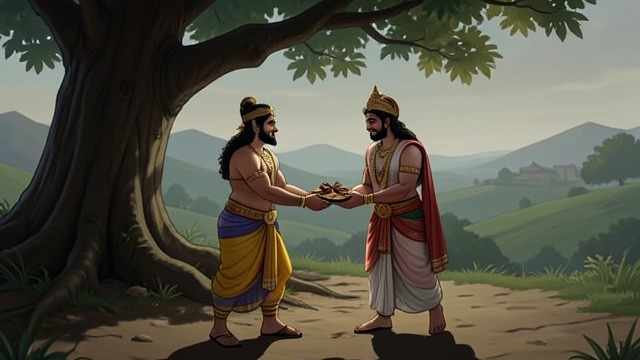
The Sandals as Authority
A failed appeal
Bharat reaches Ráma and asks him to come home, but Ráma holds to their father’s decree. Their dispute is not a contest for power: both brothers seek to honor the same family obligation.
Rule in trust
Ráma gives Bharat his sandals, and Bharat accepts them as the sign of Ráma’s sovereignty. He returns to Nandigrám and governs as a caretaker rather than claiming the throne for himself.
The Regent’s Vigil
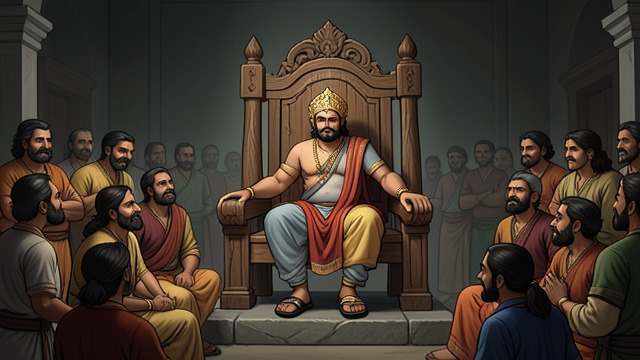
The Regent’s Vigil
A provisional court
Bharat lives austerely at Nandigrám and places the sandals on the royal seat. His political role is deliberately limited: authority remains symbolically with Ráma.
Loyalty made practical
He administers the kingdom while waiting for his brother’s return. The arrangement turns fraternal devotion into a working model of restrained government.
After Daśaratha’s death, while Bharat is away in Kekaya
At Chitrakúṭa, when Ráma refuses to return
During Ráma’s remaining years of exile
