Inspector Boyne
Rear WindowInspector Boyne is the police investigator Hal Jeffries turns to when a series of disturbances in Lars Thorwald’s household begins to suggest that Thorwald’s wife has disappeared. Boyne’s role is shaped by the gap between Jeffries’s accumulating suspicions and the evidence the police can verify: he first tests the claims cautiously, then helps uncover the physical evidence that resolves the case, while acknowledging that he too was slow to recognize a crucial inconsistency.
Identity and Introduction
When Jeffries decides that the trunk sent out from Thorwald’s apartment is part of a possible crime, he chooses Boyne because he understands him to be on Homicide, at least when they last met. Jeffries wants to avoid drawing in a group of unfamiliar officers or becoming more involved than necessary, so he calls his old acquaintance directly. Boyne greets him warmly, joking about how long it has been since they were in touch, before Jeffries asks him to record Thorwald’s name and address at 525 Benedict Avenue, fourth-floor rear.
The request is pointedly limited. Jeffries offers a firm belief that police investigation will uncover a murder, but admits he has little more than a conviction to provide. He asks Boyne to determine whether anyone actually saw Thorwald’s wife leave, rather than treating the trunk’s departure as proof that she did. Boyne thus enters the case as both a trusted contact and the official investigator who must distinguish a plausible suspicion from supportable evidence.
Investigation and Conflicting Accounts
Boyne calls back at three o’clock seeking more than Jeffries’s bare allegation. He reports that a man has made inquiries and that the building superintendent and several neighbors agree Thorwald’s wife left for the country the previous morning to recover her health. Jeffries immediately asks whether any of them saw her go. Boyne says they did not. The report that Thorwald had bought a ticket and seen her onto a train is also indirect: it comes from someone who encountered him returning from the depot, not from an eyewitness to the wife’s departure.
A postcard appears to strengthen the account. Boyne tells Jeffries that police retrieved it from Thorwald’s mailbox with bent pins; it purports to come from Anna, writing from a farm up-country, and says she has arrived and is feeling better. Jeffries presses him about the date. Boyne concedes that the postmark’s year is blurred, though the month and time remain legible as August at 7:30 p.m. The card’s message and its uncertain date cannot establish when it was written or how it reached the mailbox. Boyne nevertheless regards the accumulated reports as a reason for Jeffries to give up his theory, telling him he is going too far.
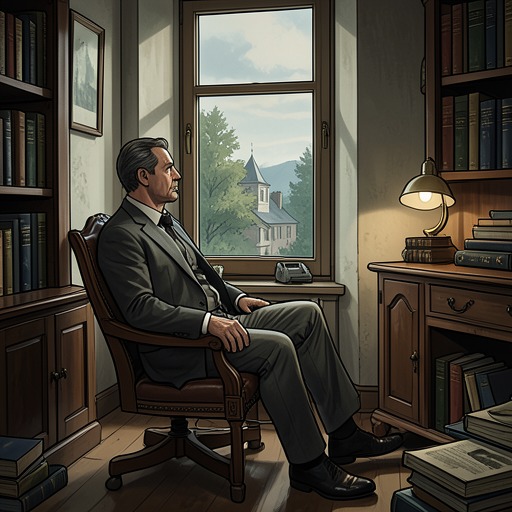
Jeffries’s view of the apartment provides a counterpoint to the police inquiries. Even after the postcard report, he sees Thorwald remain in the living room rather than use either of the two beds in the bedroom. The novel presents Boyne’s investigation through Jeffries’s limited, window-bound perspective: the officer’s reports are available, but the behavior Jeffries watches continues to trouble him. The difference is not simply between belief and disbelief; it is between a story repeated by neighbors and details that Jeffries considers inconsistent with that story.
Confrontation with Jeffries
Boyne visits Jeffries in person the following day, entering behind Sam without waiting for a cordial welcome. He is angry that Jeffries has sent his men on what he regards as a wild-goose chase and says he is relieved he did not go further by having Thorwald brought in for questioning. His reaction makes the practical cost of Jeffries’s unsupported accusation explicit: police time has been spent, and a suspect might have been detained without sufficient grounds.
Yet Boyne’s rebuke does not end the inquiry. The case turns again when Jeffries notices a vertical jump in the apparent alignment of Thorwald and the renting agent as they move between windows. He interprets the discrepancy as evidence that something lies beneath the unfinished apartment’s raised kitchen floor. In the dark, he calls Boyne’s precinct house and insists that the police investigate the cement. Boyne is present when Thorwald reaches the roof during his escape; he says he almost hates to act because Thorwald has so far to fall, then fires. Thorwald falls to his death.
Discovery and Reassessment
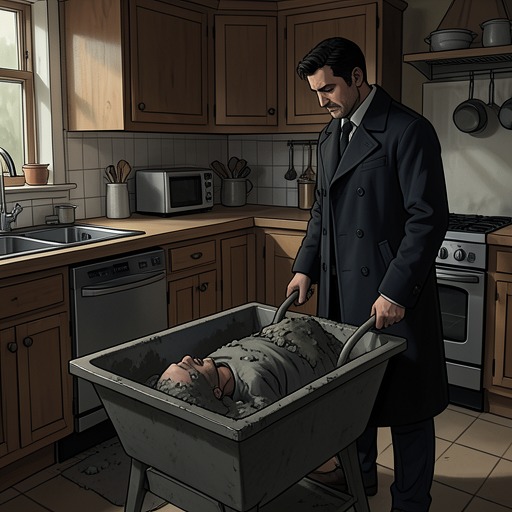
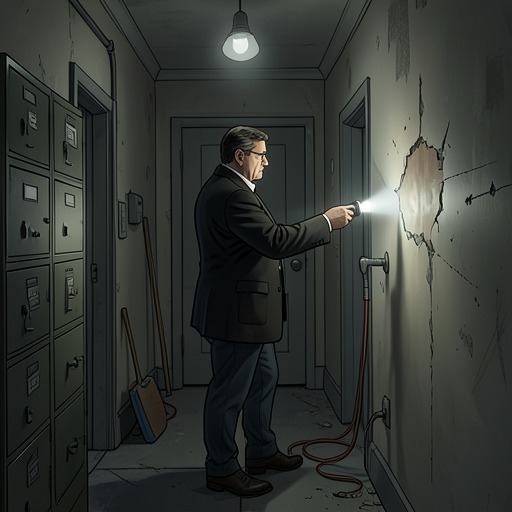
Jeffries tells Boyne to examine the cement kitchen floor in the fifth-floor apartment above Thorwald’s. The apartment is still under construction, and the raised floor has been built to meet fire regulations while creating a dropped living-room effect at low cost. Boyne goes there immediately, taking a route through the basement and over fences to save time. Because electricity has not yet been connected, officers use torches. Within about half an hour, Boyne signals from the window that the search has confirmed Jeffries’s deduction.
Boyne returns to Jeffries close to eight the next morning, after the bodies have been removed. He withdraws his earlier blame of the man sent to investigate the trunk, explaining that the officer had been instructed to check its contents, not verify the wife’s description. The officer had mentioned the description generally, but Boyne himself only later remembered that a tenant questioned two days before had supplied details that disagreed with it on important points. Boyne accepts responsibility for missing the discrepancy, calling his own recognition slow; Jeffries says that delayed recognition had marked the investigation for him as well.
Narrative Role and Significance
Boyne gives the story’s private observations an institutional counterpart. His inquiries produce information, but the initial reports depend on what neighbors say and on a postcard whose date cannot be securely established. Jeffries treats those weaknesses as reasons to keep testing the account; Boyne initially treats them, alongside the consistent neighborhood story, as insufficient grounds to pursue the murder theory. The eventual discovery beneath the raised floor supplies the physical confirmation neither the reported departure nor the postcard could provide.
His arc does not make him a flawless detective or a simple obstacle. He is willing to investigate, insists on more than an unsupported assertion, and finally acts on Jeffries’s concrete explanation. At the same time, his late recollection of the tenant’s conflicting description shows that official investigation can also be slowed by missed details. The repeated idea of delayed recognition links Boyne’s admission to Jeffries’s method: both reach the decisive understanding only after earlier clues have had time to connect.