Jeff's Apartment
Rear WindowJeff's Apartment is both Hal Jeffries's home and the fixed observation post from which he investigates Lars Thorwald. With movement limited to the path between his bed and window, Jeffries turns the rear-facing bay window into a means of reading the neighboring apartments. The view eventually yields the crucial clue to the concealed body, but the apartment's confinement also leaves him unable to flee when danger crosses into his own home.
Setting and Physical Limits
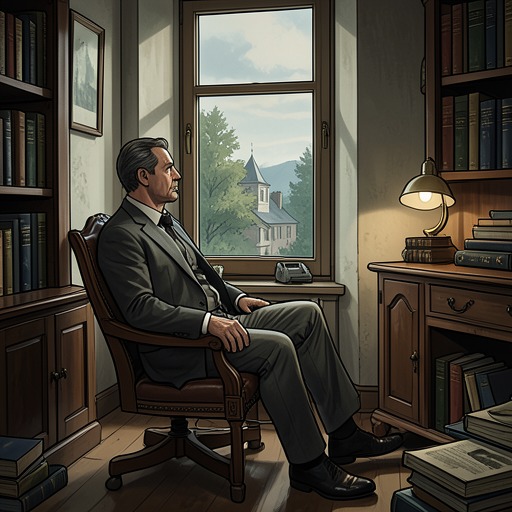
Jeffries's rear bedroom opens onto a bay window overlooking the hollow square formed by the backs of the surrounding houses at 525 Benedict Avenue. In warm weather, the window is one of the room's best features, but it has no screen: Jeffries must sit with the light out to keep insects from entering. His physical movements are strictly limited to going from the window to the bed and back. Unable to get the exercise he is accustomed to, unable to sleep, and not in the habit of reading, he watches the neighboring windows instead.
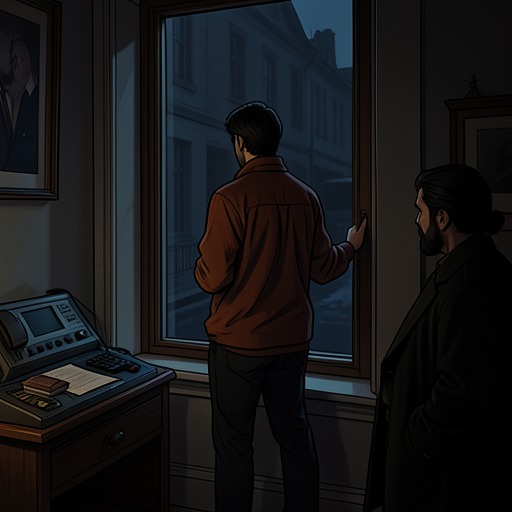
The room's layout shapes how he observes. In the early morning, when Lars Thorwald scans the rear windows in a slow sweep, Jeffries recognizes that the man may eventually look toward his own side of the courtyard. He withdraws several yards into the room, where the remaining blue night light conceals his movement, and returns to the window after Thorwald has gone. The episode establishes a characteristic tension in the apartment: Jeffries can see across the courtyard, but he must also manage the possibility of being seen.
A Window onto the Neighborhood
From the bay window, Jeffries learns to distinguish recurring patterns in the lives behind the opposite windows. He watches their comings and goings closely enough to imagine a timetable of their habits, although the distance is too great for him to identify faces or hear voices. The apartment therefore offers a view rich in repeated gesture and routine, but incomplete in precisely the ways that make interpretation uncertain.
That view becomes an investigative instrument when Jeffries watches men enter Thorwald's apartment after Thorwald leaves. From his own window, he sees them search the bedroom, kitchen, and living room, then hurry out when Thorwald appears to be returning. They find nothing incriminating; by then, the trunk has gone. The apartment's distance from the scene permits Jeffries to watch the search unfold, but it does not give him direct access to what the searchers cannot find.
The same vantage point later brings an accidental alignment into view. A landlord and prospective tenant move through the windows of the sixth-floor apartment while Thorwald moves through those of the fourth; after both pass behind a wall, they reappear at kitchen windows, one above the other. Jeffries senses that something in the apparent synchronization is wrong, though at first he cannot recover what disturbed him. The view preserves a spatial comparison he does not immediately understand, allowing the apartment to function as a place where evidence can be observed before its meaning becomes clear.
The Apartment as an Investigative Base
Jeffries uses his home not only to watch but also to direct action outside it. After the police search has failed to find evidence, he calls Sam in and asks him to enter Thorwald's fourth-floor apartment by way of the fire escape. Jeffries gives him his wristwatch and sets a twenty-five-minute limit, instructing him to disturb the rugs, furniture, and closet doors so that the rooms will show signs of entry. From the window, Jeffries watches Sam cross the fences, reach the fire escape, and get inside. He cannot follow or protect him; he remains behind the scenes, watching while the risk belongs to someone else.
The apartment's immobility thus becomes operational as well as frustrating. Jeffries can coordinate a timed intervention from his chair, but cannot serve as lookout on the ground or shield Sam. His position grants a broad view of the courtyard while leaving him dependent on other people to move through it. Later, that dependence becomes more dangerous: when Jeffries realizes that Thorwald may be inside the house, he knows he cannot get out of his chair or summon help quickly enough to make a difference.
The Clue in the Vertical View
The decisive deduction also begins at Jeffries's window. Recalling the landlord and tenant's movement alongside Thorwald's, Jeffries finally identifies the flaw he had noticed: the paths did not remain parallel. There had been an upward jump. The crucial discrepancy was vertical, not horizontal, and the several floors visible from his apartment turn that small visual irregularity into a clue about where to search.
Jeffries tells Inspector Boyne that Anna Thorwald's body is in the unfinished fifth-floor apartment above Lars Thorwald's. He identifies the cement kitchen floor, raised above the level of the other rooms, as the place to dig. The proposed floor had been built to meet fire regulations while creating a dropped living-room effect cheaply; its height, read against the stacked apartments Jeffries had watched, explains the apparent jump. Boyne crosses the fences and searches the unpowered apartment by flashlight. About half an hour later, he signals from the window that the body has been found. Jeffries's home has supplied not a view into the apartment where the body lies, but the spatial comparison that makes its concealment legible.
From Observation Post to Trap
The apartment's protection is only the protection of distance. After Jeffries calls Boyne, the telephone line is cut somewhere inside the house, and Jeffries realizes that death is now within the building. He is unable to rise from his chair; shouting to the neighboring residents might bring them to their windows but not to his aid in time. The darkness that had helped him observe without being noticed now intensifies his isolation, while the familiar layout offers no weapon within reach.
When the intruder fires, the flash briefly lights the room and the bust above the books breaks against Jeffries's shoulder. The attacker then moves toward the window, looking for a way out. In the apartment where Jeffries has spent the story converting restricted movement into a form of surveillance, he is finally reduced to the same helplessness that the window had made him forget. Yet the view has already done its work: the apartment has linked his immobility to the discovery of the concealed body, even as its exposed position makes him vulnerable to the man he watched.