Lars Thorwald
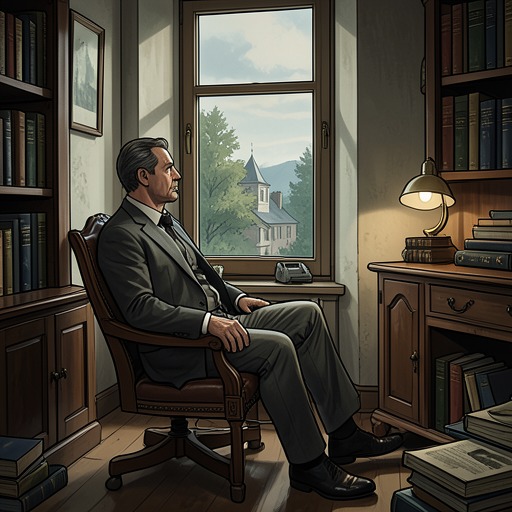
Rear WindowLars Thorwald is identified as a husband living with his wife in the rear apartment on the fourth floor of 525 Benedict Avenue. When she disappears and her trunk is sent away, Hal Jeffries suspects that Thorwald has murdered her. The case turns on a concealed body in an upstairs apartment, while the proposed motive and sequence of events remain, at first, Hal’s reconstruction rather than established fact.
Identity and Introduction
Sam supplies the address and identifies the residents as Mr. and Mrs. Lars Thorwald. The couple’s shared home is therefore established before the suspicions against Thorwald are fully laid out. Later, Hal tells Inspector Boyne that the household has changed: a man and wife had been living there, but now only the man remains.
The trunk’s departure is one of the details Hal gives Inspector Boyne as grounds for investigating. He asks whether anyone saw Thorwald’s wife leave in person, distinguishing the movement of her belongings from proof that she herself had gone. The distinction matters: the apparent departure may be a cover, and Thorwald’s continued presence in the apartment becomes part of the puzzle.
Suspicion and the Clues
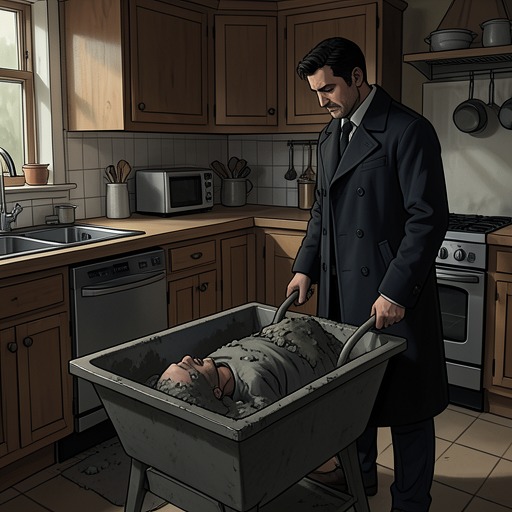
Hal’s suspicion develops through observations about the apartment and the movements associated with it. He eventually identifies an upstairs apartment still undergoing work, where the Cement Kitchen Floor in the Fifth-Floor Apartment had been raised. He links that construction detail to the apparent change in height between Thorwald and the renting agent when each is seen at a kitchen window, contrasting it with their relative height at the living-room windows. The clue gives the altered floor a second meaning: it may conceal something beneath its surface.
The floor does not, by itself, establish Thorwald’s guilt or explain what happened to his wife. Hal presents the construction detail to Inspector Boyne as the basis for searching the unfinished apartment, directing him to dig up the raised cement kitchen floor. The inference becomes testable through a physical search rather than remaining only a theory formed from watching the building.
Hal’s Reconstruction of the Crime
Hal’s later account proposes a motive and sequence, but explicitly labels the explanation conjecture. He reasons that Thorwald’s wife had been in poor health for years and that Thorwald had been out of work; he further suspects that Thorwald had become dissatisfied with both circumstances and had met another woman. These elements are offered as Hal’s explanation, not as independently confirmed facts about Thorwald’s private thoughts or relationships.
In Hal’s theory, Thorwald may have insured his wife for as much as possible and tried to poison her gradually. Hal imagines that she discovered the attempt on the night the apartment light remained on, and that Thorwald then killed her in a way that differed from his supposed original plan. He proposes that Thorwald took advantage of the newly laid but unfinished floor in the apartment above, concealed her body there, and covered it with fresh cement. The raised floor that first seemed an architectural oddity thus becomes, in Hal’s reconstruction, a makeshift hiding place.
Hal also conjectures that Thorwald arranged a false account of his wife’s departure: he sent her trunk and its keys away with an accomplice, used a previously sent postcard to suggest she had left, and intended for her death to be attributed to suicide at a later date. The account connects the trunk, the postcard, and the concealed body into one proposed deception. Its details remain part of Hal’s explanatory theory; the decisive confirmation comes from the search of the floor.
Discovery and Ending
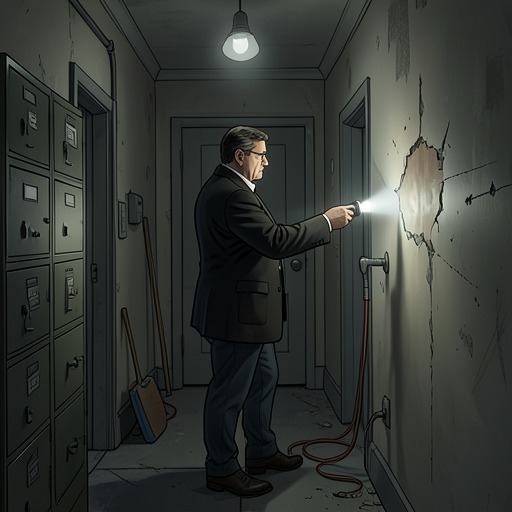
Inspector Boyne goes to the upstairs apartment and has it searched by flashlight because its electricity has not yet been turned on. About half an hour later, he signals to Hal that the search has confirmed the suspicion. The police later recover Anna Thorwald’s body, establishing that she had not simply left with her trunk.
Thorwald does not survive the investigation. After standing on a parapet, he drops his gun and falls while trying to escape, dying after landing below. The ending joins the two discoveries that resolve the case: the body beneath the floor confirms what happened to his wife, and Thorwald’s death closes the pursuit. Inspector Boyne later acknowledges that an earlier check focused on the trunk’s contents rather than carefully verifying the woman’s description, a lapse that delayed recognition of the deception.
Narrative Role
Thorwald is defined in the account through the gap between appearances and evidence. A husband remains in the apartment after his wife’s trunk has gone; an apparently ordinary renovation conceals the clue that exposes the crime. Hal’s uncertain deductions drive the investigation, but the search and recovery of the body distinguish suspicion from confirmation. Thorwald’s characterization is therefore presented chiefly through the traces of his actions and the competing explanations those traces invite, rather than through direct access to his thoughts.