Motion attracts
Rear Window“Motion attracts” names a danger built into watching: the observer who studies movement may become visible through movement in turn. The expression first sharpens Hal Jeffries’s reading of Lars Thorwald’s repeated survey of the rear windows, then takes on greater force when Thorwald’s glance lands directly on Jeffries’s dark bay window. Its significance lies in that reversal: looking is not a safely one-way act, and a small gesture can disclose attention before its meaning is understood.
First Formulation: Watching Without Moving
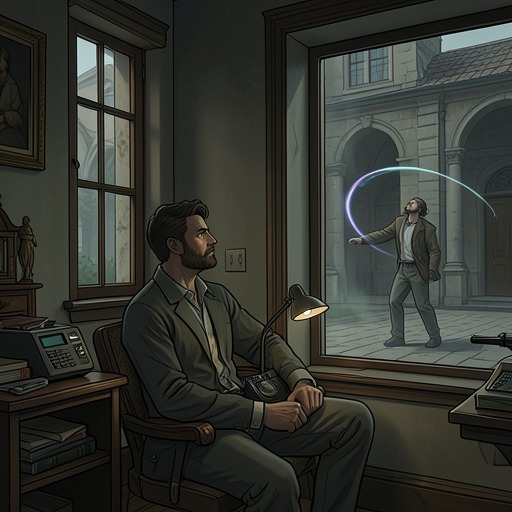
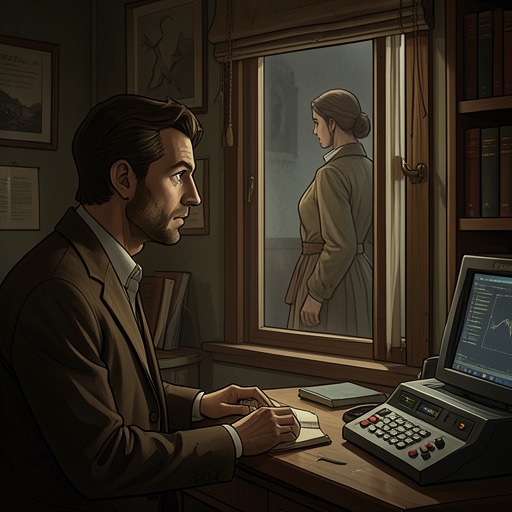
Jeffries formulates the expression while Thorwald stands at a window and slowly sweeps his gaze across the rearward windows. The scene is organized around a contrast between stillness and motion. Thorwald’s head makes a continuous, almost microscopic shift in direction; Jeffries, hidden in the darkness of his bay window, deliberately remains immobile until the distant glance has passed. The sweep is not merely something he sees. It is a movement whose possible consequence shapes his own conduct.
The sentence arrives after Jeffries has tried to account for Thorwald’s behavior as concern for his wife. Thorwald appears preoccupied, but does not go to check on her; then his attention lifts and begins another circuit of the windows. Jeffries notices the gap between the possible inward motive and its outward signs, and the renewed scan makes that discrepancy harder to dismiss. “Motion attracts” condenses the practical lesson of the moment: to observe without being noticed, Jeffries must control his own visible movements even as he tracks Thorwald’s.
The Observer Enters the Pattern
The expression also carries an uncomfortable self-implication. Jeffries is not only watching Thorwald watch the windows; he recognizes that he, too, is looking into other people’s rooms. His attention briefly turns from Thorwald’s apparent interest in the neighbors to the likeness between their acts of looking. Yet he marks a difference: he believes Thorwald is worried, whereas he himself is not worried about anything. That distinction helps him interpret Thorwald’s attention, but it does not remove the structural resemblance between the two watchers.
The scene therefore makes motion a risk shared by both sides rather than a simple clue belonging to one suspect. Thorwald’s head traces a cautious circuit; Jeffries’s safety depends on holding still inside the darkness. His self-awareness does not dissolve the suspense. Instead, it makes his position more exposed in thought: he knows that he is participating in the same practice of watching that he is trying to interpret, while relying on concealment to keep that practice one-sided.
The Glance at the Bay Window
Later, the idea becomes more threatening when Thorwald briefly turns on a light, apparently to locate something, switches it off, and glances out as he passes the window. This look differs from the earlier precautionary sweeps. Rather than beginning elsewhere and traveling around the panorama, it lands for an instant at the center of Jeffries’s bay window. The direction is specific; the duration is fleeting. The combination makes the glance difficult to classify but impossible to treat as an ordinary repetition of the earlier scan.
Jeffries initially resists what the look might mean, treating the direct alignment as an accidental bull’s-eye. The narration then gathers several details that have not yet fused into a conclusion: a wordless telephone ring, a stretch of darkness in which the two men might be stalking one another’s window squares, the last flicker of light, and the parting glance fixed on Jeffries’s window. Jeffries’s eyes register these incidents before his mind gives them a settled meaning. The expression thus returns as a narrative principle as well as a rule of concealment: a gesture may attract attention, but its significance can arrive late.
From Maxim to Suspense
The movement in the expression is not limited to a person crossing a room. A slight turn of the head, a passing glance, or a brief light can become legible against the stillness of the surrounding windows. The earlier scene emphasizes Jeffries’s disciplined immobility; the later one makes the danger reciprocal, as Thorwald’s targeted look suggests that the watcher may himself have been noticed. What had seemed a general explanation for how attention is drawn becomes a question of who has detected whom.
The phrase’s compactness contrasts with Jeffries’s delayed interpretation. It sounds like a rule he can apply immediately, yet the later sequence shows how little a rule alone can settle: the glance is unmistakably directed toward his window, but its intention is not at first admitted or understood. In this way, “Motion attracts” links physical vigilance to the story’s uncertainty. Observation produces evidence in small, visible increments, while recognition lags behind; the gaze that once seemed to belong to the observer may already have turned back toward him.