Police Find Anna's Body in the Upstairs Apartment
Rear WindowPolice Find Anna's Body in the Upstairs Apartment is the decisive discovery that confirms where Anna Thorwald was hidden and explains why the earlier search of Lars Thorwald's apartment found nothing. Hal Jeffries directs Inspector Boyne to an unfinished apartment above Lars Thorwald's; the police investigate its raised cement kitchen floor and confirm the concealed body there.
The Clue in the Building's Vertical Layout
Earlier, police had thoroughly searched Lars Thorwald's apartment while he was out, examining the bedroom, kitchen, and living room. They found nothing incriminating and left before he returned. The fruitless search matters because it establishes that the answer is not in the rooms already examined: the body is concealed elsewhere in the building.
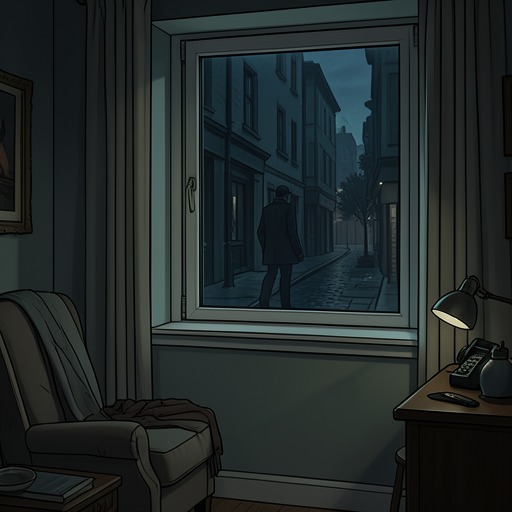
Hal Jeffries's eventual lead comes from an accidental alignment at the rear windows. A landlord and prospective tenant look through the finished sixth-floor apartment while Lars Thorwald is visible two floors below, in his own apartment. Both move from their living-room windows toward their kitchens, disappearing briefly behind a blind section of wall. Hal Jeffries recalls that their reappearance contains a vertical hitch, an upward jump. The discrepancy, rather than their timing, signals that Lars Thorwald's movement does not match the others'.
The observation had bothered Hal Jeffries since midafternoon, but its meaning arrives only later, in another instance of what he calls delayed action. Once the spatial mismatch clicks into place, he concludes that the missing body is in the apartment between Lars Thorwald's and the sixth-floor unit: the unfinished Rear Apartment on the Fifth Floor at 525 Benedict Avenue. He tells Inspector Boyne to investigate its cement kitchen floor.
Search of the Unfinished Apartment
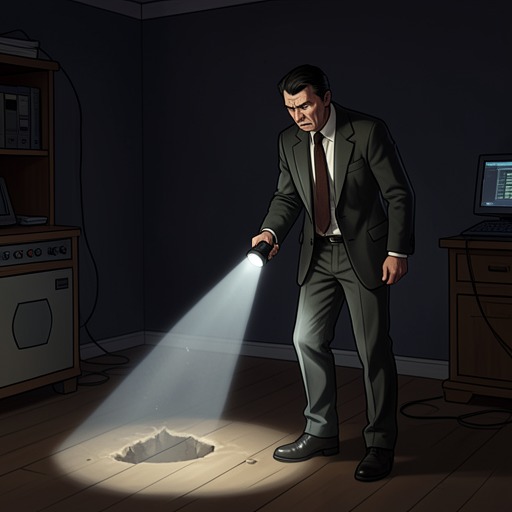
Inspector Boyne acts immediately, going through the basement and across the fences to reach the apartment without delay. The electricity has not yet been connected, so the officers use torches. Their search is brief once they begin examining the floor: about half an hour later, Inspector Boyne signals Hal Jeffries from the window to confirm that the inference was correct.
The construction detail makes the hiding place intelligible. The kitchen's cement floor is raised above the level of the other rooms, a feature intended to meet fire regulations while creating a dropped living-room effect cheaply. The raised surface is not an incidental irregularity: it is the concealed space Hal Jeffries identifies as the place to search. The body is found beneath it, outside the apartment the police had previously searched.
Confirmation and Consequences
Inspector Boyne does not return to Hal Jeffries until nearly eight the next morning, after the police have tidied the apartment and taken away both Anna Thorwald's body and Lars Thorwald's body. The discovery thus closes two linked searches: it locates the woman whose absence prompted Hal Jeffries's suspicions and follows the death of the man he had been trying to expose.
Inspector Boyne also acknowledges that the investigation had missed a discrepancy in details supplied by a tenant questioned earlier. An officer sent to check the trunk had not been instructed to verify the woman's description, and Inspector Boyne says that he himself only recognized the inconsistency after going home. His admission echoes Hal Jeffries's experience of delayed recognition: in both cases, information was available before its significance fully registered.
Significance
The discovery turns the building's arrangement into evidence. The first search is not defeated by a lack of thoroughness within Lars Thorwald's rooms; it fails because the crucial hiding place lies one floor above, in a space still under construction. Rear windows, a blind spot, the vertical relation between apartments, and the raised kitchen floor together make the location legible.
The confirmation also gives material force to Hal Jeffries's method of watching and revising his conclusions. A small flaw in an apparently ordinary pattern of movement supplies the missing direction; the unfinished floor then converts that inference into proof. The case is resolved not by finding the body where suspicion first focused, but by reading the spaces between the observed rooms.