Police Search of Thorwald's Apartment Finds No Evidence
Rear WindowPolice Search of Thorwald's Apartment Finds No Evidence is a failed early test of Hal Jeffries’s suspicion that Lars Thorwald has harmed his wife. The search turns on a gap between private observation and verifiable proof: Jeffries sees a pattern of domestic habits break apart, but the police find neither evidence in the apartment nor a reliable witness to the wife’s departure. The investigation appears to close, even as the unexplained details remain in view.
Suspicion and the Decision to Search
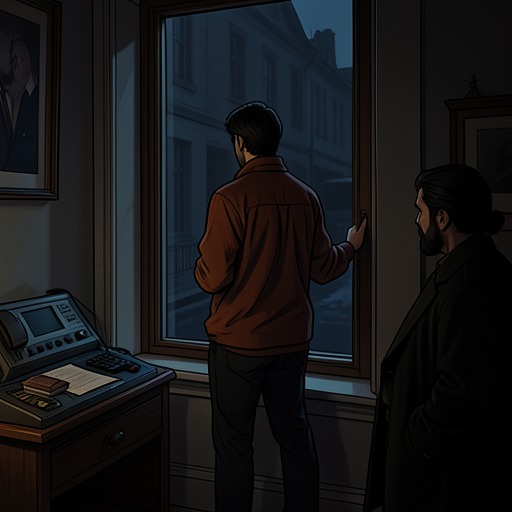
The suspicions began with an ordinary routine. From across the courtyard at 525 Benedict Avenue, Jeffries watched the neighboring flats settle into their familiar evening patterns: lights came on, distant sounds carried between windows, and residents repeated small daily rituals. Against that background, the stillness at Thorwald’s apartment became conspicuous. Its shades stayed in the same positions through the day, and Jeffries realized that he had not seen Thorwald’s wife. When Thorwald returned, he kept his hat on and did not go to greet her. The expected exchange between husband and wife did not happen, and the familiar routine no longer explained what Jeffries could see.
For a time, the clues admitted innocent explanations. The wife might be ill; the packed Thorwald's Trunk might mean she was being sent away to recover. But Thorwald’s conduct continued to trouble Jeffries. He delayed entering the bedroom, then searched it in a way that suggested to Jeffries that he was looking through an empty room; the beds were unoccupied. The observation transformed a diffuse uneasiness into a conviction, though Jeffries recognized that he had not witnessed a crime. He called Inspector Boyne with a name, an address, and a request for investigation, explicitly distinguishing his belief from proof. His case rested on disrupted habits and the absence of the woman, not on a direct sighting of what had happened to her.
The Apartment Is Examined
After Lars Thorwald left that evening, two men entered the apartment he had just vacated. They separated and searched from opposite ends: one began in the bedroom, the other in the kitchen, and they worked toward one another. They then examined the living room together, each covering a side. Jeffries watched their movements from across the courtyard, following a search he could observe but not influence.
The men completed their examination before the warning that Thorwald was returning reached them. They straightened, faced one another in visible frustration, and then turned sharply as if alerted by the doorbell. They left quickly. The search had been thorough in its coverage of the rooms, but it produced nothing that they could take as incriminating evidence. Jeffries had expected this possibility: Thorwald's Trunk had already gone, and Jeffries’s own suspicion depended on interpreting behavior rather than finding an obvious object in the apartment. Thorwald returned carrying a large paper bag and apparently did not discover that anyone had entered.
Statements and the Postcard
Boyne later reported the result to Jeffries: the search had turned up nothing. He also relayed what the building superintendent and several neighbors had told his investigator: Thorwald’s wife had supposedly left for the country early the previous morning to regain her health. None of those people, however, had actually seen her depart. The account had reached them through others, leaving the central event unverified.
A second-hand report offered another supporting detail: Thorwald had been seen returning from the depot after allegedly buying his wife a ticket and seeing her onto a train. Jeffries objected that this, too, was a statement passed along rather than an eyewitness account of the wife leaving. Boyne’s investigator had thus returned with an account of a journey, but no direct confirmation that the woman had made it.
The police had also recovered Thorwald's Wife's Postcard from his downstairs mailbox, using bent pins to draw it from the slot. It claimed that she had arrived safely at a farm up-country and was already feeling better. The message appeared to support the story that she had gone away, but its date could not be established: the postmark showed August and a time of 7:30 p.m., while the year was blurred. Nor could the investigators establish how the card had entered the mailbox. It might have come through the mail, or it might have been placed there from an old drawer. The postcard therefore supplied a claim, not a verified chronology.
A Setback, Not an Explanation
Confronted with the empty search and the postcard, Boyne told Jeffries to stop pressing the case. Jeffries did not accept the evidence as conclusive. The card’s uncertain year and uncertain route meant it could not prove when it had been sent, while the neighbors’ story did not establish that anyone had seen the wife leave. Still, the investigation had no physical evidence to replace those weak accounts. Jeffries continued to insist that the trunk should be traced and opened, but the immediate search had not substantiated his accusation.
The failure matters because the police examined the apartment where Jeffries expected evidence to be found, while the decisive concealment lay elsewhere. Later, Jeffries identified the raised Cement Kitchen Floor in the Fifth-Floor Apartment directly above Thorwald’s as the place to investigate. Boyne searched it, and the discovery there confirmed what the earlier apartment search had failed to uncover. The initial negative result was therefore not proof that no crime had occurred; it showed the limits of a search confined to the wrong space. The episode sets Jeffries’s inference from repeated, observable irregularities against the police need for evidence that can be located and checked.