The Chain of Everyday Habits
Rear WindowThe Chain of Everyday Habits is the network of repeated actions and expectations that Hal Jeffries uses to interpret life across the courtyard. It makes otherwise ordinary gestures legible: people return home, switch on lights, prepare for sleep, and follow familiar domestic routines. When those routines fail in Lars Thorwald’s apartment, their absence becomes a pattern of evidence. The concept therefore describes both the habits themselves and the fragile method by which Jeffries turns disruptions in them into suspicion about Anna Thorwald’s disappearance.
A Pattern of Ordinary Life
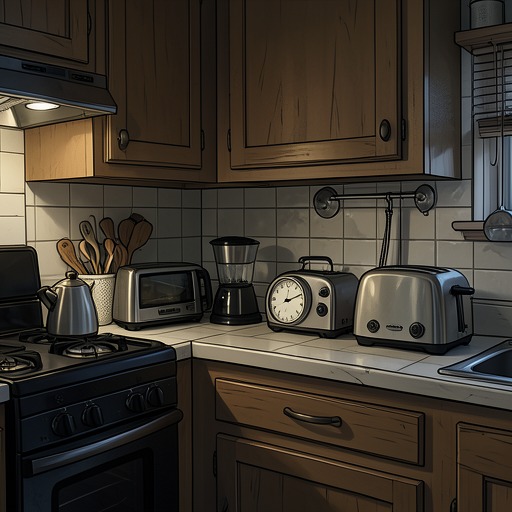
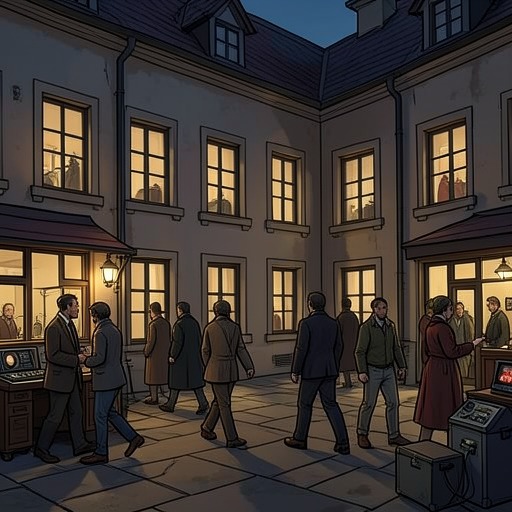
The chain first appears across the courtyard as a broad account of neighboring lives. As evening comes, lights switch on, fragments of radio and the faint sound of dishes carry between the buildings, and familiar activities resume. A couple leaves for the evening and returns; elsewhere, a woman settles her child before attending to her own appearance. These repeated actions make daily life seem ordered and predictable. The narrator describes residents as bound by habits even while they consider themselves free: routine is not merely a series of private choices but a structure through which their lives can be observed and understood.
That larger pattern provides the standard against which a particular household’s behavior becomes conspicuous. In the fourth-floor apartment, three shades remain raised and one stays lowered throughout the day. At first, Jeffries has not been attending closely enough to register the stillness. A light appearing in the kitchen finally draws his attention to the unchanged shades, and with them to a more consequential absence: Anna has not been seen all day. The clue begins not as a dramatic act but as a routine that has failed to produce its usual signs of life.
The Break in the Thorwalds’ Routine
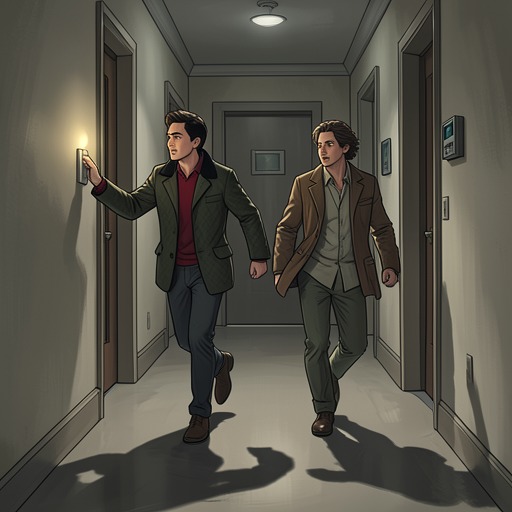
When Lars Thorwald comes in, he keeps his hat on. Jeffries reads the gesture as a sign of disturbance rather than simple discomfort, observing that Thorwald pushes the hat back over his hair instead of removing it. Anna does not come out to greet him, breaking what Jeffries regards as the first link in the household’s customary sequence. Thorwald also remains apart from the bedroom where she might be resting. The important feature is the relation among these details: each becomes more troubling because it differs from an expected action and coincides with the other departures from routine.
Jeffries considers an ordinary explanation before treating the deviations as evidence of wrongdoing. Anna may be ill and staying in bed; if she had been sent away for her health, several of the anomalies would lose their force. The lights left on overnight, Thorwald’s late return, his hat, and Anna’s failure to greet him could then be accounted for without implying a crime. Jeffries also discounts the drinks and Thorwald’s apparent concern about the surrounding windows as inconclusive on their own. His reasoning depends on comparing explanations, not simply collecting suspicious gestures.
One detail resists the explanation that Anna has already left. Thorwald sleeps in the living room rather than the bedroom, despite having a bed available there. Jeffries reasons that this would be difficult to explain if Anna were already gone. He has also been awake early enough to see Thorwald rise from the sofa, and he has not observed Anna leave that morning. These limits matter: not seeing her is not, by itself, proof that she is absent. But the chronology of the unchanged bedroom, Thorwald’s choice of sleeping place, and the period Jeffries watched makes the simple departure theory increasingly hard to sustain.
The Empty Bed and Delayed Recognition
The trunk’s departure briefly supports a different interpretation: Anna may be travelling, and Thorwald may simply be forwarding her belongings. Yet Thorwald’s behavior after the trunk has gone unsettles that account. After hours of keeping away from the bedroom, he enters it, raises the shade, looks around in a manner Jeffries reads as surveying an empty room, and throws two sets of mattress and bedding over the foot of the bed. The mattresses remain unoccupied. The scene supplies a new, specific point of contact for suspicions that had previously remained indistinct.
Jeffries understands his recognition as delayed action. For two days, uneasiness has accumulated without becoming a settled conclusion. Small reassurances, including the raising of shades after an unnaturally long period, have repeatedly prevented him from recognizing what the irregularities might mean. The empty mattresses abruptly bring the scattered observations together: his instinctive suspicion reaches certainty before his rational mind can catch up. He concludes that Lars Thorwald has done something to Anna, but immediately checks the strength of that conclusion. What he has directly established is negative evidence: Anna is no longer visible to him. The distinction preserves the gap between inference and direct knowledge even at the moment his suspicion becomes forceful.
Reconstructing the Chain as Evidence
Jeffries later makes his case to himself by laying out the household’s disruptions in sequence: the lights burning all night, Thorwald arriving late, the hat left on, Anna’s missing greeting and continued absence, the drinks associated with packing and dispatching the trunk, Thorwald’s uneasy attention to other windows, and his night spent in the living room. This inventory turns the metaphor of a broken chain into a practical method. Each link is an observed departure from the pattern, but its meaning depends on what comes before and after it.
The same method exposes the weakness in the benign theory that Anna had been sent away while ill. That explanation can account for several irregularities at once, but it conflicts with Thorwald’s staying out of the bedroom the night before the trunk leaves. If Anna were already gone, Jeffries reasons, there would be little reason for Thorwald to avoid the room. If she were still there, the later discovery of an empty bed would need another explanation. The resulting sequence seems to loop back on itself: the room is treated as though Anna remains in it and then revealed as empty after the trunk is dispatched. Rather than smoothing over the contradiction, Jeffries treats it as a reason to reconsider what the trunk’s departure means.
A later visual discrepancy shows the chain of inference continuing beyond domestic routine. Jeffries notices that the renting agent and Lars Thorwald appear to move between windows one above the other, until their parallel paths seem to make an upward jump at the kitchen. He does not dismiss the mismatch as a timing error; the apparent change is vertical. This observation prompts him to conclude that he has something more concrete to offer and to telephone Inspector Boyne. The chain thus extends from repeated household conduct to a careful comparison of movement across the building: in both cases, an expected pattern makes a deviation visible.
Narrative Function and Limits
The Chain of Everyday Habits gives the story a way to make routine carry suspense. Shades, lights, beds, a hat, a greeting, and a trunk are not inherently proof of a crime. Their significance emerges from recurrence, timing, and contrast with what Jeffries expects to happen. The same habits that make neighbors’ lives seem ordinary become a measuring instrument when a sequence breaks. The observer’s attention turns a quiet courtyard into a field of small, connected signs.
The concept also keeps the investigation uncertain for as long as observation permits. Jeffries builds competing explanations, identifies which details each explanation can absorb, and notices when one detail refuses to fit. Delayed recognition describes the timing of that process: perception has registered unease before conscious reasoning can name it. Yet the movement from unease to certainty is not the same as direct access to what occurred inside the apartment. The narrative’s tension rests on that distinction. Habit can reveal where a story no longer holds together, but the observer must still interpret the break and test what it can establish.