The chain of habits
Rear WindowThe chain of habits describes the repeated routines through which the narrator reads life in the apartments across the quadrangle. Its significance lies in the contrast between predictable daily patterns and the moment those patterns break: a missing greeting, an untouched bedroom, or a changed sequence of actions becomes a clue because it interrupts an established order.
Routine as a Visible Order
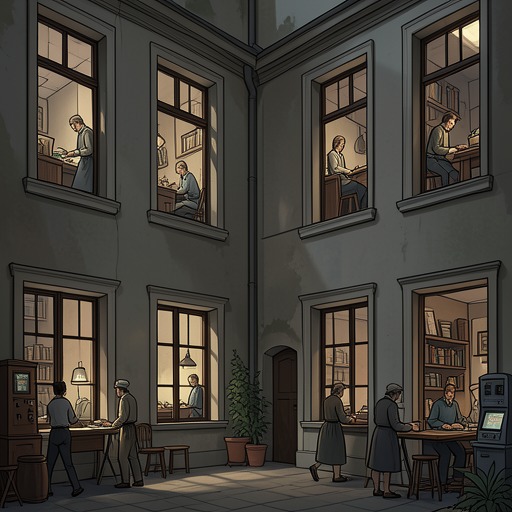
At evening, lights come on around the quadrangle; radio fragments and faint clicks of dishes travel across the space. The narrator sees the residents’ small routines unspool as a chain: the jitterbugs leave for the open spaces, return and switch off their lights, while a woman puts her child to bed, leans over the cot, and then sits down to redden her mouth. These repeated actions make otherwise separate households seem bound to a shared rhythm. The people may think themselves free, the narrator reflects, yet their habits hold them with the force of restraints.
That image is not merely a description of routine. It establishes the baseline against which change can be noticed. A light, a shade, or a person’s movement acquires meaning through its relation to what usually happens. The chain is therefore both social pattern and a kind of evidence: an expected link can be identified only because the surrounding sequence has become familiar.
The Broken Sequence
The fourth-floor rear apartment provides the decisive interruption. Three shades remain raised and the fourth, which masks the bedroom, stays down throughout the day. The narrator has not consciously attended to this arrangement until a light comes on in the kitchen and makes the stillness newly conspicuous. More troubling is the absence of Anna Thorwald, who has not appeared all day.
When Lars Thorwald returns, he keeps his hat on and pushes it back over his hair rather than removing it. The narrator reads the gesture as a sign of harassment or uncertainty, not simple discomfort. Anna does not come out to greet him, breaking what the narrator calls the first link in the chain of custom. Lars remains two rooms away from the lowered bedroom shade instead of going to check on her. She might be asleep, or too ill to rise; but either explanation leaves a gap, since he cannot know her condition without looking in. His stillness by the window, where he stands for several minutes looking downward, adds to the sense of a routine displaced without an obvious explanation.
Turning Deviations into a Case
The narrator later reconstructs the irregularities as a connected sequence rather than isolated impressions. The lights had stayed on all night on the first night; Lars had returned later than usual on the second; he had kept his hat on; Anna had not greeted him and had not appeared since the evening before the lights were left burning. Lars had packed her trunk, taken a drink afterward, and then taken three stiff drinks the next morning after the trunk was sent away. He seemed inwardly disturbed while showing an unusual concern for the surrounding rear windows. During the night before the trunk’s departure, he had slept in the living room and avoided the bedroom.
The list shows how the chain functions as a method of inference. The narrator tests whether illness and a departure for the country could explain the apparent breaks. That possibility would make the first four irregularities unremarkable, and the drinks and watchfulness would not by themselves incriminate Lars. But it does not account for his sleeping outside the bedroom. The narrator reasons that if Anna had already left, there would be no practical reason for him to avoid the bedroom, which had two beds, in favor of a sofa or an uncomfortable easy chair. The routine’s broken link thus redirects attention to what may still be inside the apartment.
Delayed Recognition
The bedroom and trunk make the sequence seem almost contradictory. If Anna had left, the narrator reasons, she would have had to go the previous morning; yet the bedroom shade and mattresses remained undisturbed until after the trunk was dispatched. Lars then entered, raised the shade, and tossed over the mattresses, behavior that appeared to show she had not been there. Rather than resolving the question, the order of these actions produces what the narrator calls a crazy spiral: each detail changes the apparent meaning of the one before it.
The eventual recognition arrives as delayed action. The thought has been waiting since midafternoon, but only later does it suddenly cohere, after the narrator notices an upward jump in the apparent parallel movement of the renting agent and Lars across the windows. The chain of habits consequently describes more than the residents’ repetitions: it also models the narrator’s own process of observation, in which details accumulate before their significance becomes clear. A broken routine first makes suspicion possible; only a delayed rearrangement of the evidence gives that suspicion a new direction.