Thorwald Attacks Jeffries and Falls to His Death
Rear WindowThe attack on Hal Jeffries by Lars Thorwald turns Jeffries’s observation into an immediate physical danger: the man he has been trying to expose reaches his apartment, while Jeffries is trapped in his chair and unable to summon help. Thorwald’s escape across the rear of the buildings ends when Inspector Boyne shoots him from below. The death resolves the pursuit, but the decisive evidence is the architectural clue that directs the police to the body hidden in the unfinished apartment above Thorwald’s.
Causes and the decisive clue
The confrontation grows out of Jeffries’s prolonged effort to make the police recognize that Thorwald has concealed a murder. An earlier search of Thorwald’s apartment had been thorough, but it found no incriminating evidence; the trunk that Jeffries had watched Thorwald send away was gone. Later, Jeffries arranged for Sam to enter the apartment and disturb its furnishings, hoping to provoke Thorwald into revealing what he was protecting. Sam crossed the yard fences, reached the fire escape, and got inside through a partly lowered window. Jeffries watched from his own apartment, unable to shield him if Thorwald caught him there.
A moment of accidental coordination supplied the clue that earlier scrutiny had missed. A landlord and prospective tenant moved through the sixth-floor apartment while Thorwald moved through the fourth; both parties crossed from their living-room windows to their kitchen windows. Jeffries remembered that their apparent parallel movement had included a vertical jump. When the memory finally returned with force, he understood that the change was not in their timing or horizontal route: the kitchen floor in the apartment between them was raised. The unfinished fifth-floor flat had a cement kitchen floor above the level of its other rooms. Jeffries inferred that the body was beneath it and called Inspector Boyne, insisting that the police dig there.
The severed line and the staged decoy
Before the police could act on the clue, Jeffries’s telephone connection abruptly failed. He realized that the wire had been cut somewhere inside the building, since the line ran underground outside. The cut transformed his apartment from a place of observation into a sealed point of danger: he could no longer reach Inspector Boyne, and he could not get out of his chair. He believed Thorwald was coming up the stairs, though the absence of a familiar door sound left him unable to locate the intruder.
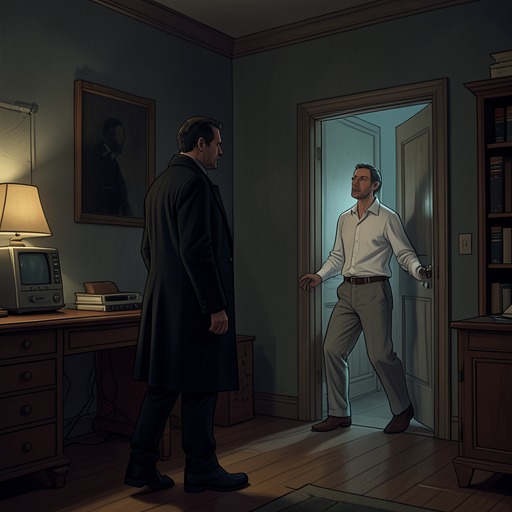
Jeffries tried to disguise his helplessness. He pulled down a bust from the wall, arranged a rug around it to resemble a covered figure, and slumped into his chair so the arrangement might look like a sleeping person in the dark. Thorwald was adept with locks and hinges; Jeffries never heard the door open. An air current told him that someone had entered, but not exactly where Thorwald stood. The bust and blanket were a desperate attempt to buy time, not a reliable defense.
The attack and escape
Thorwald fired. The shot lit the dark room and shattered the bust on Jeffries’s shoulder, exposing the decoy. Jeffries flung himself into the narrow space between the chair and the wall. Thorwald then leaned toward the window, apparently searching for a way out, before turning and firing again at close range. The shot missed Jeffries. The failed attempt left a brief opening, but Thorwald was still armed and moving; Jeffries remained unable to pursue or restrain him.
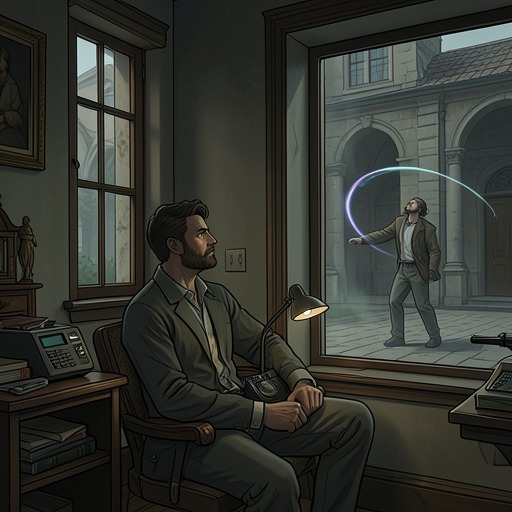
Thorwald went over the windowsill and dropped two storeys into the yard, landing on a strip of grass rather than the cement. He crossed two fences, returned to the rear yard of his own building, and climbed upward by way of the fire escapes. His route depended on the linked yards, fences, windows, and exterior stairs that had also enabled Sam to enter the apartment. Sam had latched a window during his visit but reopened one for ventilation on his return; Thorwald used that opening as he climbed toward his own windows. When something went wrong there, he veered away from them and continued upward, passing the fifth and sixth floors to reach the roof.
Death and discovery
Inspector Boyne appeared beside Jeffries with his weapon trained on Thorwald. The chase had carried the armed man onto the roof parapet, where he lingered, still trying to kill before he was killed. Boyne fired. The shot broke a windowpane near Jeffries, and Thorwald let his gun go before falling after it. He missed the fire escape, struck a projecting plank, bounced, and landed on the ground. The fall killed him. Jeffries, who had watched the flight rather than the action around him, only then registered that Inspector Boyne had arrived beside him and fired.
Jeffries immediately gave Inspector Boyne the location he had deduced: the unfinished fifth-floor apartment and its raised cement kitchen floor. Inspector Boyne crossed the rear yards to reach it quickly. Because the electricity had not yet been connected, the officers used torches to inspect and excavate. Within about half an hour, Inspector Boyne signaled from the window that Jeffries’s deduction was right. By the following morning, the search was complete and both bodies had been taken away: Thorwald’s, newly dead after the fall, and the body concealed beneath the cement.
Significance
The episode joins two forms of pursuit. Jeffries’s careful watching finally becomes useful action when he reconstructs the vertical mismatch in the tenants’ movements and locates what the apartment search missed. But the insight does not make him physically safe: the severed telephone line and his immobility leave him isolated as Thorwald enters. The resolution therefore depends both on Jeffries’s interpretation of the building and on the arrival of Inspector Boyne, whose shot ends the escape. The same rear-yard architecture that offered Thorwald a route upward also makes the final chase visible from Jeffries’s window, bringing the hidden crime and the exposed killer into the same field of view.