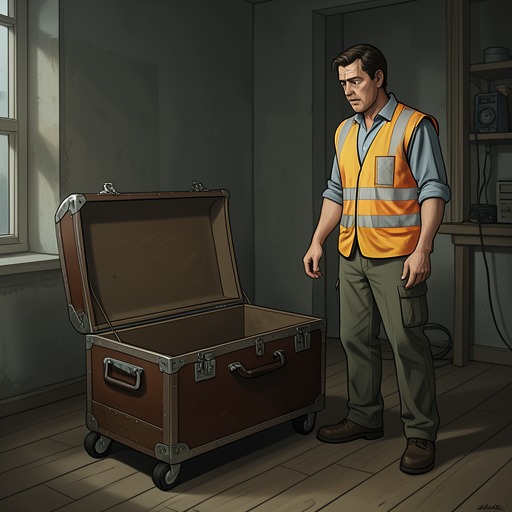
Thorwald Fakes His Wife's Departure
Rear WindowLars Thorwald’s apparent arrangement for Anna Thorwald to leave town is a carefully staged explanation for her absence: her clothes are packed into a trunk and sent away, while a postcard seems to confirm that she has arrived at a farm upstate. The performance depends on familiar signs of departure, but those signs do not fit what Jeffries has watched from across the quadrangle. The trunk, the postcard, and the persistent absence of Anna become parts of a false account whose seams are exposed by details of everyday behavior.
The Departure That Does Not Fit
The first clue is not an object but a break in routine. Around the apartments, evening habits repeat with almost mechanical regularity: lights come on, radios and dishes carry faintly across the courtyard, and residents move through familiar domestic sequences. Against that background, the fourth-floor flat stands out. Its shades remain in the same positions through the day, and Jeffries realizes that he has seen no sign of Anna. When Lars Thorwald comes in wearing his hat, he does not remove it or go toward the bedroom. He stays apart from the room behind the lowered shade, while his gestures suggest to Jeffries an unsettled state of mind. Anna does not appear to greet him, a familiar domestic exchange that Jeffries treats as the first broken link in the household’s customary pattern.
Jeffries initially allows ordinary explanations. Anna may be ill and resting in bed; Lars Thorwald may not want to disturb her. But the explanation grows harder to sustain when Lars Thorwald does not even look in on her. Jeffries later assembles the irregularities into a list: the lights had remained on all night on an earlier evening; Lars Thorwald had returned later than usual, kept his hat on, and avoided the bedroom; Anna had not appeared; and, after packing the trunk, Lars Thorwald had taken several drinks. Any one detail could be innocent. Taken together, they make the supposed departure difficult to reconcile with what Jeffries has observed, especially Lars Thorwald’s continued avoidance of the bedroom.
Packing and Sending the Trunk
The trunk first emerges through a limited view. Lars Thorwald repeatedly dips out of sight behind a dark V-shaped obstruction, then rises again, while Jeffries struggles to identify what is happening. When Lars Thorwald brings out a bundle of shifting colors and lays it across the obstruction, the shapes change from white to red to blue. Jeffries recognizes them as women’s dresses. Lars Thorwald pulls the dresses down one by one, then appears to exert pressure on the V-shaped object; it folds into a cubed wedge and disappears to one side. Jeffries concludes that Lars Thorwald has packed Anna’s belongings into a large upright trunk.
The next morning gives the packing a practical appearance. Two expressmen in leather aprons arrive, and Lars Thorwald watches closely as they maneuver the black, cubed trunk out of the apartment. He hovers and shifts from side to side, anxious about how the men handle it. After they leave, he wipes his head as though he, rather than the carriers, has exerted himself. From the window, the sequence looks like a husband forwarding his wife’s luggage to wherever she has gone. Yet the care devoted to the trunk’s removal also makes it central to Jeffries’s suspicion: the container is treated as more than routine baggage, and its departure appears to establish a destination for Anna without showing Anna herself.
The Postcard and the Counter-Story
During a police search, Inspector Boyne reports that officers found a postcard waiting in Lars Thorwald’s letter box and retrieved it with bent pins. It bears a message attributed to Anna, saying that she has arrived safely at a farm upstate and is already feeling better. The note appears to resolve the mystery in Lars Thorwald’s favor: Anna has gone away for her health and is communicating from a new location. Its reassuring wording supplies precisely the explanation that the missing woman and departing trunk seem to require.
The postmark, however, cannot establish when the postcard was mailed. The month, August, and the time, 7:30 p.m., remain legible, but the year is blurred. Jeffries points out that the card could therefore be several years old and that the police cannot prove how it reached the mailbox; it may have come from a letter carrier or from the back of a bureau drawer. Inspector Boyne treats the postcard as a reason to stop pursuing the case, while Jeffries continues to watch the apartment. Even after hearing about the note, he notices that Lars Thorwald again stays out of the bedroom despite two unused beds there. The postcard creates a plausible account, but its uncertain date and the continuing mismatch in Lars Thorwald’s behavior prevent it from conclusively explaining Anna’s absence.
Jeffries’s Reconstruction and Its Limits
The false departure becomes intelligible only when Jeffries connects it to the possibility that Anna never left. He reasons that if she had gone away before the trunk was sent, Lars Thorwald’s earlier avoidance of the bedroom would be inexplicable; if she remained in the bedroom, the departure story and the later rearrangement of the room contradict one another. After the trunk is dispatched, Lars Thorwald goes into the bedroom, raises the shade, and tosses the mattresses, making it appear that Anna has not been there. For Jeffries, the sequence is not a simple mistake but a deliberate attempt to make the apartment’s visible evidence support a departure after the trunk has gone.
Jeffries eventually presents a larger reconstruction to Inspector Boyne, but he marks its most serious claims as conjecture. He imagines that Lars Thorwald may have insured Anna heavily and tried to poison her gradually; that Anna may have discovered the attempt on the night the lights stayed on; and that Lars Thorwald then killed her violently and improvised a way to hide her. In this account, Lars Thorwald concealed her body in a trough cut into fresh cement in an upstairs apartment, covered it with new cement, and left the floor for cork surfacing to be laid over. Jeffries calls the resulting hiding place a permanent, odorless coffin. He further supposes that Lars Thorwald sent an accessory upstate near a place associated with Anna’s earlier summers, dispatched the trunk and its keys, and planted an already-used postcard with its year obscured. The scheme, as Jeffries reconstructs it, would have made Anna appear to die later by suicide, with ill health offered as the explanation and an insurance claim as the possible payoff. These motives and steps remain Jeffries’s stated theory rather than independently confirmed details; the postcard, trunk, and broken domestic routines are the evidence from which he builds it. The delayed moment when that pattern finally clicks for him turns the apparent luggage shipment into a clue to concealment rather than proof of an ordinary journey.