Thorwald's Pistol
Rear WindowThorwald's Pistol is the concealed weapon that turns Hal Jeffries's investigation of Lars Thorwald into an immediate threat to his life. First glimpsed as Thorwald retrieves it from a hidden recess, the gun becomes the instrument of a planned confrontation and then erupts into the room where Jeffries is waiting. Its significance lies in that progression: a secret discovered through observation becomes a danger that can no longer be kept at a distance.
Concealment and Discovery
After a telephone conversation, Thorwald moves directly through to the bedroom, a room he has stopped going near, and disappears into its clothes closet. He remains inside for about a minute. When he emerges, the account infers that he has taken something from a concealed cranny or niche—one that the detectives had missed. The movement of his hand, piston-like just before it vanishes inside his coat, tells Jeffries what the concealed object is: a gun.
The discovery depends not on seeing the weapon plainly but on reading a gesture. Thorwald's hand and coat briefly disclose what the closet hides. The pistol is therefore first present as an inference drawn from movement, not as an openly displayed object. That partial visibility makes it a turning point in Jeffries's watch: he now has reason to fear that Thorwald is armed, although he has not yet seen the gun used.
The Lakeside Park Trap
Jeffries understands the weapon in relation to the meeting he has arranged. After Thorwald leaves for Lakeside Park, Jeffries thinks it fortunate that he is not waiting there for the seventy dollars Thorwald was supposedly to bring. Thorwald returns twenty-nine minutes after leaving. When Jeffries calls him, he says that he stayed away because Thorwald was expected to bring money rather than a gun, and claims to have seen Thorwald tap the inside of his coat while going out onto the street.
The accusation is a calculated test, not a neutral report. Jeffries admits that Thorwald may not have made the gesture at all; the point is that Thorwald may no longer remember whether he did. By speaking as if the armed departure had been observed, Jeffries makes the weapon part of the pressure he applies over the telephone. He then claims to know where the thing Thorwald has concealed is, and says that he was there while Thorwald was away. Thorwald answers with silence and quick breathing. The pistol's concealment has not protected Thorwald from the possibility that his secret has been found out.
From Threat to Gunfire
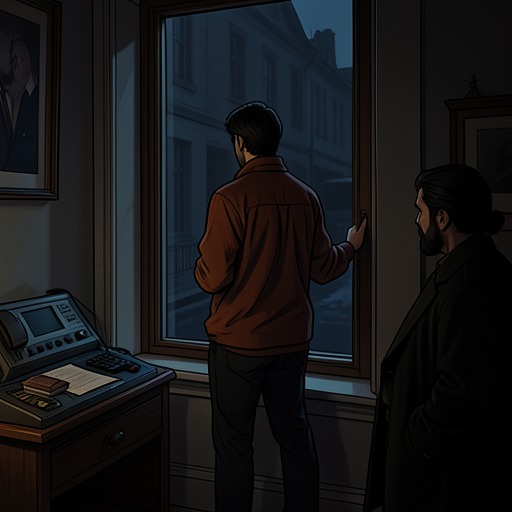
Jeffries expects that Thorwald means to use the gun in the open at Lakeside Park. During the later encounter inside Jeffries's darkened room, he weighs a different possibility: Thorwald might use a knife or strike him on the head, or might fire the gun. Jeffries reasons that a physical attack could give him a chance to grapple with Thorwald, while a gun would leave little more than a few seconds of difference. He knows Thorwald has the weapon; what remains uncertain is how Thorwald will act in the room.
The first flash of the shot briefly lights the darkness, and a bust on Jeffries's shoulder bounces apart into chunks. The impact makes the weapon's force visible through damage to an object beside its intended target. Jeffries then flings himself into the narrow gap between a chair arm and the wall, though his legs, head, and one shoulder remain exposed. Thorwald turns and fires again at close range. The flash is compared to looking into the sunrise, but Jeffries feels no impact and realizes the shot has missed.
Escape and Narrative Significance
After the close-range shot, Thorwald says only a brief, unfinished-sounding word to himself; the account notes that the rest of his life is action rather than speech. He goes over the windowsill on one arm and drops two stories into the yard. He misses the cement and lands on the strip of sod in the middle. The pistol's appearance has thus led from a hidden recess to a planned meeting, from accusation to gunfire, and finally to an escape attempt by another route.
The weapon also changes the texture of the scene. Before the shots, it is known to Jeffries through observation and inference: a hand disappearing into a coat, a suspected movement, and a silence that follows a pointed accusation. In the dark room, the pistol becomes perceptible through its flashes and consequences—the broken bust, the near miss, and Thorwald's flight. It is no longer merely something concealed and watched; it acts on the material surroundings and places Jeffries in immediate danger. That shift gives the gun its decisive role in the confrontation: it converts the distant, investigative contest between the two men into a physical struggle over survival.