Thorwald's Wife's Postcard
Rear WindowThorwald's Wife's Postcard is a small piece of purported evidence in the investigation of Anna's disappearance from the apartment of Lars Thorwald. Found in Thorwald's letter box, it appears to confirm that Anna left for the country and was recovering there. But its postmark cannot establish the year, and the circumstances of its arrival are not independently verified. The postcard therefore offers reassurance without certainty: it can support Thorwald's account, but cannot settle what happened to Anna.
Discovery and Message
Inspector Boyne reports that the postcard was waiting in the letter box downstairs. His investigators fished it out of the slot with bent pins, then copied its message. It was presented as a card from Anna, written the previous day at a farm up-country. The message said that she had arrived safely, was already feeling somewhat better, and sent her love. In its plainness, the note supplies exactly the kind of ordinary explanation that the investigation needs: Anna has gone away for her health and remains in contact with her husband.
That account is significant because it counters a suspicion built from absences and irregularities rather than direct observation. Hal Jeffries has seen the trunk leave, but not Anna; he has watched Lars Thorwald remain apart from the bedroom and has noticed that Anna no longer appears. When Jeffries first reports the case, he gives Inspector Boyne Thorwald's name and address at 525 Benedict Avenue, specifying the fourth-floor rear apartment, and asks for an investigation into a possible murder. The postcard introduces a document that seems to answer the central question behind that request: if Anna is alive and away, her absence has an innocent explanation.
What the Postmark Can Establish
Jeffries does not treat the card's stated message as proof of when it was written or mailed. He asks whether the investigators can verify that it was written the previous day and presses for the postmark date. Inspector Boyne says the corner had become wet and the ink had smudged. The month, August, and the mailing time, 7:30 P.M., remain legible, but the year does not.
That missing year matters. Jeffries points out that the visible date could belong to 1937, 1939, or 1942, so the postmark cannot show that the card was sent during Anna's supposed journey. Nor can the investigators establish how it reached the box: it might have arrived through the mail or have been taken from the back of a bureau drawer and placed there. These are possibilities raised in the argument, not findings that prove the card was planted. The evidence leaves both the card's timing and its route unresolved.
The postcard thus has a more limited evidentiary value than its reassuring message first suggests. It establishes that a card bearing this message was in Thorwald's letter box when the investigators found it. On the information available to Jeffries, it does not independently establish who placed it there, when it was written, or whether Anna actually made the journey it describes. Its status is not disproved; rather, the details needed to authenticate its account are missing.
A Counterclaim Against Accumulating Clues
The postcard also belongs to a wider dispute over testimony. Inspector Boyne has already reported that the building superintendent and several neighbors said Anna left for the country to recover her health. Yet none of them saw her leave, according to Boyne's investigator. The investigator had also been told that Thorwald returned from the depot after buying a ticket and seeing Anna onto a train, but this, too, is a report of what Thorwald supposedly did, not an eyewitness account of Anna's departure. Jeffries distinguishes the repeated story from direct confirmation: several people repeating an account do not necessarily make its central event observed fact.
The card sharpens that distinction. Its content fits the neighbors' account, but the date that might connect it to that account is precisely what cannot be read. For a moment it unsettles Jeffries; he admits to himself that the postcard has shaken him. Yet while speaking with Inspector Boyne, he continues watching Thorwald's apartment. Thorwald again stays in the living room rather than using the two available beds in the bedroom. That observation does not by itself refute the card, but it renews the tension between the reassuring explanation and the pattern of behavior Jeffries has been assembling.
Earlier, the missing greeting when Thorwald came home had broken what Jeffries calls the chain of everyday habits. Later, after Thorwald searches the bedroom and upends the empty mattresses, Jeffries's diffuse uneasiness suddenly becomes a conviction that Anna has been murdered. The postcard temporarily gives the ordinary explanation documentary form, but it does not erase the earlier disruption or answer the question of why Anna is never seen. In this structure, it functions not as a final resolution but as an obstacle that forces suspicion to contend with apparently contrary evidence.
Retrospective Significance
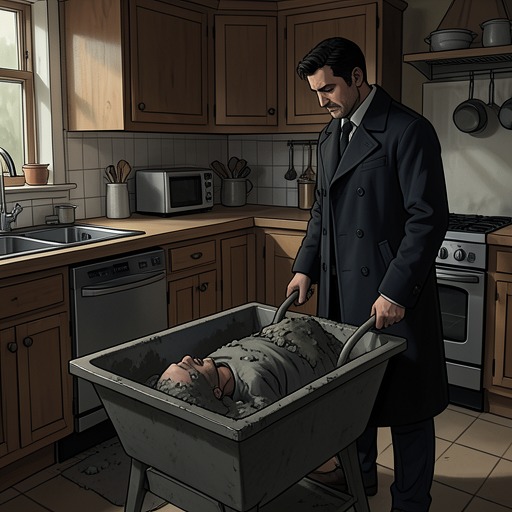
The eventual discovery changes the weight of the competing explanations without resolving every uncertainty about the postcard's making or delivery. Jeffries identifies the raised cement kitchen floor in the fifth-floor apartment above Thorwald's as the place the police must investigate. Inspector Boyne orders it dug up; within about half an hour, he signals that the search has succeeded. The bodies are later taken away. This discovery supports the conclusion that Anna was murdered and concealed, making the postcard's apparent account of her safe departure incompatible with what the investigation finds about her fate.
That outcome does not, on its own, show who wrote or deposited the card, or explain exactly how it came to be in the letter box. Its narrative role is instead to show how a plausible document can complicate an investigation while remaining weaker than it looks. The card's friendly message and apparent date invite belief; the blurred year and uncertain chain of arrival prevent verification. Against the later physical discovery beneath the raised kitchen floor, those omissions become decisive: the postcard had offered an account of Anna's whereabouts, but never secure evidence that she was alive and away.