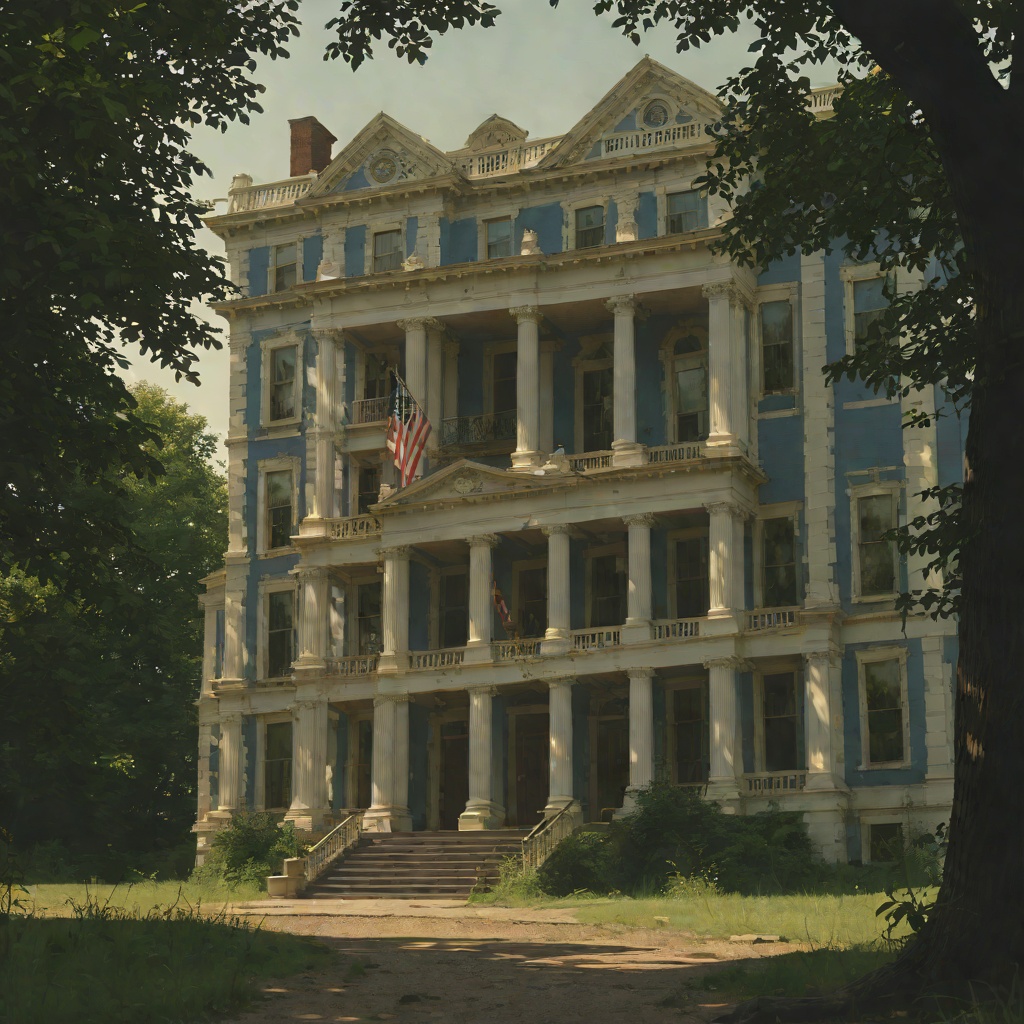
Buckingham Palace
Red, White & Royal BlueBuckingham Palace stands at the center of the novel's world as the official residence of the British royal family and the most visible symbol of the institution Henry is born into. It is the setting where the public face of the monarchy is performed, where its internal conflicts are fought, and where the private rebellion that defines Henry's arc reaches its decisive confrontation. The palace is not merely a backdrop but an active force in the story, shaping the characters' choices and embodying the weight of centuries of tradition that both constrains and defines them.
The Royal Wedding and the Public Face of the Monarchy
The novel opens with a grand spectacle at Buckingham Palace: the wedding of Prince Philip to Martha, a daughter of nobility. The streets of London are crammed with crowds draped in Union Jacks, waving tiny flags, and the city is plastered with commemorative souvenirs bearing the couple's faces on everything from chocolate bars to underwear. Alex, attending as a guest, is struck by the sheer scale of public devotion to something he finds "comprehensively dull." The ceremony itself, he observes, is "as sexy as a business transaction" — a union of a prince and a respectable noblewoman that lacks any passion or drama. This wedding establishes the palace as the stage where the monarchy performs its most ritualized public ceremonies, and it introduces the central tension of Henry's life: he is expected to participate in these loveless, transactional unions to preserve the institution's image. The event also marks the first meeting between Alex and Henry, when a royal attendant materializes at the Claremont-Diaz table and asks June to dance with Prince Henry, setting the story's central relationship in motion within the palace's formal, hierarchical setting.
The Palace as a Site of Confrontation and Power
Buckingham Palace becomes the arena for the novel's most intense power struggle when Henry and Alex must face Queen Mary to seek approval for their relationship. The meeting takes place around a long, ornately carved table in a palace meeting room, with Philip present and looking like he is about to chew through his tongue. Queen Mary glides in wearing slate-gray separates and a stony expression, her gray bob arranged with razor precision. Alex is struck by how tall she is, straight-backed and fine-jawed even in her early eighties, with a definite story in her shrewd blue eyes and angular features. The temperature in the room drops as she takes her seat at the head of the table, and she deliberately makes them wait while she fixes her tea at a glacial pace — the milk poured with one gently tremoring, ancient hand, one cube of sugar picked up with deliberate care with tiny silver tongs, then a second cube. This slow, deliberate ritual is a display of absolute control, a way of asserting her authority before a single word is spoken. The scene is a masterclass in the palace's function as a space where power is exercised through protocol and patience, and it sets the stage for the confrontation that follows, in which Henry must declare his commitment to Alex in the face of the queen's disapproval.
The Palace in the Public and Private Spheres
The palace also serves as the backdrop for the novel's climactic public moment: the coming-out of the First Son and the youngest prince. On October 2, 2020, the whole world watches as Henry emerges from Marine One on the South Lawn of the White House, not Buckingham Palace, but the palace remains the symbolic counterweight to that American stage. The novel's structure repeatedly contrasts the two seats of power — the White House and Buckingham Palace — as the twin poles of the protagonists' lives. The palace represents the old world of inherited privilege and rigid tradition, while the White House represents the new world of democratic politics and the possibility of change. Henry's journey is defined by his movement between these two spaces, and his ultimate choice to be with Alex means choosing the White House's world over the palace's. Yet the palace never fully recedes; it remains the place where Henry's family lives, where his mother and siblings reside, and where the institutional weight of the monarchy continues to press upon him. The novel's final victory scene, set in Austin, Texas, with President Ellen Claremont's reelection address, is geographically distant from the palace, but the palace's shadow still falls across the celebration, reminding the reader that Henry's choice to be public came at the cost of his place within that institution.
The Palace as a Space of Contrast and Memory
The palace is also defined by contrast with other spaces in the novel. Where the lake house in Texas is warm, vibrant, and filled with family — the orange exterior, tall cactuses, teal doors, and Spanish tile accents, with windows flung open and curtains drifting on a warm breeze — Buckingham Palace is formal, cold, and hierarchical. The palace's ballrooms and meeting rooms are places of performance and constraint, while the lake house is a place of genuine connection, where Henry learns to eat barbecue with his hands and talks with Alex's father about outboard motors. Similarly, the palace contrasts with the intimate spaces Alex and Henry carve out for themselves, such as the secret room in the Victoria and Albert Museum that Henry calls his favorite, with its vaulted roof and Gothic choir screen. These private spaces offer the freedom and intimacy that the palace denies. The palace, in this reading, is the novel's primary symbol of the closeted, constrained life Henry must escape, and its power is felt most acutely in the moments when Henry and Alex are forced to navigate its protocols and hierarchies. The palace is where Henry's identity as a prince is most fully imposed upon him, and it is the place he must ultimately defy to become himself.