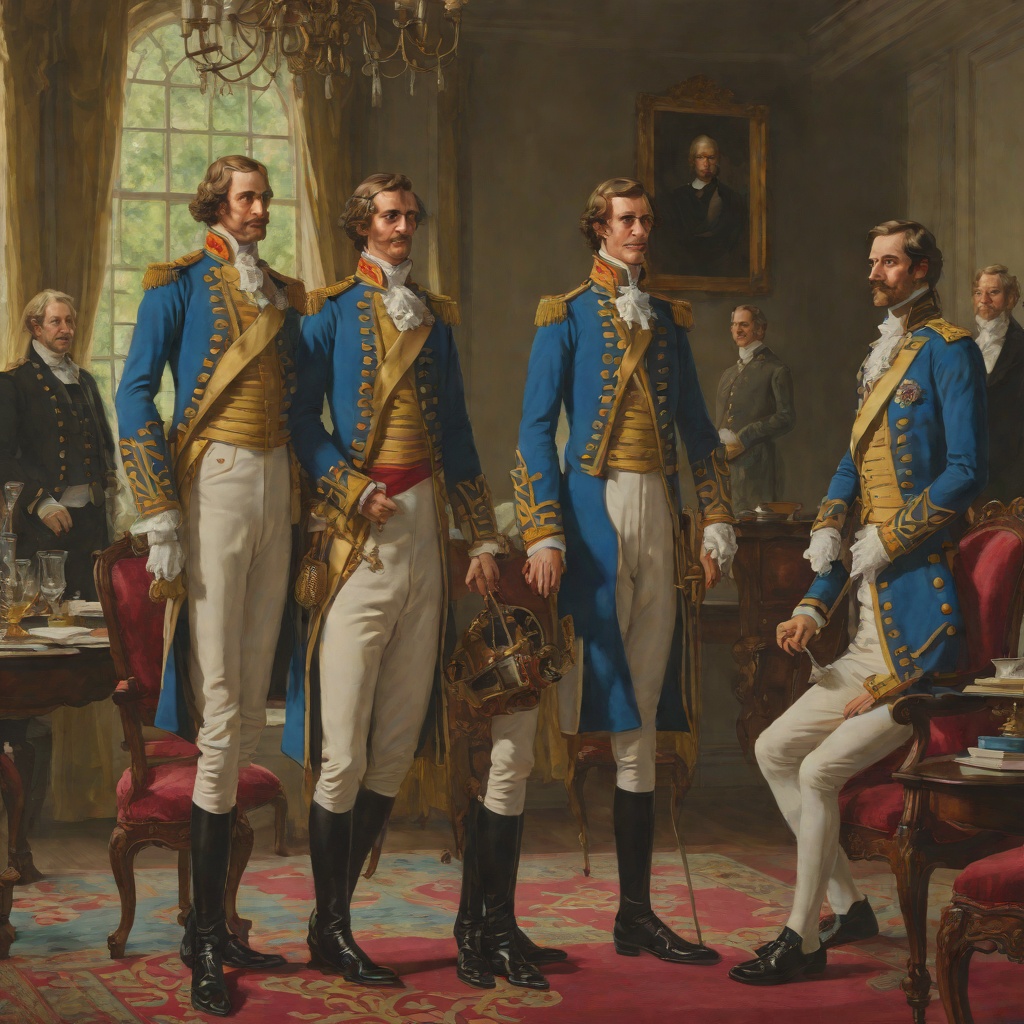
Henry George Edward James Fox-Mountchristen-Windsor
Red, White & Royal BlueHenry George Edward James Fox-Mountchristen-Windsor, known to the world as Prince Henry of Wales, is introduced as the very picture of royal perfection: classically handsome in a tailored three-piece suit, with tousled sandy hair, high cheekbones, and a soft, friendly mouth. He holds himself with innately impeccable posture, as if he emerged fully formed and upright out of some beautiful Buckingham Palace posy garden one day. His face is infuriatingly symmetrical, and he carries the weight of centuries of royal blood in every gesture. Yet beneath this polished surface lies a man trapped by duty, terrified of his own desires, and slowly learning that the life he was born into may not be the life he wants to live.
Identity and Background
Henry's official family name is Mountchristen-Windsor, hyphenated like Alex's, making his full name Henry George Edward James Fox-Mountchristen-Windsor. He is the younger sibling of Philip and Beatrice, and the son of Princess Catherine and the late Arthur Fox. He studied English literature at Oxford University and plays classical piano, accomplishments that mark him as the intellectual and artistic member of the royal family. His parentage and education are matters of public record, filling Wikipedia pages and news cycles, but the private Henry is far more complex than the cardboard cutout his public persona suggests. He is a man of deep feeling hidden behind a mask of royal composure, a prince who has learned to perform perfection while suppressing the parts of himself that do not fit the crown's expectations.
Arc Through the Plot
Henry's relationship with Alex begins as a rivalry, the two men having competed for a Vogue editorial debut in their teens, and their mutual annoyance is palpable when they are forced together. But the animosity slowly gives way to something far more dangerous: genuine love. The turning point comes at the lake house, where Alex nearly confesses his feelings and Henry, panicked and unprepared, pushes him away. Henry later admits that night was the first time he let himself think Alex might actually say the words, and he panicked, calling it daft and unfair. The separation that follows nearly destroys him, and he confesses that trying to give Alex up that week nearly killed him. When he wakes up and looks at Alex, he realizes there is no trying to get by anymore. He wants to offer Alex all of himself, in whatever way Alex will have him, and the chance of a life together, even if he is never allowed to tell the world.
Relationships and Conflict
Henry's relationships are defined by the tension between his public role and his private self. His sister Beatrice is his closest ally, the one who answers the door at Kensington Palace when Alex arrives, brandishing a guitar and ready to fight off Philip, only to drop it and scoop Alex into a bone-crushing hug. She has told their mother what Alex has done for Henry, and she is fiercely protective of her brother's happiness. Henry's relationship with his mother, Princess Catherine, is more complicated. When he introduces Alex to her, his jaw is tight with fear, not anger, and Alex recognizes the expression: Henry wondering if it is safe to accept the love offered to him, and wanting desperately to take it regardless. He puts his arm around her and lets her kiss his cheek, then introduces Alex as his boyfriend, as if it is not obvious. She pulls Alex toward her and kisses his cheek too, thanking him for what he has done for her son. The moment is a quiet triumph, a royal mother accepting her son's love, but it is hard-won. Henry's relationship with Philip is more fraught, marked by the older brother's disapproval and the weight of royal expectation. And his relationship with Alex is the central conflict of his life: a love so powerful it threatens to upend everything he has been taught to value, yet so necessary he cannot give it up.
Change and Ending
Henry's transformation is complete by the novel's end. On election night, as the Claremont family takes the stage in Austin, Texas, Henry hovers in the wings, always hesitant to step on anyone's moment. But Alex will not let him stay hidden. He is family now, part of it all, headlines and oil paintings and pages in the Library of Congress, etched right alongside. Alex yells for him to come on, and Henry spares a second to look panicked before tipping his chin up, buttoning his suit jacket, and stepping out onto the stage. He gravitates to Alex's side, beaming, as President Ellen Claremont steps up to the podium. The prince who once hid behind royal protocol has become part of a new family, one built on love rather than blood, and he stands in the spotlight not as a royal but as a man who chose to be seen.
Thematic Significance
Henry embodies the novel's central tension between duty and desire, between the life one is given and the life one chooses. His journey from closeted prince to public partner of the First Son is a story about the cost of authenticity and the courage it takes to claim one's own identity. His relationship with Alex redefines what family means, expanding the traditional royal model to include a man who loves in defiance of expectation. Henry's final act, stepping onto that stage, is not just a personal victory but a political one, a statement that love is indomitable and that even the most entrenched institutions can be changed by it. He is the proof of the novel's premise: that choosing love, however terrifying, is the only legacy worth having.