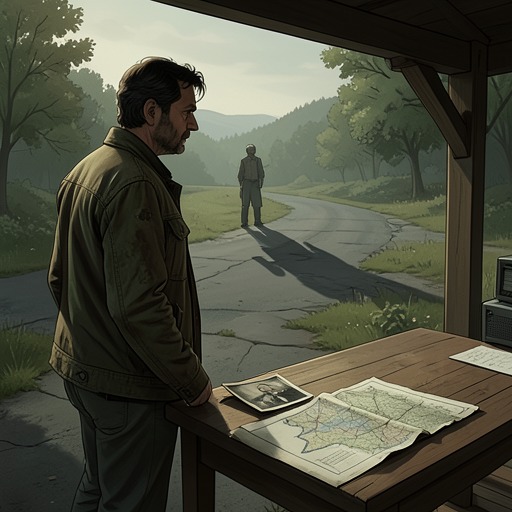
Cameron’s arrival in Sowell Bay
Remarkably Bright CreaturesCameron’s arrival in Sowell Bay begins with a rough drive, a dwindling cash reserve, and a search for Simon Brinks that immediately runs into closed doors. The journey brings Cameron to the place he hopes will answer a question about his family, but the town offers neither a prompt meeting nor an easy next step: Brinks Development is locked, and even the aquarium is not yet open. His battered camper carries him north; its unreliability, and the precariousness of his finances, make the arrival feel less like a triumphant threshold than a makeshift beginning.
The road north and the cost of getting there
Cameron is no camper expert, but he is confident this vehicle is a “piece of shit.” The engine rattles, a loose belt whines, and the driver’s seat has musty, scratchy brown upholstery that makes his back itch through his shirt. The mattress in the back is no more inviting. The camper’s condition is not an incidental inconvenience: it is the vehicle he owns outright, purchased for twelve hundred dollars after he persuaded its previous owner to lower the price. A replacement belt sits in the glove compartment, still in its package, a small practical safeguard against the noise and strain of the drive.
The money that made the purchase possible came from Jeanne Baker, whose contribution Cameron understands as a “not-a-loan.” By the time he is heading north, he has about eight hundred dollars left, and six of those remaining dollars have just gone toward an overpriced latte. He estimates that the money could last a while now that he no longer has to pay for lodging, but that calculation depends on finding Brinks or on his duffel bag catching up with him. His arrival therefore rests on limited, uncertain resources rather than a secure plan.
His first night in Washington has already shown how provisional his new arrangement is. He slept poorly in the far corner of an industrial-looking parking lot south of Seattle. When tires on gravel woke him, he saw a police car through the camper’s small window, scrambled into the driver’s seat, and drove away. That flight leaves him tired as he continues north, but he treats the new day as a fresh start. The relief of having a vehicle of his own coexists with its roughness, the discomfort of sleeping in it, and the fear that a place to stop may not be safe.
Reaching the target
The road signs count down the distance: twenty miles to Sowell Bay, then ten, five, and two. In the drizzle, the camper’s wipers barely clear the windshield. Cameron leans forward to see; when brake lights color the dashboard red, he brakes hard as traffic suddenly backs up. Along the slow approach, the wet highway, mossy guardrail, weedy shoulder, and tightly packed evergreens make the landscape feel strikingly green. Cameron’s attention to the trees turns the scenery into part of his uneasy arrival: their density makes him almost uncomfortable, as though he were claustrophobic on their behalf.
After turning off the highway, he passes a faded, rusty sign welcoming visitors to Sowell Bay and drives straight to the address he has found for Simon Brinks’s office. The destination is a plain space in a small commercial building beside the highway, marked Brinks Development, Incorporated. Its empty parking lot gives Cameron a bad feeling before he even tries the door. The door is locked. The man he has traveled to find is not there, and the office provides no immediate explanation of when he might be available.
Cameron tries to make the absence seem temporary. It is still early, he reasons, and perhaps Brinks and his staff are not morning people; Cameron himself is not, either. His thought that this may be an inherited trait gives the closed office a personal edge, but it does not change the practical fact that his first attempt has yielded no meeting. The target is only twenty miles away at the beginning of the drive and now physically before him, yet access remains out of reach.
The aquarium and another closed door
With the office unavailable, Cameron considers a detour to the aquarium, hoping someone there might know when Brinks Development opens. The building offers a second introduction to the town’s pace. Mildew streaks its domed metal roof, moss and bird droppings mark the surface, and seagulls circle above a parking lot that is also empty. Cameron pulls on the door and finds it locked.
The posted hours explain the immediate obstacle: the aquarium opens at noon. Cameron mutters at the sign, and the delay enlarges his impression of Sowell Bay as a place that is only half awake—or perhaps half dead. The deserted boardwalk adds to the sense of emptiness. Even the unpleasant smell that initially suggests a sewage pit has an ordinary explanation: seaweed baking on the rocks. Tiny waves lap the break wall nearby. The town’s first impressions thus arrive through concrete absences and details—the vacant lots, locked doors, weathered surfaces, and the smell from the shore—rather than through an encounter with the people he has come to find.
The arrival’s narrative turn
The arrival establishes both Cameron’s objective and the limits on his ability to pursue it. He has reached Sowell Bay specifically to seek Simon Brinks, but the office is closed; his attempt to ask the aquarium for help meets its own posted opening time. Each obstacle is small and mundane, yet together they leave him waiting at the beginning of a search whose outcome is not available on arrival. His budget, camper, and uncertain accommodation make that delay more consequential than a simple scheduling inconvenience.
The scene also contrasts Cameron’s forward motion with the town’s apparent stillness. He has driven north through traffic and drizzle, counting down the miles, only to find an empty parking lot and doors that will not open. The camper carries him into Sowell Bay but cannot carry him past the need to wait. In this way, the arrival is a threshold without an immediate passage through it: Cameron reaches the place associated with his search, but the search has not yet become a meeting.