Daphne Cassmore and Simon Brinks photograph
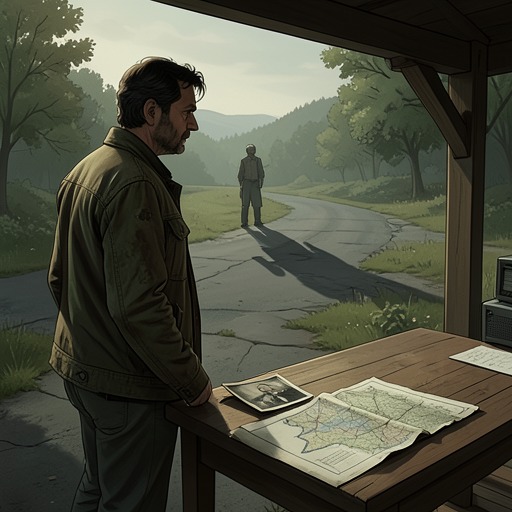
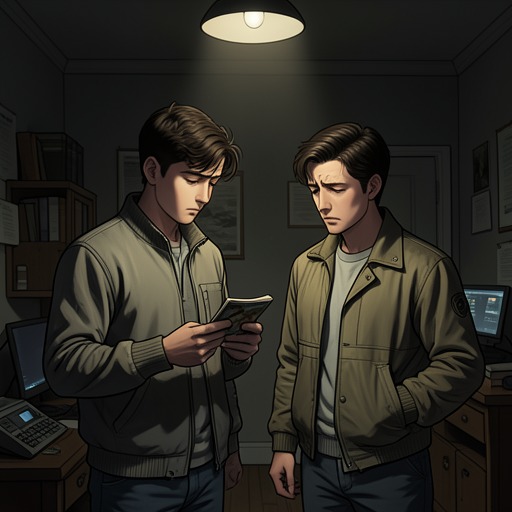
Remarkably Bright CreaturesThe Daphne Cassmore and Simon Brinks photograph is a physical remnant of a past Cameron Cassmore barely knows how to imagine. Folded around a class ring and hidden among his mother’s jewelry, it gives him his first concrete lead toward identifying his father. Its force comes from what it can establish—a young Daphne, a man beside her, and a connection to the class of 1989—and from what it cannot: the photograph makes Simon Brinks a plausible candidate, not a confirmed father.
Discovery and Physical Form
Cameron finds the photograph after opening a box from Jeanne. A small black drawstring bag has fallen out of the box; inside it are bracelets, necklaces, empty lockets, and a broken silver chain. When Cameron checks the bag’s bottom, a crusty old photograph, folded around a large class ring, finally comes loose. The image is not presented as a keepsake he already understands. It has been tucked among objects he initially judges by their possible resale value, and its significance emerges only when he unfolds it.
The ring carries the words SOWELL BAY HIGH SCHOOL, CLASS OF 1989. That inscription gives Cameron a year and a place to investigate, while the photograph supplies a face from his mother’s past. Even in the half-dark, he recognizes a teenage Daphne, smiling with her arms around a man he has never seen. The paired objects therefore offer different kinds of evidence: the ring identifies a graduating class, while the image suggests a relationship. Neither alone answers Cameron’s question, but together they point him toward a specific history.
From Image to Identification
Cameron later uses the class year to search an online reunion page for the class of 1989 at Sowell Bay High School. The page contains scanned photographs and, apparently, the senior yearbook. He looks for Daphne among the grainy pictures, recognizing her brown curls, but his attention is also fixed on the unfamiliar man from the folded photograph. The private object has become a guide to reading a much larger archive: Cameron is not searching the yearbook without direction, but comparing its images against the small picture he has kept beside him.
The ring offers another clue when Cameron turns it over and notices the faint engraving EELS. He initially takes it for the school mascot, although the yearbook images do not seem to display an eel theme. The inscription remains puzzling rather than immediately explanatory. In the search for Simon, it functions as a small, uncertain mark of identity—one more detail to interpret, not a complete answer.
Among the scanned photographs, Cameron finds a different image of Daphne on a crowded pier. The same man has an arm around her; his face is turned into her windblown hair, in a pose that appears affectionate. A caption identifies the pair as Daphne Cassmore and Simon Brinks. This caption supplies the name that the old photograph itself does not provide. Cameron responds by searching for Simon, whose results identify him as a prominent Seattle real estate developer and nightclub owner, a figure of conspicuous wealth. The contrast between an anonymous man in a worn family photograph and the public profile attached to Simon’s name sharply enlarges the possible significance of the image.
A Lead, Not a Verdict
After finding the caption, Cameron returns to the photograph wrapped around the ring and studies it closely. He considers whether the man pictured with his mother could really be his father. The photograph cannot settle that question, but it gives him more than he has had before: a visible connection between Daphne and a named person. The distinction matters. Cameron’s conclusion remains tentative even as the clues begin to align, and the object’s importance lies in making further inquiry possible rather than delivering certainty.
His attention to Daphne’s face also makes the photograph evidence of a past different from the one he remembers. In the image she looks carefree, with a broad, healthy face; Cameron contrasts that appearance with his memory of her as bony and sunken. The photograph does not explain how or why she changed. Instead, it preserves an earlier version of his mother that Cameron can compare with the mother he knew, making the gap between those versions part of his search.
The image’s background offers a further, explicitly uncertain clue. Cameron notices a large planter full of daffodils and tulips and guesses that the photograph was taken in April, while allowing that it could have been March or May. He then sets that estimate against his own birthday, February 2, and works through the timing of a possible pregnancy. The calculation makes him wonder whether he could already be present in the photograph. His reasoning turns the picture from a record of Daphne’s youth into a possible point on Cameron’s own timeline, but the season and the arithmetic remain circumstantial.
Narrative Significance
The photograph changes the texture of Cameron’s search. Before its discovery, his lack of a father is an absence with little to attach it to; the folded image gives that absence a face, and the yearbook caption gives the face a name. Its journey—from a concealed bag, to Cameron’s close inspection, to comparison with an online archive—makes material evidence the hinge between a private family mystery and a searchable public past.
At the same time, the photograph resists becoming a simple answer. Its worn surface, incomplete clues, and uncertain date invite interpretation but do not confirm paternity. Cameron can identify Simon Brinks as Daphne’s companion in the captioned yearbook image and can see that a possible conception timeline is plausible; he cannot prove from these photographs that Simon is his father. The object therefore advances the plot by narrowing the mystery while preserving its central uncertainty. It is both a record of a relationship and the beginning of a question Cameron must still pursue.