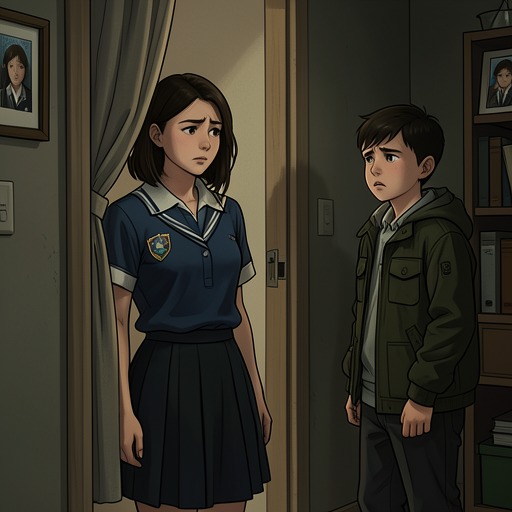
Daphne's Sowell Bay High School
Remarkably Bright CreaturesDaphne's Sowell Bay High School enters the story less as a visited building than as a place preserved in inscriptions, reunion records, and photographs. Its Class of 1989 ring first raises a question about Cameron Cassmore’s mother, Daphne Ann Cassmore; an online yearbook archive then supplies the identifying caption that points him toward Simon Brinks. The school’s significance lies in this passage from object to record to name: its traces make a hidden family connection legible without resolving everything Cameron wants to know.
Identity and Historical Trace
The school is identified through a heavy class ring engraved with the words “SOWELL BAY HIGH SCHOOL, CLASS OF 1989.” The ring turns up folded inside an old photograph in a small black drawstring bag Cameron has emptied while looking through a box of belongings. It is a worn, material remnant of a graduating class, but its inscription gives Cameron a precise place and year to investigate.
The date acquires personal force because Cameron is thirty, and he realizes that his mother would have become pregnant in the same summer that the students of this graduating class were finishing high school. The ring therefore does not merely identify a school; it gives his search a possible chronology. Cameron wonders which of the young men associated with the class might have fathered him, while the evidence at this point leaves the ring’s original owner—and the identity of his father—unconfirmed.
A School Reconstructed Through Records
Cameron finds that the Class of 1989 has an unusually substantial online presence, which he associates with the class’s approaching thirty-year reunion. A reunion page contains what appears to be a scanned copy of the entire senior yearbook. The school becomes available to him through this archive rather than through a present-day visit: its students appear in grainy photographs, posed amid the hairstyles and clothes of the 1980s.
At first the material offers abundance without an answer. Cameron scrolls through pictures of ordinary high-school antics and pauses at faces and hair that might resemble his mother’s. The archive supplies a crowd of possible classmates, but his attention is fixed on one particular person: the man shown with Daphne in the old photograph he found alongside the ring. The yearbook’s value is thus not simply that it preserves a class; it gives Cameron a way to compare a family keepsake with a public record.
The Ring and the Photo Caption
The class ring’s underside bears a second engraving: “EELS.” Cameron initially takes this to refer to the school’s mascot, reasoning that an eel would suit a school near the water. He looks for an eel theme in the yearbook pages and does not find one. In this moment, the inscription functions as a clue that he can read only partially: he connects it to the school, but not yet to the person whose initials it may represent.
A yearbook photograph changes the direction of the search. Cameron recognizes Daphne standing on a crowded pier with the same young man who appears in the folded photograph. The man’s face is turned into her windblown hair, and the caption identifies the pair as Daphne Cassmore and Simon Brinks. That printed identification gives the previously unknown face a name and sends Cameron to search for Simon. The school archive has not established that Simon is Cameron’s father; it has supplied a concrete lead that makes the possibility investigable.
Narrative Significance
Daphne's Sowell Bay High School functions as an evidentiary landscape: the ring narrows Cameron’s search to one place and graduating year, while the reunion archive makes a photograph—and its caption—available decades later. The sequence moves from a physical object to a digital collection and then to a named person. Each medium preserves something different: the ring carries the class designation and the enigmatic EELS engraving; the yearbook preserves images; the caption supplies an identity.
The school’s records also give Cameron’s private uncertainty a historical frame. His mother’s teenage photograph belongs to a larger class archive, and his possible conception falls in the same summer as that class’s graduation. Yet the clues remain distinct from proof. The class ring’s owner is not established in this discovery, and the photograph identifies Simon as Daphne’s companion without confirming paternity. The school is therefore important not because it resolves Cameron’s family history, but because it converts an old, ambiguous keepsake into a specific line of inquiry.