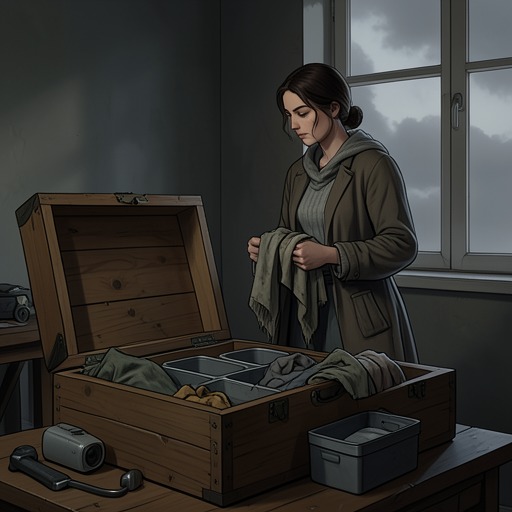
Erik’s unresolved disappearance
Remarkably Bright CreaturesErik Sullivan’s unresolved disappearance is the enduring absence around which Tova Sullivan’s understanding of her son keeps changing. He went to work at a ferry dock one July night after his senior year of high school and never came home. The missing boat and a cut anchor rope leave physical clues, but no eyewitness or decisive lead establishes how he disappeared. Years later, the possibility that Erik was seeing a girl, and the revelation that he had fathered a child, reshape Tova’s account of that night without resolving it.
The Disappearance and Its Unanswered Facts
In Tova’s recollection, Erik’s disappearance began with an ordinary departure and ended with his failure to return. He had gone to the ferry dock to work; afterward, a boat was found to be missing, and the rope on its anchor had been cut. Those details suggest a sequence of events but do not say who cut the rope, why the boat was absent, or what happened to Erik. The sea remains the place where the evidence stops.
The investigation initially proceeded thoroughly, according to Tova. But there were no eyewitnesses and no leads. A former classmate named Adam Wright was not a close friend, and the police did not speak with the classmate who later surfaced in Tova’s thinking. With nothing conclusive to pursue, the investigators appeared eager to close the case. The absence of an answer thus has two sources: the night itself yielded no clear account, and the inquiry eventually lacked a path forward.
Tova Reconsiders the Official Possibility
Tova tells Cameron Cassmore that she never believed Erik killed himself. Her certainty is not the same as proof: when she learns that Erik might have been seeing a girl his friends barely knew, she recognizes that the girl could have been with him that night and might know something. She cannot establish that this happened. Instead, she asks Cameron whether he knows how to contact his mother, whom Tova has identified as the girl. The question turns a long-closed family silence into a possible source of information, while leaving the central uncertainty intact.
Cameron responds by asking whether his mother could have had something to do with Erik’s disappearance. Tova does not accuse her. She says she does not know, and distinguishes the possibility that Cameron’s mother was with Erik from the more serious possibility that she was involved in what happened. Neither the relationship nor the circumstances of that night are confirmed by the exchange. Its consequence is a new line of inquiry, not a solution.
A New Family Fact, a Different Theory
The discovery that Erik fathered Cameron changes the emotional force of Tova’s reasoning. Erik did not know he had a child on the way. As Tova sits alone on the pier shortly before midnight, on what she recognizes as her first day as a grandmother, she grips the bench and clings to a revised theory: Erik could not have ended his life with a child coming. She concludes that it must have been an accident, perhaps involving drunk teenagers and impaired judgment. This is Tova’s inference, born of the new family knowledge; the circumstances of Erik’s death remain unverified.
Tova imagines one possible accident in physical detail. A disturbance could knock the bow off course; wind might catch the slackened sail; the boom could swing, strike Erik on the head, and knock him overboard. The imagined chain makes a sudden mishap conceivable, but Tova also acknowledges that the accident could have happened in any number of ways. Erik had been captain of the crew team and was an accomplished sailor, yet there was stolen beer and there was a girl. Each detail pulls interpretation in a different direction without settling it.
The Limits of Reconstruction
A later conversation with Avery gives Tova another image through which to consider accident and trauma. Avery wonders whether a girl she saved had experienced combat or an explosion. The mention of an explosion leads Tova to imagine how a swinging boom might have caused Erik’s fall. She tells Avery that saving the girl mattered. The exchange offers no new evidence about Erik’s disappearance; instead, it shows how a possible mechanism can be pictured without being established as fact.
The case therefore remains suspended between competing explanations. Tova’s refusal to accept suicide, the possible girlfriend, the cut anchor rope, the missing boat, and the imagined boom all make the night newly legible in different ways, but none supplies a witness or confirmation. The revelation of Cameron’s parentage gives Tova a reason to keep asking and a powerful reason to believe in an accident. It cannot restore the missing account of what happened. Erik’s disappearance remains unresolved precisely because each new fact changes the story Tova can tell while leaving the decisive event beyond her knowledge.