Ethan Mack and Cindy’s past romance
Remarkably Bright CreaturesEthan Mack and Cindy’s past romance is a story of pursuit that briefly becomes a shared life, then ends without explanation. Ethan crosses an ocean and much of the continent for Cindy, marries her in a roadside chapel, and is left behind when their van fails in Washington. The abandonment does not erase the journey, but it changes what pursuit means to him: years later, as he worries about Tova Sullivan, he remembers that he once broke himself chasing a woman.
Leaving Scotland for Cindy
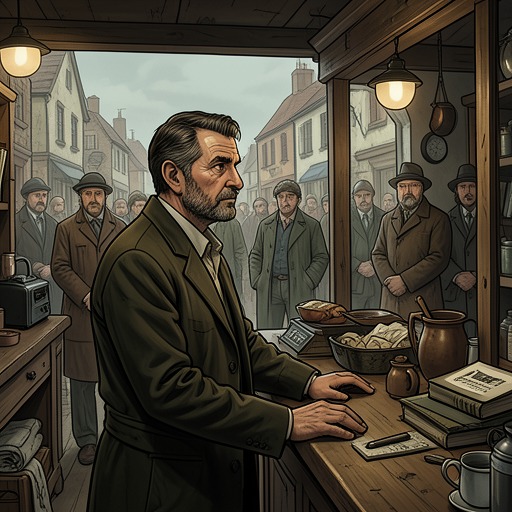
The romance is recalled during a foggy night outside the Shop-Way grocery store, where Ethan sits smoking after his shift. The fog draws him back to Kilberry, on Scotland’s Sound of Jura, the home he had left forty years earlier. He had been a docker in Kennacraig; then he packed a duffel and spent his savings on a ticket from Heathrow to JFK to pursue Cindy, an American on holiday. Even in retrospect, he judges the plan as foolish: the decision meant abandoning his post and staking his savings on a relationship whose future he could not know.
Ethan remembers watching the Scottish islands grow smaller through the airplane window. That image gives the pursuit a cost before its outcome is known: departure is already a separation from home, and the romance carries him farther from the place he still considers home, despite having lived in the United States for four decades. His recollection does not present the journey as a calculated move toward security. It begins as an impulsive wager on Cindy.
A shared journey and a brief marriage
The relationship does not end with Ethan’s arrival in New York City. In the gritty city of the 1970s, he and Cindy make larger plans. Cindy empties her Brooklyn flat to buy an old Volkswagen van, and together they drive west across the country. The scale of the United States astonishes Ethan: Pennsylvania, Indiana, Nebraska, and Nevada seem vast enough that any one of them might contain Scotland. Their travels turn the original pursuit into a shared adventure, with the couple moving together through a landscape that repeatedly measures the distance between Ethan’s old home and his new life.
Finding the sea again brings Ethan relief. He and Cindy linger on the Northern California coast for weeks, making love beneath giant redwoods, before continuing north along the Pacific Coast Highway. Near the Oregon border, in a ramshackle chapel, they marry. The ceremony marks a change in the relationship: the woman Ethan crossed an ocean to find is now his wife, and their improvised life on the road has acquired a formal bond. Yet the chapel is described as ramshackle, and the marriage occurs within a journey still dependent on the van and on their ability to keep moving.
The breakdown in Aberdeen
Weeks after the wedding, the van’s transmission finally fails in Aberdeen, Washington. Ethan tries to tinker with it, but the vehicle is beyond repair. The next morning Cindy is gone. The sequence is stark: mechanical failure interrupts their travel, Ethan attempts to fix what has broken, and then he wakes to her absence. The account gives no reason for Cindy’s departure and does not describe a farewell or a later reconciliation; the silence around her choice is part of the relationship’s ending.
Ethan reduces the result to a finality: that was that. The compressed conclusion stands against the length and movement of the journey that preceded it. A relationship that had carried him from Scotland across the United States ends in a Washington town, beside a van he cannot restore. The marriage is documented, but its duration and the circumstances of its dissolution are not. What remains in his recollection is the contrast between the expansive road trip and the abrupt disappearance that leaves him alone.
Aftermath and the memory of pursuit
Aberdeen becomes Ethan’s home after Cindy leaves. Though he has never visited the Scottish town of the same name, its low gray skies and industrious people feel familiar. He finds work as a longshoreman, rents a bed in a rooming house, and settles into a life marked by the sea and fog. His later circumstances are not presented as a direct consequence of Cindy’s departure, but they follow it in the chronology of his life: after the failed marriage, he remains in the United States and establishes himself there.
The cost of his years of physical labor eventually reaches his back. At fifty-five, he retires with a modest union pension and moves inland, nearer to the physical therapists needed to reshape it after years of hoisting logs onto boats. Retirement leaves him restless; he takes a swing shift at the Shop-Way grocery store, then gathers his savings and buys the business. These details show the long life Ethan builds after the romance, a life of work and self-reliance that does not undo the memory of having crossed an ocean for Cindy.
That memory returns in his response to Tova Sullivan. For almost two years, her late-evening visits have made him press his flannel collar before work and try to look more presentable. When she goes out at night, he worries about the dangers on the road and wishes he could drive by her house to see whether her car is there and her lights are on. But he does not act on that wish. He recalls that he once broke himself chasing a woman, and Cindy’s history gives his hesitation a particular weight. The past romance is therefore not merely an old marriage: it is the experience against which Ethan measures a new attachment, leaving concern visible in his watchfulness while keeping pursuit at a distance.