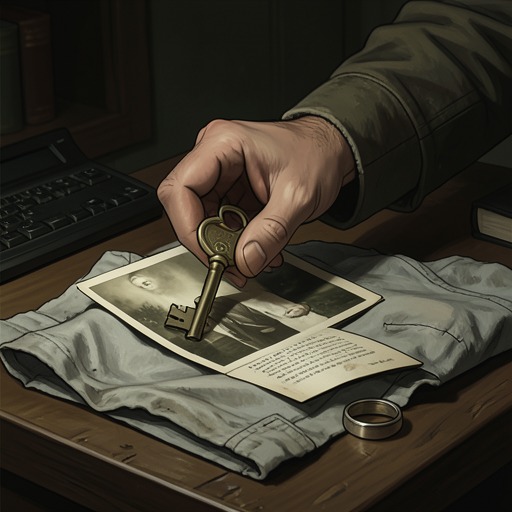
Grateful Dead concert T-shirt
Remarkably Bright CreaturesThe Grateful Dead concert T-shirt is a cherished piece of Ethan Mack’s memorabilia, but its unremarkable appearance and hiding place under the kitchen sink make it look like an ordinary rag to Tova Sullivan. When she uses it to clean up after dinner, the shirt becomes the center of an awkward rupture between them; her costly effort to replace it then turns the object into a measure of how differently they understand both the loss and the apology.
Identity and Original Use
The shirt is white with faded print, worn enough that Tova initially reads it as a cleaning cloth rather than clothing. While washing dishes at Ethan’s house, she finds it beneath the sink and uses it to wipe the counters. In doing so, she swipes through a puddle of Cabernet Franc spilled during Ethan’s haphazard pouring. The cotton absorbs the wine; when she rinses and wrings it in the sink, the stain fades to muted violet. To Tova, this is a practical success: she has cleaned the kitchen and found a rag suited to the job.
The shirt’s actual identity is tied to a particular concert: the Grateful Dead show at Memorial Stadium on May 26, 1995. Ethan tells Tova it was the band’s last show in Seattle and one of Jerry Garcia’s last performances. He calls the shirt a rare specimen, and his alarm at seeing it stained makes clear that its worn, faded condition does not make it disposable. Its importance comes from the specific event it commemorates and from Ethan’s attachment to concert memorabilia, not from any feature Tova can recognize at first glance.
The Accident and Its Recognition
The misunderstanding hinges on the gap between the object’s apparent purpose and its personal value. Tova has just finished the dishes and wiped the counters when Ethan returns with Cameron. Cameron avoids her eyes and soon leaves through the rear door; the camper’s ignition sputters to life. Ethan, tense and preparing to tell Tova something, does not initially notice her cleaning. Instead, his attention fixes on the bundled shirt she has left on the counter. He picks it up, recognizes what it is, and turns pale.
Tova answers his alarm by describing what she has done: washed the dishes and cleaned the kitchen. She had even considered tackling the mess beneath the sink. Ethan sinks into a chair, his voice hoarse, and identifies the shirt by its date and concert. Tova knows that Jerry Garcia died in 1995, but the cultural reference does not immediately convey the shirt’s significance to her; she thinks of the fact as the kind of clue crossword puzzles might use. Ethan’s explanation that the shirt is rare supplies the meaning that its faded print and utilitarian location had concealed.
Their disagreement about where the shirt belonged makes the mistake more than a simple failure to recognize a collectible. Ethan objects that the shirt was in a closet; Tova points out that the cupboard and the closet are both compartments with doors, and that most people keep cleaning supplies under the sink. She has followed the visible logic of the room. He responds that other people’s habits do not matter and asks whether red wine stains can be removed. Tova suggests undiluted bleach might lighten them, but the prospect of further damaging the fabric compounds the problem: the cleaning method that seemed to solve a household mess has altered an object Ethan had treasured.
Replacement and Apology
Tova wants to make the damage right, but she does not know how to respond to Ethan immediately. After she gets home, Ethan leaves a message asking her not to worry about the shirt; the next morning he also texts to apologize for the evening’s sour note and asks her to call. She considers calling back, yet cannot find a reply. Instead, she decides that locating a replacement is the more urgent task and asks Janice Kim for help searching online.
Janice finds an auction listing showing the same faded white T-shirt. The listing displays photographs of it from the front and back, laid out on a wooden dining table. When Janice reaches the payment page, she discovers the asking price: two thousand dollars. Tova accepts the cost as appropriate for a rare specimen and insists that she is correcting something she damaged. She uses the credit card she ordinarily resorts to only when cash is not an option. Janice questions whether she is sure before pressing the purchase button; Tova tells her to proceed. The site’s confirmation says the item will ship within two to three weeks.
That decision is an unusually concrete form of apology. Tova does not explain herself through a long conversation or try to persuade Ethan that the shirt was only a rag to her; she spends a substantial sum to replace the item she ruined. The scale of the purchase surprises Janice, who remarks that it will certainly make the seller’s day, and surprises Tova herself through the quick beating of her heart. Yet Tova considers the expense manageable against her savings. Her urgency is not simply about the shirt’s market price: she knows it mattered to Ethan and wants her action to show that she has understood this after the fact.
Return and Significance
When Tova next encounters Ethan at Shop-Way, she has the replacement rolled neatly among her groceries, between a quart of milk and a grapefruit. Ethan is working the checkout after serving a group in the deli. He congratulates her on selling her house, then scans her bread, preserves, coffee, eggs, crackers, and apple. The white shirt briefly looks like just another item on the belt. As he tries to find a UPC code, he turns it over and recognizes it; once it unrolls, his surprise gives way to questions about how she found it and what she spent.
Ethan says shirts like that cost thousands of dollars, and Tova answers that she is replacing the one she ruined. With other customers waiting and watching, he holds the shirt close to his chest and minimizes its importance as only a T-shirt. Tova replies that it was important to him. Her voice shakes as she apologizes. Ethan’s response shifts the scene away from the collectible’s price: he says he would give away a hundred such shirts to redo their supper at his house. He then smiles over the concert image and asks how she bought it online; Tova explains that Janice Kim helped her and that she drove all the way to Tukwila to collect it.
The replacement therefore repairs less than the original accident seemed to threaten. The first shirt’s stain cannot simply be undone, but the new one gives Tova a tangible way to acknowledge Ethan’s attachment. His wish to redo supper shows that what weighs on him most is the strained encounter, not the loss of one piece of memorabilia. The shirt moves from valued collectible to mistaken rag, from stained evidence of Tova’s well-intentioned cleaning to an expensive act of restitution, and finally to a shared recognition that the relationship matters more than the object. Its path makes the domestic error legible without turning either person into a villain: Tova acts according to what she sees, while Ethan’s response reveals the history and feeling that the object had carried unseen.