Jeanne Baker
Remarkably Bright CreaturesJeanne Baker is Cameron Cassmore’s aunt and the half-sister of his mother, Daphne Ann Cassmore. Her connection to Cameron is both a source of practical care and a point of painful conflict: she has been there in emergencies, but she also withheld the fact that he came from Sowell Bay. When Cameron confronts her, Jeanne offers neither a simple vindication of her own silence nor an easy explanation of his absent father. Instead, she insists that hardship does not remove the need to decide how to live with it.
Identity and Family Background
Ethan Mack traces Jeanne’s place in the family through an ancestry website. Starting with a record for Daphne Cassmore, who later married and became Daphne Scott, he finds her half-sister, Jeanne Baker, then sixty and living in Modesto, California. The discovery gives Cameron’s aunt a precise place in the family line: she is his mother’s half-sibling, not an unrelated guardian, and therefore a potential source of knowledge about the family history Cameron is trying to recover.
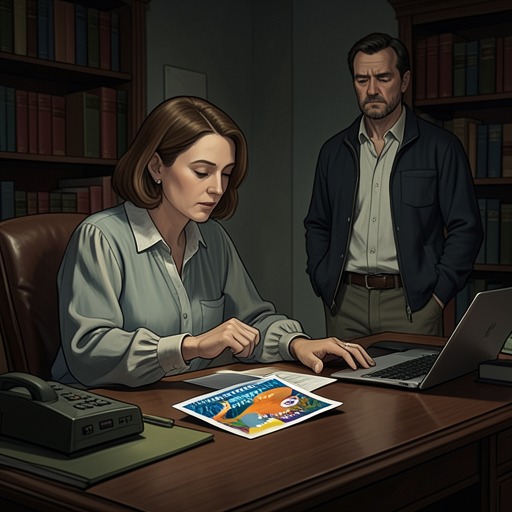
Jeanne’s public online presence appears, to Ethan, to come largely from her participation in communities for collectors and consigners. Cameron has complained about his aunt’s hoarding problem, and Ethan sees a possible fit between that complaint and her interest in buying and selling collectibles. The characterization is filtered through Ethan’s interpretation rather than Jeanne’s own account; the available scenes do not explain how she understands her collections or what they mean to her.
A History of Practical Care
Cameron’s concern for Jeanne is grounded in an earlier emergency. When she called him from the hospital, she had a dented head and a shattered hip, and two police officers were in her room seeking a statement about an altercation at Dell’s Saloon. Cameron hurried to the hospital, which was then only twenty minutes away. Later, when another call arrives in the middle of the night, that memory makes his stomach drop before he knows why she is calling. The physical injuries and police presence give their relationship a history of real vulnerability, not just family obligation.
This time, Jeanne quickly reassures him that she is fine. She says she called because she received a bank transfer from him and believes he sent too much. Cameron explains that the excess is interest, calculated to account for what she might plausibly have earned had the money been invested. Jeanne points out that they never agreed to interest. Her response sets the tone for their exchange: she is willing to acknowledge the money, but she resists letting an unspoken calculation turn into a debt or a claim between them.
The Call and Its Conflict
Jeanne then challenges Cameron’s sudden willingness to spend. She questions why he is buying houses for people she believes do not need them, and urges him to keep the money and make something of his own life. Her advice is blunt, but it is directed toward his future rather than toward her own gain. Cameron replies that he is trying to build a life and resents what he sees as the bad hand he was dealt.
Jeanne’s answer distinguishes circumstances from choices: she tells him, in effect, that the hand itself may not be his fault, but how he plays it is under his control. Cameron leaves the camper and paces barefoot in Ethan Mack’s driveway, carrying the argument into the warm pavement of a summer night. The movement makes the disagreement more than a debate about money. Cameron’s frustration turns toward Jeanne’s silence about his origins, while her advice asks him to look beyond what was withheld and consider what he can still do.
Family Secrets and the Absent Father
Cameron reproaches Jeanne for never telling him that Sowell Bay was where he came from. Her answer is not that the information was unimportant; she asks what good it would have done. When Cameron presses her about the man he believes might be his father, Jeanne insists that the man is not his father and argues from what she knows of her sister. Daphne had flaws, Jeanne says, but was no fool. If the father had been a prominent or even reasonably responsible man—or had still been alive—Jeanne doubts Daphne would have allowed him to miss out on Cameron’s life.
This is Jeanne’s reasoning, not proof of the man’s identity or circumstances. She does not claim to know every detail, and her uncertainty is audible in the way she considers several possibilities. Her argument nonetheless complicates Cameron’s search: it suggests that the absence may have been a decision connected to what Daphne knew, rather than merely a failure to find or contact a potentially suitable father. At the same time, Jeanne’s defense of her sister cannot settle Cameron’s grievance. He turns the charge back on Daphne, saying that she, too, missed out on being part of his life and that letting people go seemed easy for her.
Change and Narrative Role
Jeanne’s final response softens without retracting what she has said. She answers that letting go can be the hardest thing. The exchange leaves her position deliberately complicated: she protects the memory of her sister from Cameron’s harshest judgment, yet does not erase the hurt caused by Daphne’s absence or her own decision not to tell Cameron about Sowell Bay. Nor does she resolve the question of who his father was. Her role is to place limits on what Cameron can know while insisting that uncertainty and an unfair beginning need not dictate every later choice.
Through Jeanne, Cameron’s search for family history becomes an argument about responsibility as well as identity. She is a practical aunt who has relied on Cameron’s help in a crisis and now objects when he spends money in ways she considers misplaced. Their exchange brings care and conflict into the same relationship: concern appears as blunt advice, while old loyalty appears in Jeanne’s guarded defense of Daphne. Her account cannot close Cameron’s questions, but it makes clear that the past includes difficult decisions and people who understood letting go differently.