Knit-Wits
Remarkably Bright CreaturesThe Knit-Wits are a women’s social group whose decades of shared lunches give friendship a durable form even as its membership thins. Founded as a knitting club, they became a refuge from empty homes and changing family lives. For Tova Sullivan, whose grief over her missing son Erik remains private and unresolved, the group offers companionship she values but never quite feels she belongs to. As members leave and Tova plans to move, the Knit-Wits’ familiar routines become a measure of both connection and the cost of accepting care.
Origins and Membership
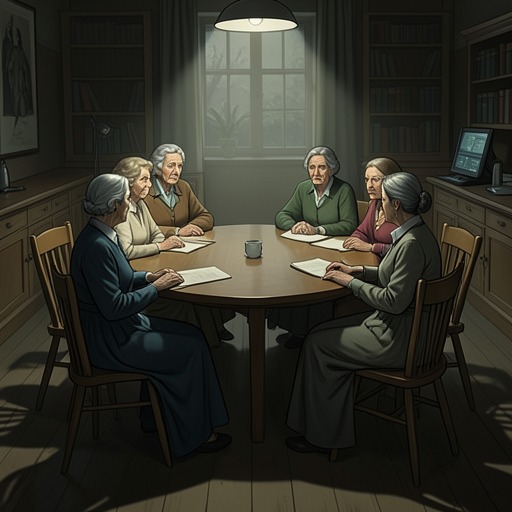
The Knit-Wits began twenty-five years earlier, when a handful of women in Sowell Bay met to exchange yarn. In time, the knitting club became something broader: a place to escape the emptiness left when children grew up and moved away. The name endured even as knitting itself receded from the group’s weekly luncheons; the members still gathered, but their continuing purpose was companionship rather than craft.
The group’s history is marked by absences. There had once been seven members; by the time of the story, only four remained, with another empty place appearing every few years. Mary Ann Minetti’s yellow crocheted teapot cozy recalls the group’s knitting origins, though it may have been made by someone back when knitting was still a regular part of their meetings. The object quietly holds together the club’s earlier identity and the social habit it has become.
Their conversations move through the ordinary particulars of one another’s lives. At one luncheon, they discuss a neighbor suing an orthopedist after a poor surgery, then look at photographs of Janice Kim’s Yorkie, Rolo. Such exchanges are not grand occasions; their significance lies in repetition, in attention to a neighbor’s trouble or a pet’s upset stomach, and in the fact that the women keep showing up.
Tova’s Place in the Group
Tova initially resisted joining. The other women’s experience of an empty nest seemed unlike hers: their children had grown and moved away, leaving a bittersweet absence, while Erik had disappeared five years earlier. Tova’s grief had no sweetness in it. She kept her motherhood inward, carrying it as a private wound rather than a topic for the table. Even after years of friendship, she sometimes felt like a misplaced jigsaw piece in the group.
That difference surfaces in the women’s recurring talk about children and descendants. Earlier, their complaints concerned the long drive to the university and the scarcity of Sunday-afternoon phone calls. Later, their conversation turned to grandchildren and great-grandchildren. Tova could sit among them and take part, but their loud, familiar way of inhabiting motherhood contrasted with her own silent, enduring loss. The group provides a place at the table without erasing the distance between their experiences.
The Knit-Wits also show care in practical forms. When Tova began working nights at the Sowell Bay Aquarium, her friends pressed her for weeks to replace her older car, arguing that a safer vehicle mattered for driving after dark. Tova’s yellow hatchback, with its unfamiliar key-fob chirp and flashing sidelights, is a concrete result of that insistence. Her decision to give in suggests a characteristic negotiation: she may resist being looked after, but she does not always refuse the help her friends arrange.
Routine, Absence, and Mutual Care
The weekly meetings are steady enough to become part of Tova’s calendar and sense of belonging. When an injury keeps her away, Janice arrives at Tova’s home with a casserole and points out that she missed Knit-Wits. The visit is both social and watchful: Janice has heard that Tova fell at work and wants to know what happened. Concern travels through the same familiar channels as news.
During that visit, Janice tells Tova that Mary Ann is moving in with her daughter. The move is practical: Mary Ann’s house has steep stairs, and its basement laundry contributed to a fall the previous year. The group plans a special luncheon to say goodbye, although the timing depends on how quickly the arrangements proceed. Tova says she will attend even if she has to hobble there. Her insistence makes clear that the farewell is not merely a calendar item; it is part of honoring a friendship built over decades.
Mary Ann’s departure also makes the group’s future newly visible. Janice notes that three members will remain and raises the question of a longer-term plan. Tova imagines the meetings without Mary Ann and her store-bought, oven-warmed cookies, and recognizes how deeply the gatherings have become a habit. Later, the group considers a tablet so Mary Ann can join virtually. The proposed solution cannot restore the old arrangement, but it shows the women trying to keep their connection available across distance.
Tova’s Planned Departure
As Tova prepares to sell her home and move to Charter Village, the shrinking group becomes part of a larger question: whether accepting assistance means imposing on friends. Her move is not simply a change of address. Tova explains to Janice that she has no children or grandchildren to visit after a fall, unclog a drain, or check that she is taking her pills, and she does not want to make those responsibilities her friends’ burden. In her view, a residential community is the safest and most responsible choice.
Janice challenges the premise rather than dismissing Tova’s independence. She suggests that the problem may be Tova’s assumption that care would be a burden. Their disagreement brings affection and strain into the open: Janice wants Tova to remain in Sowell Bay, while Tova has already made plans and insists she will sign the house-sale papers. The conversation is especially pointed because the group itself is a form of support Tova has accepted for years, even while keeping emotional distance from it.
The women’s assistance with the house is similarly tangible. As Tova sorts family belongings into categories for Charter Village, for disposal, and for other destinations, Barb Vanderhoof and Janice offer to help; Janice’s son and several friends are expected to join the hauling. Tova plans to order pizza, though she feels it may be indulgent when her freezer is full of casseroles. She would rather trusted friends handle her family heirlooms than strangers. Their help does not settle the question of where she should live, but it reveals how care can be offered through labor, food, and familiar company.
Significance
The Knit-Wits embody a kind of attachment made through repetition: shared meals, small disclosures, practical interventions, and farewells that must be planned even when nobody wants the group to shrink. Their history parallels the changing lives of their members, but it does not make those changes painless. As departures accumulate, the familiar luncheon table becomes both a refuge and a reminder that friendship cannot prevent aging, loss, or relocation.
For Tova, the group’s importance lies partly in the tension between belonging and reserve. She is not simply absorbed into the other women’s family-centered experience, nor does she explain away her grief. Yet she attends, promises to come even while injured, accepts help with her car and her home, and remains concerned with the group’s rituals. The Knit-Wits therefore make care visible without requiring it to erase independence: their friendship offers Tova a place among others, while the question of whether she can let that support count remains unresolved.