Lars Lindgren’s death and Tova’s retrieval of his belongings
Remarkably Bright CreaturesLars Lindgren’s death and Tova Sullivan’s retrieval of his belongings bring an estranged sibling relationship into sharp, practical focus: first as a message Tova cannot bear to hear, then as an envelope, a journey to Charter Village, and a box she carries out. The event does not erase the distance between brother and sister. Instead, it makes Tova confront what that distance may have meant at the end of Lars’s life—and what she is still willing to do for him.
The message and the news
The news arrives amid the ordinary clutter of Tova’s answering machine. One message is a scam; another is a mistaken call. The fourth begins in silence, and Tova is just about to delete it when a woman asks for her by name. Maureen Cochran identifies herself as calling from Charter Village Long-Term Care Center. At the mention of bad news, Tova’s water glass strikes the counter. Before the caller can continue, Tova clicks the machine off. She already knows what the message will say, or at least what kind of loss it announces: her brother, Lars.
The interrupted message makes the death both confirmed and withheld. Tova does not need to hear the explanation to understand that Lars has died; the pause and her immediate reaction carry what the caller has not yet said. The scene gives no cause of death or precise circumstances, and Tova receives no comfort from details. What matters first is that she has been expecting this news for some time, and that expectation does not make its arrival painless.
Estrangement and the belongings
When Bruce LaRue comes to see Tova, he introduces himself as an attorney for Lars’s estate and offers a formal condolence. Tova answers, again, that she and Lars were not close. Her insistence frames the practical business that follows: LaRue has an envelope containing a list of Lars’s belongings, on Charter Village letterhead, and says that Lars had personal assets. The list is only a beginning; the monetary assets will have to be sorted out later. For now, Tova is asked to contact the center and arrange to collect his personal effects.
The request turns the abstract fact of death into a task with a destination. Charter Village is in Bellingham, an hour away, and Tova objects to the distance. LaRue leaves the choice bluntly with her: she can collect the items or leave them, in which case they will eventually be disposed of. His manner gives the errand little ceremony, but the possibility that no one will claim Lars’s belongings unsettles Tova. She knows of no second marriage after Lars and Denise separated, though she has assumed he may have had a sweetheart or a close friend. LaRue’s words lead her to wonder whether anyone had shown up for Lars at all, and whether he died among people for whom his presence was only part of a shift.
That fear is Tova’s conjecture, not an account of Lars’s final hours. The uncertainty is important: she has spent years at a distance from his life, and the estate business offers no sudden access to what she does not know. Still, she chooses not to let the belongings be discarded. She tells LaRue she will go, quietly converting a strained history into a concrete obligation.
The journey to Charter Village
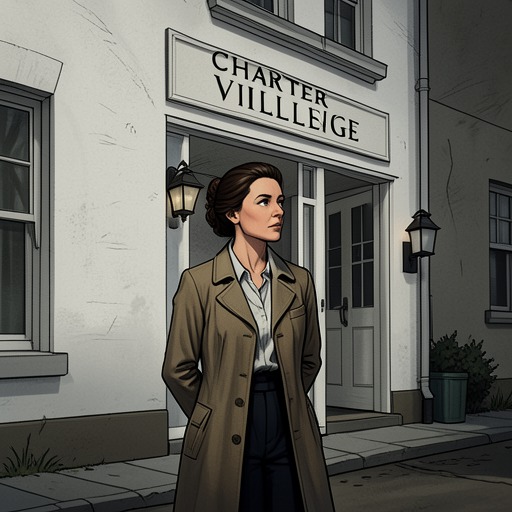
Ethan Mack accompanies Tova to the center. The campus initially looks nothing like the grim institution she may have imagined: a winding drive passes signposts for the Memory Center, Tennis Complex, Acute Care, and Clubhouse before leading to reception, framed by ivy-covered maroon-brick columns. Ethan whistles at the place’s polished, almost university-like appearance. Its scale and amenities complicate the simple image of a residence as a place where people merely wait to grow old.
The visit also places Tova’s immediate errand beside the prospect of her own future. As Ethan tours the grounds, he notices the billiard room, buffet, pool, Jacuzzi, room service, and beds made daily with fine sheets; the residents seem happy enough that even he finds himself half-convinced by the place. Tova, however, is there to collect what Lars left behind, not to make the center feel inviting. The expansive campus cannot answer her questions about her brother, and its comforts do not dissolve the loneliness she has imagined around him.
About an hour later, Tova emerges clutching a box. Ethan rises from the reception chair to meet her and asks whether everything is all right. She says that it is. The box makes her appear smaller in her purple cardigan, but the scene does not disclose what it contains. Its significance lies in the act of carrying it away: Lars’s belongings are no longer an unclaimed list on an attorney’s letterhead, and Tova has not left them to be discarded.
A final act of attention
Tova’s decision is not presented as a reconciliation. She has said repeatedly that she and Lars were not close, and the retrieval cannot recover the conversations or companionship that distance may have cost them. Nor does the event settle her questions about whether Lars had loved ones nearby. Instead, it exposes the gap between what she knows and what she fears: she cannot say who was there for him, but she can make sure someone comes for his things.
The episode belongs to a larger pattern of loss in Tova’s life, though each grief remains distinct. At the pier, she imagines her son, Erik, beneath the moonlit water, holding its reflections like candles for her. In another memory, the ordinary intimacy of an evening with her husband, Will, stands beside the unanswered question of where Erik was on the night he disappeared. These losses show how the dead remain present in Tova’s attention; they do not make Lars’s death interchangeable with theirs. His belongings call for a different response, one shaped by estrangement and uncertainty rather than by the closeness she recalls with her son and husband.
The event’s quiet reversal is that Tova first stops the message because she cannot bear to hear more, then accepts the work that follows from it. She cannot change the distance that marked her relationship with Lars, or learn from this errand how his final days unfolded. She can, however, travel the hour to Charter Village and bring back the box. In a novel where grief often persists through ordinary objects, places, and repeated acts of care, the retrieval gives Tova’s belated attention a weight she can carry in her hands.