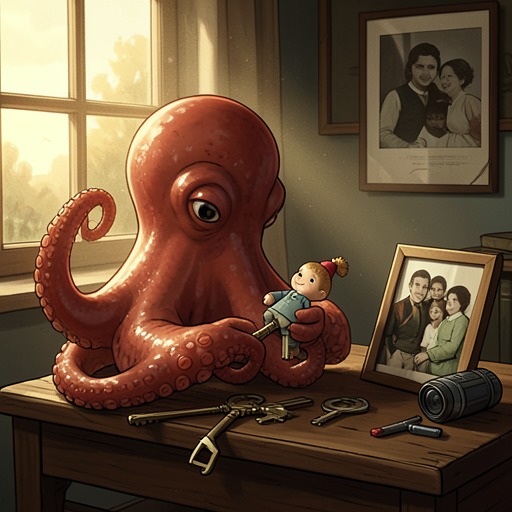
Marcellus returns Tova’s lost key
Remarkably Bright CreaturesMarcellus returns Tova’s lost house key in a quiet encounter that changes the meaning of an ordinary object. The octopus recognizes the key as a copy of one he found on the seafloor before his capture, among remnants of a human life; by giving it back, he offers Tova a small but intimate connection to the loss she carries.
A cautious visit becomes an encounter
Tova approaches the tank as she has before, greeting Marcellus and noticing that his colors look brighter. He emerges from behind a rock, drifts toward the glass, then jets back and traces the edge of a small gap with a tentacle. His movements make the gap seem newly important: what begins as a visit between an older woman and a creature she knows becomes a moment in which Marcellus appears to be asking for access beyond the glass.
When Tova guesses that he wants to shake hands, she drags over a chair and climbs onto it so she can remove the tank’s back cover. The decision carries a risk she understands. As she unfastens the latch, she realizes that Marcellus may be encouraging her to open the tank so he can escape. She lifts the lid anyway, choosing to trust the encounter despite the possibility that she is helping him out of captivity.
Marcellus initially floats beneath her with all eight arms spread around him. He lifts one arm from the water, winds it around Tova’s hand, and reaches up to touch her chin. When he tugs sharply, she loses her balance on the chair and fears he may pull her into the tank. Instead of ending the contact, she leans close enough for their eyes to meet. Another arm reaches over her shoulder and prods her freshly styled hair, prompting her to laugh and tell him not to muss it. Their physical closeness is awkward and startling, but it is also playful: a creature’s unfamiliar gestures become a form of contact Tova can answer.
The key is offered
Marcellus releases Tova and disappears behind his rock. She is left startled, touching the damp place on her neck where his tentacle had been. When he reappears, one of his arms holds a small gray object. He extends it to her as an offering: the house key she lost the previous year.
The return turns the encounter from an unusual exchange into a deliberate act of recognition. Marcellus had found the key on the floor near the place where Tova keeps her belongings while cleaning. He admits, in his own account, that he should not have taken it, but something about it seemed familiar. He hid it in his den, in a deep pocket of the hollowed rock that even the most thorough tank cleaning cannot reach, among the objects he has collected during captivity.
That hiding place matters because the key was not simply recovered and immediately handed back. Marcellus kept it with his private collection until he understood why it drew his attention. He had encountered many keys, and by this point he generally passed them over, much as he did commonplace coins. This one felt different before he could explain the difference. Its return is therefore not a routine act of tidiness but the result of a recognition that only becomes clear when he examines the object again.
A duplicate opens onto the sea’s secret
Running a tentacle over the key’s ridges, Marcellus realizes he has encountered an identical one before. He remembers holding a copy when he was very young, before his capture. That earlier key was attached to a circular ring at the bottom of the sea, in a trove of human remnants sheltered under rocks: a rubber sneaker sole, a vinyl shoelace, and several plastic buttons. The material is sparse, but to Marcellus it forms the trace of a person whose other remains have not endured.
He reasons that the key from the seafloor must belong to the person Tova mourns. The account does not identify that person by name, and the objects do not establish the full history of how they reached the seabed. What it does establish is an uncanny correspondence: the key Tova misplaced on land has a twin associated with a human loss beneath the water. Marcellus’s recognition brings those two locations together without resolving the mystery surrounding the remains.
His thoughts turn from recognition to regret. He wishes he could return to the sea and collect the sneaker sole, shoelace, buttons, and matching key, then give all of them to Tova. He cannot do that, and the lost house key is the one tangible object he can place back in her hands. He regards returning it as the least he can do for her. The gesture is modest beside the larger loss he imagines, but its very smallness gives it force: he has noticed that an object matters to Tova and has used what he can remember to restore it.
Significance of the return
The scene moves between Tova’s close, embodied experience and Marcellus’s first-person explanation of what the key means to him. Tova sees a gray object extended from an octopus’s arm; Marcellus’s account supplies the buried sequence behind it: where he found the key, why he concealed it, what it recalled, and why he chose to return it. The delayed explanation makes the offering more than a charming surprise. It reveals that Marcellus’s collection, built from objects lost by humans, is also a record of his attention and memory.
The scene’s emotional turn is from uncertainty to recognition. Tova risks opening the tank because she thinks Marcellus is asking for contact, even while suspecting that he might use the opportunity to escape. Their exchange remains physically precarious—she wobbles on the chair, and his pull briefly frightens her—but it ends not in an escape attempt but in an offering. Marcellus, meanwhile, moves from an unexplained attraction to a particular key to an understanding of its twin and its possible connection to Tova’s grief. The key does not repair that grief or explain the sea’s history; it gives their relationship a concrete token of care, carried from his hidden collection into her hand.