Marcellus's captivity
Remarkably Bright CreaturesMarcellus McSquiddles’s captivity is the defining condition of his life for nearly four years: he is taken from the sea as a juvenile and kept in a tank where he expects to die. Its duration is measured against the short lifespan of a Giant Pacific octopus, while its narrow physical limits give rise to clandestine escapes. When Tova Sullivan finally carries him back to the water, confinement ends not with a cure for his mortality but with a last, unexpected freedom.
Identity, confinement, and the clock
Marcellus is brought to the aquarium as a juvenile. The plaque beside his tank gives the average lifespan of a Giant Pacific octopus as four years; he calculates that this means 1,460 days for him. At the point when he explains his circumstances, he believes that at most 160 days remain before his sentence is complete. The arithmetic makes captivity inseparable from mortality: the tank is not merely where he lives, but the place where he assumes his life will end.
His narration marks time with captivity-day headings, including days 1,299, 1,300, and 1,301. The count gives the story an exacting measure of confinement, turning each day into a small unit within a life whose limit is already known. Marcellus does not expect rescue; he imagines that he will die within the glass walls. His knowledge of the lifespan plaque therefore offers no comfort. It measures the remaining sentence without making the enclosure less final.
A hidden route beyond the glass
The tank is not perfectly sealed. Near its top, the pump enters through a hole in the glass, and a gap between the pump housing and the glass is just wide enough for two or three human fingers. Marcellus can reach through with a tentacle, unscrew the housing, and let the pump float into the tank. Although the opening seems too small for him, he can reshape his body to pass through it. He slides down the glass into the pump room behind the tank, gaining a route out without revealing it to Terry Bailey.
That route does not amount to freedom. Once out of the water, Marcellus has eighteen minutes before he must submerge again or face what he calls The Consequences. The limit is absent from the plaque; he has worked it out for himself. From the cold concrete floor, he must choose between remaining in the pump room, where nearby tanks are accessible, and breaching the door into the rest of the building. Even the pump room offers constrained choices: the wolf eels are dangerous, the Pacific sea nettles are too spicy, the ribbon worms are rubbery, and the bay-blue mussels disappoint him. Sea cucumbers appeal, but taking too many might draw Terry Bailey’s attention.
On one excursion, Marcellus returns to his tank with his gut full of halibut. He replaces the floating pump, screws its housing back into place, and swims to his den behind the rock. The return brings relief as well as food: his three hearts beat with what he recognizes as the bodily response to having survived a narrow brush with death. He has pushed the boundary of his confinement and made it back, but the danger is real. He says that there have been other occasions when he tested his freedom, yet he never again relies on those extra minutes by propping the door. The gap remains his secret; no one else knows it, and he wants it kept that way.
What the sea preserves
The sea beyond the tank is not an abstract alternative to captivity for Marcellus. Before his capture, as a young octopus, he encountered a key attached to a circular ring on the seafloor. It lay among objects left by a human life: a rubber sneaker sole, a vinyl shoelace, and plastic buttons, sheltered beneath rocks. Later, when he recognizes a copy of the key, he understands that the things must belong to the person Tova Sullivan mourns. He regrets that he cannot return all the objects he found, and hopes that giving back the key may offer something in response to her loss.
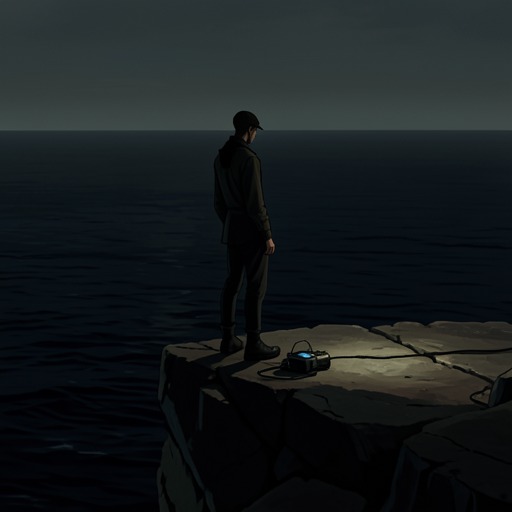
For Tova, the sea is also where grief turns into an image she cannot verify. At the pier, she looks across the water and imagines her son, Erik Sullivan, beneath its surface. Marcellus’s captivity and her mourning thus meet at the boundary between land and sea: he is held behind glass, while the water contains traces of a life she has lost. His memories of the seafloor make his confinement a separation from a place that holds both the remnants of human lives and the possibility of returning to them.
Release and the end of captivity
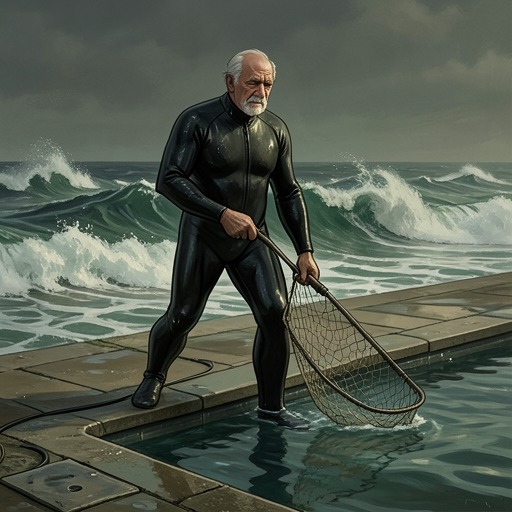
By the time Tova takes Marcellus toward the water, his condition has worsened and Terry Bailey has said he may have only weeks or days left. Tova asks what she will do without him, then turns the question toward what she will do with him and decides to take him home. Their journey along the waterfront is slow and physically demanding: she is seventy years old and weighs about ninety pounds, while Marcellus weighs sixty. She pulls him in a yellow bucket toward the jetty, his arms trailing over its sides. The journey reverses the ordinary direction of his life in the aquarium: instead of retreating through a hidden opening to return to the tank, he is carried openly toward the sea.
After Tova releases him, Marcellus swims from the rocks toward deeper water. He descends into darkness, returning to the region where he found the key as a juvenile and where the long-disintegrated bones of a beloved son lie. He does not pretend that release has made death remote; his death is still imminent, and he expects only a day or two, perhaps, to enjoy the sea. But the ending differs decisively from the future he had anticipated. He had believed his life would end inside the tank. Instead, he reaches the sea again, describes it as home, and meets the remaining time with gratitude.
Narrative significance
Marcellus’s hidden escapes show the difference between a gap in captivity and actual freedom. His body can squeeze through an opening designed around a pump, and his intelligence lets him exploit the aquarium’s overlooked spaces, but neither ability erases the eighteen-minute limit or the risk of discovery. The secret route grants brief, carefully managed excursions rather than control over his circumstances. Even his successful returns underscore how completely the tank’s boundaries govern his life.
The day count and lifespan calculation keep the confinement’s emotional force concrete: each escape occurs within a finite life, not outside time. His final return to the sea does not extend that life or undo the years in the tank. It changes where he will spend what remains. The contrast between his expected death within glass and his actual descent into the sea makes release both an ending and a last possibility: captivity can be broken, even when mortality cannot.